

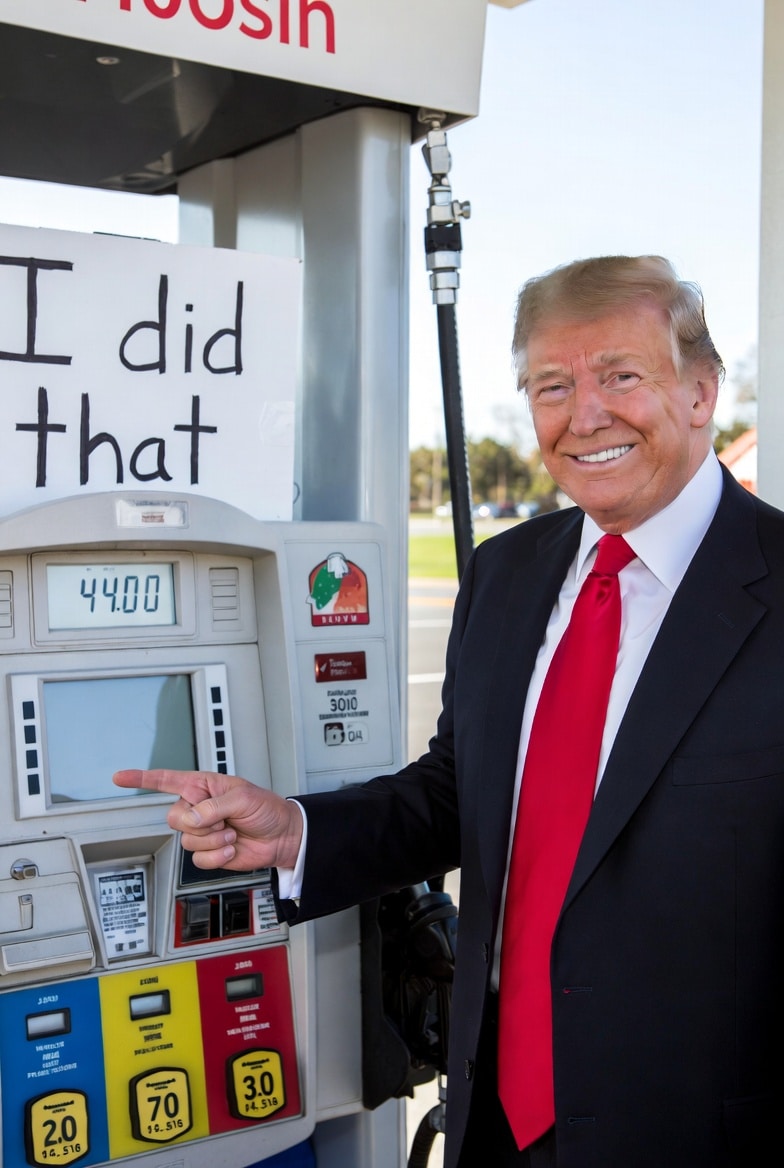
Back in 2022, media was reporting on people affixing to gas pumps stickers with a photo of then President Joe Biden pointing toward the gas price display on the gas pumps. The text “I DID THAT!” prominently accompanied the photo on the stickers. People putting the stickers on gas pumps sought to emphasize the judgment that Biden was responsible for the gas price increasing. It looks like those stickers could be making a comeback, with the photo of Biden replaced with one of the current president — Donald Trump.
Mark Huffman, in a Wednesday article at Consumer Affairs, reported that there has been a quick and big increase in the price of gas apparently caused by President Donald Trump committing the United States to joining Israel in attacking Iran over the weekend. Wrote Huffman:
AAA reports the national average price for regular gasoline reached about $3.19 per gallon on March 4, up sharply from roughly $3.00 just days earlier.
The spike follows escalating military strikes and retaliatory attacks in the Middle East, raising concerns that tanker traffic or oil production could be disrupted in the Strait of Hormuz, a narrow shipping lane that carries roughly one-fifth of the world’s oil supply.
Oil prices jumped more than 5% after the fighting intensified, pushing U.S. crude toward $75 a barrel and driving wholesale gasoline prices higher.
Because gasoline prices are tied to global crude markets, analysts say geopolitical shocks can quickly show up at the pump — even though the United States produces much of its own oil.
Just last week, Trump was boasting in his State of the Union speech about having brought the American economy from what he described as pretty much the worst ever to the best ever in just one year as president. A big part of this argument was that Trump had brought down many prices of many goods for which Americans regularly pay, including the price of gas. As I wrote about the next day, Trump made an absurd claim in his speech that gas was then “below $2.30 a gallon in most states” — a figure so low that most Americans who regularly buy gas should find it questionable at the least. Trump’s claimed gas price was also, I noted, about 70 cents lower than what AAA reported to be the average gas price in America in its daily posting of gas prices the day after the speech. Indeed, Trump’s claimed price was even below every single average price reported for each of the 50 states plus Washington, DC.
The obvious reason Trump or his speech writers tried to pull a fast one in regard to gas prices is that high gas prices are among the most clearly identifiable economic burdens of many Americans. If Americans can be tricked into thinking Trump is providing them with big savings at the pump, they will more likely be optimistic about the economy and their financial prospects. They will also be more likely to support candidates from Trump’s party in the upcoming congressional elections.
Now we have a big jump in the gas price that is obviously attributable to Trump’s decision to start, along with the Israel government, a war on Iran. The war has shuttered a significant portion of the oil production and transport that routinely has taken place in what has suddenly become a war zone. As the war continues, the supply problems can be expected to increase, meaning gas prices will climb further.
If there were a commonly both accepted and viewed as good reason for the US going to war, the majority of Americans might be amenable to paying more at the pump, at least for some period of time. But, Trump and top members of his administration and Republican congressional leaders haven’t even settled on a rationale for the war after it is already in progress.
Top contenders for why the US is at war against Iran include that the war is being fought because Israel says so or because it flows from Trump’s “morality” that Trump claimed in a January New York Times interview is “the only thing that can stop me” in the pursuit of intervention abroad. Neither of those reasons can be expected to be very comforting for most people paying more to fill up their gas tanks or paying higher prices for other goods because of production, shipping, and other associated costs having increased because of the war.
Are you paying more at the gas pump? Trump did that.
