
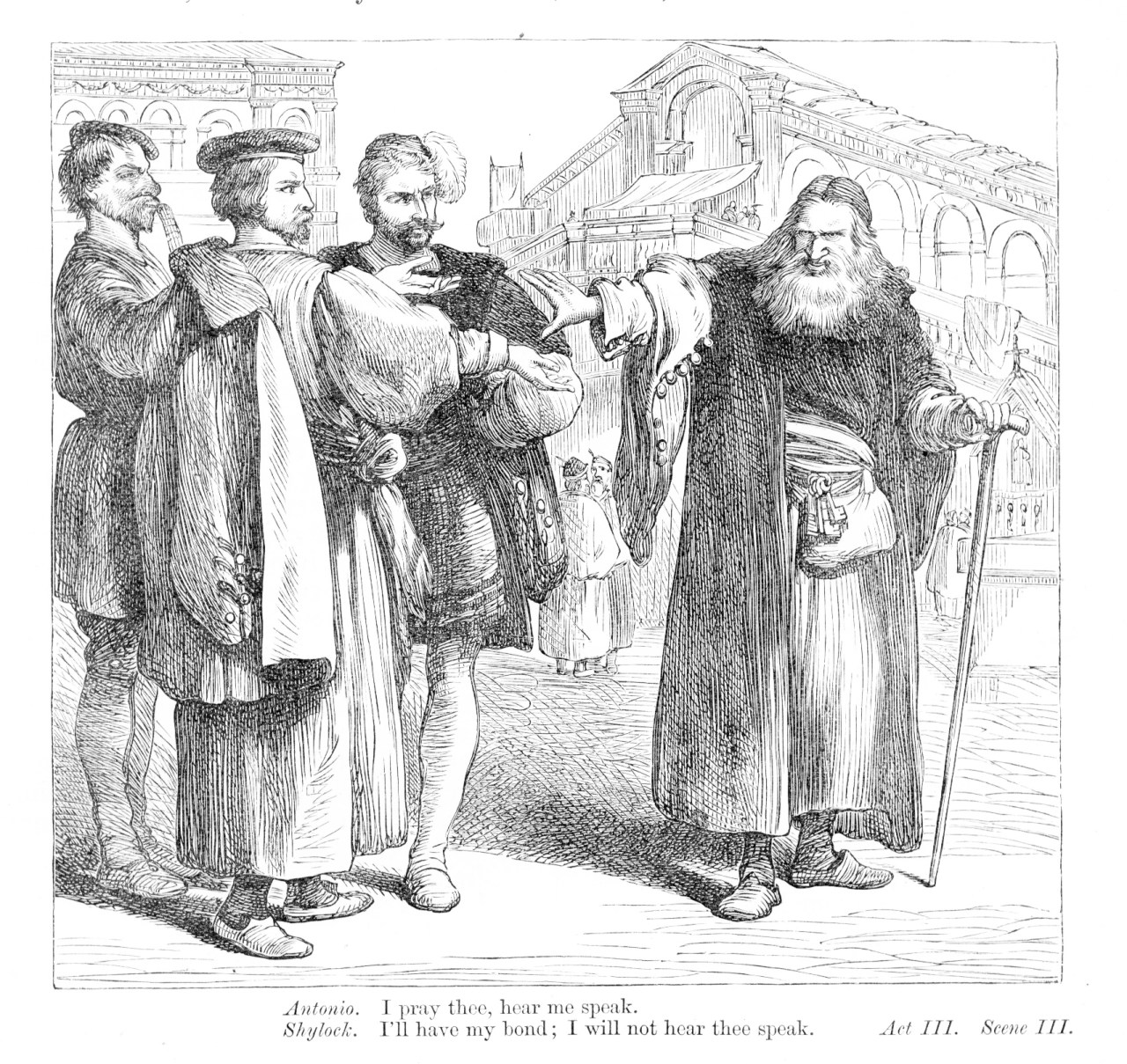
The name of Shylock, a character in William Shakespeare’s play The Merchant of Venice has long been embraced in the English language as a means of referring to charging high interest for loans or engaging in business ruthlessly. That second meaning also applies to the name Scrooge from Charles Dickens’s A Christmas Carrol. “Scrooge” may refer as well to disliking people or their pursuit or attainment of happiness.
These are two examples of names from fiction and religious texts that have entered the English language — in various parts of speech — as shorthand for something related to the named character or individual. Other examples include Babbitt, Chicken Little, Hercules, Judas, Pollyanna, and Solomon. Names even come into use in this nature from history. Consider “Napoleon” as an example. Despite the many things the French leader did in his life, the primary thing his name is associated with in this manner relates to him having been short. Likely you have heard a “Napoleon complex” mentioned.
What was the religion and ethnicity of each of these characters and individuals? Most people may not know the answer for the majority offhand. And that ignorance in no way matters for understanding what the use of the names conveys. If you knew Hercules was a polytheist and Solomon was a Hebrew, that matters naught because the use of their names is in regard to nothing having to do with religion or ethnicity. The use of their names is a reference, respectively, to strength and wisdom.
Some people are displaying their linguistic ignorance or doing a Pinocchio (lying) in asserting that President Donald Trump made an antisemitic comment in a speech on Monday. The comment was part of Trump’s effort to defend United States Sente member Roger Marshall (R-KS) from criticism of Marshall for Marshall’s effort to recover fees he said were owed by his medical patients. Trump said that critics had charged that Marshall “was some kind of a Shylock-type guy.”
That’s it. Of course, this is a standard use of the term Shylock in the English language, having all to do with business practices and nothing to do with religion or ethnicity. Nevertheless, people are jumping up and exclaiming that Trump’s comment constitutes an antisemitic incident given that the character Shylock in Shakespeare’s play is a Jewish person.
As is typical of coverage in much media, USA Today reporter Emily R. Condon wrote in a Tuesday news article regarding the matter that Trump “reinvoked an antisemitic slur.” While it is fine to write a news article about how some people claim Trump did such, it is entirely inappropriate to write a news article purporting to state that it is a fact that he did such.
Condon’s article further notes that Trump had also said “Shylock” in July of 2025 in relation to some bankers. Condon reported that Trump defended using the word by stating, “The meaning of shylock is somebody that’s a money lender at high rates.”
Yup. Even if you don’t like Trump, it is hard to argue that he is wrong about that.
But, there are people and organizations that are on a mission to inflate the incidences of antisemitism by declaring antisemitism present in many places where it is not. Two of those organizations — the Anti-Defamation League and the Jewish Council of Public Affairs — were quoted by Condon to support the notion that Trump’s mention of “Shylock” this year and last is indisputably antisemitic.
It is groups like this that are turning the charge of antisemitism into a joke by automatically applying it to comments like Trump’s and even any criticisms of the government of Israel.
Notably, the Trump administration itself has been a big proponent in making false antisemitism allegations as well, as demonstrated repeatedly in its crackdown on speech critical of the Israel government at colleges and beyond. Nonetheless, the proper course is to call baloney on the false claims of antisemitism, even those aimed at people who themselves are responsible for the flinging of such false claims.
