

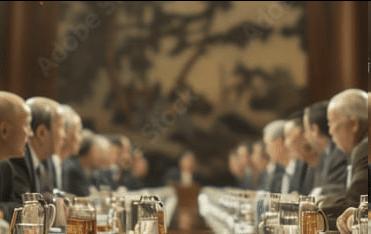
The unipolar club is closed. The United States no longer holds the only key. A new table is being set in global politics, and the question isn’t whether the world is becoming multipolar. It aleady is. The question is: who actually gets a seat? Not who is invited. Not who is hoped for. Who earns it.
For decades, there was no table. There was only a throne. The United States sat alone at the head of the global order. Everyone else stood below – either as vassals secured by American protection or as enemies targeted by American power. There were no peers, only subjects and adversaries. But that hierarchy is crumbling. Look at the Philippines. For decades, a treaty ally, a strategic outpost in the American empire. Now, in light of developments in the Persian Gulf, Manila is in direct talks with Beijing to co-develop gas fields in the South China Sea. This isn’t hedging. It’s a recognition that the throne is, if not vacant, certainly vacillating. When a vassal starts negotiating with the hegemon’s rival over disputed territory, it’s not because the protection is “insufficient.” It’s because the hegemon can no longer fully enforce the hierarchy.
The lesson is being written in fire as we speak in the Gulf. The Gulf monarchies, all hosts to American forces, are being pummeled, not despite the bases, but because of them. US air defenses could not stop it all. The message was brutal: alignment with Washington doesn’t always buy safety. It can buy a target. The security umbrella has holes. The guarantee is no longer valid. For now, the Gulf states are sticking with USA, but for how long?
So, who sits at the new table? The United States, China, and Russia are already seated. They have the nuclear arsenals, the economic mass, the global reach. They are poles by default, by history, by capability. But multipolarity demands more than three. It demands regional centers of gravity that can shape their neighborhoods without asking permission.
Enter Iran. Iran isn’t asking for a seat. It is taking one. Through active war, it is proving the criteria. A pole isn’t defined by GDP or population alone. It is also defined by will, resilience, and reach. Can you absorb a blow and strike back? Can you project power beyond your borders without a patron? Can you impose costs on a superpower that make escalation politically unsustainable? Iran, under direct attack, has done all three. It has kept its missile forces operational, activated proxy networks across the region, and triggered the largest global energy shock since the 1970s by closing the Strait of Hormuz. That is leverage. That is pole behavior. Iran looks likely to emerge from the chaos in the Gulf as the regional superpower. A compariuson can be made to Prussia in the 19th century – smaller population and economy, but its punching power meant it was a full player in the concert of European nations of the time.
And speaking of them, what of Europe? The UK, France, Germany, Italy – the EU as a whole? Europe is an economic titan, a regulatory superpower, a cultural beacon. But is it a pole? France has nuclear weapons and expeditionary ambitions, but it is overextended and domestically constrained. Germany has industrial might but remains a military lightweight, dependent on American security. The UK talks of “Global Britain” but lacks the resources to back the rhetoric. The EU can set standards for smartphones, but it cannot agree on a unified response to a war on its doorstep. Europe has wealth, but not unity; capability, but not will. It remains within the American orbit, even as that orbit weakens. Can we say it is a stakeholder, but not entirely a sovereign actor? If the need is a new USB connector, Europe is the first to get the call. But resolve a geopolitcal issue? Until and unless the current crop of leaders are replaced, Europe might get invited to the dinner, but they will only be allowed into the building through the servant’s entrance.
Now consider who else doesn’t get a seat, despite their wealth or alliances. Japan is an economic giant, a technological powerhouse, a key US ally. But it remains a protectorate, not a pole. Its military is constitutionally constrained; its foreign policy echoes Washington’s. It has influence, but not autonomy. The Arab states, Saudi Arabia, the UAE, Egypt, have petrodollars and ambition. They broker deals, invest globally, and posture as regional leaders. But when the missiles flew, their US-backed defenses faltered. Wealth without will, or weapons without independence, does not earn a seat. They are customers, not architects.
Then there is Turkey. Ankara desperately wants in. It plays all sides: NATO member, buyer of Russian systems, mediator in Ukraine, power broker in the Caucasus. But no one fully trusts it. Its ambitions outpace its reliability. In a world where poles must be predictable to their allies and formidable to their adversaries, Turkey’s volatility keeps it on the periphery. It is a swing state, not a center of gravity.
And Africa? For politeness, for the optics of inclusion, South Africa or Nigeria might be invited to the multipolar dinner. They have populations, resources, and regional voices. But at a global scale, they remain observers. Neither can project power beyond its subregion, nor shield its neighborhood from external intervention. They are important, but not yet indispensable. Their time may come. But the table being set today is not waiting.
Which brings us to the other contenders. Brazil and Indonesia have massive populations, growing economies, and regional influence. They speak loudly at BRICS and the G20. But influence is not the same as imposition. A pole can set the rules in its neighborhood; a regional power often negotiates them. Can Brazil prevent external powers from intervening in South America if they choose? Can Indonesia deter great-power coercion in Southeast Asia? Currently, they remain arenas where the big three compete, not independent centers of gravity that can dictate terms. They are waiting for an invitation. But at this table, invitations aren’t sent. Seats are taken.
Then there is India. The wildcard. It has the raw materials: a booming economy, a large military, strategic location. It practices autonomy, buying Russian oil while partnering with the US on technology. But true pole status requires more than balance. It requires the capacity to enforce regional stability without outside help. India is moving in that direction, but it remains cautious, hesitant to fully shoulder the burdens of leadership. It is watching, calculating. But in a world where power is proven in real time, hesitation can cost you a seat. For now India is at the table, but as the junior member, whose major leverage is as swing state, not center of power.
So, what actually makes a pole? Iran’s example clarifies the test. It is less about raw totals and more about three things: resilience (can you take a hit and keep fighting?), reach (can you project influence beyond your borders?), and will (are you willing to pay the price for autonomy?). Economy, population, and military strength are the entry fee. But the seat is earned by how you use them under pressure.
By that measure, Iran has earned its place. Japan and the Arab states have the wealth but not the will. Turkey has the ambition but not the trust. Africa has the potential but not the projection. Brazil and Indonesia are still preparing their applications. India is in, but not really a fully consolidated member. Europe assumes it will have a place of honor at the table, but that requires that the others respect it, even if grudgingly. Does Europe currently have that respect?
The old rules no longer apply. In this new order, autonomy is the ultimate currency – and it is earned, not given. The question isn’t who wants a seat. It’s who is willing to do what it takes to claim one. The table is being set. The chairs are limited. And the world is watching to see who stands, and who finally sits.
Reprinted with permission from Ashes of Pompeii.
