
President Trump’s emissaries shuttled from Moscow to Kyiv seeking a way to end the Ukraine war. Afterward, Trump negotiator Jared Kushner explained, “…the hardest issue is still territory.” That dispute centers on Crimea and Donbas.
These areas have been points of territorial intransigence for Ukraine and Russia.
However, there is a way to break that deadlock. But it might not be what either side expects. That’s because the territorial claims of both Russia and Ukraine rest on competing narratives rather than basic facts. Each side seems stuck on its own version. The underling truth is an orphan.
Russia seems to have based its related claims on kinship and historical background. Ukraine’s position presumes that the territorial authority of the pre-2014 Ukrainian constitutional order continued uninterrupted after the revolution.
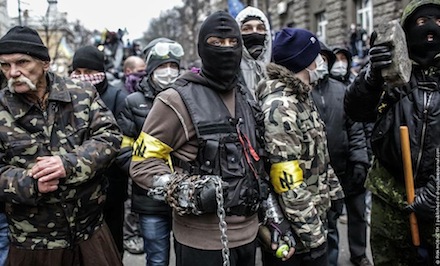
But that presumption overlooks what happened to Ukraine’s constitutional democracy in 2014. The country’s established order began to unravel in Kyiv. That was before Crimea and Donbas became the hot issues they are today. The precipitant was the Ukrainian Revolution.
The revolutionaries did not simply take over Ukraine’s structure of governance. They threw it out. They disposed of the democratic constitutional order.
The Western media told a different story. The New York Times called it a decisive “victory for democracy.” However, that transition had not been accomplished constitutionally or democratically. That didn’t seem to matter, though. The Economist wrote that “the world applauds the collapse of the regime and offers to help build a democracy.”
What an ultimate irony that was. Mainstream Western media widely celebrated the new rule by revolutionary force as a triumph for freedom and democracy.
Amidst that bravado something important was overlooked. With the discarded constitution, out with it also went the basis of authority for all the officials and offices that had derived their legitimacy from it. What remained was simply the power of force exerted by the revolutionaries.
Territory quickly became a central issue.
It is important to recognize that at the time of this rupture, the revolutionariy’s power of force did not extend to Crimea or parts of Donbas.
Ukraine’s borders had never existed independently of its constitutional order. They were defined and protected by it. Once that order had been thrown out, the territorial borders were no longer what they had been before the revolution.
That rupture turned out to have far-reaching consequences.
You see, before the revolution the power and authority of all government leaders, and indeed of the parliament itself, flowed from that very constitution — including the president. That means the revolutionaries had disenfranchised them all in one single act. They had terminated Ukraine’s constitutional democracy and all that went with it.
The only remaining basis of authority was the power of force exerted by the revolutionaries.
A revolutionary parliament then adopted an earlier version of the Constitution and used it as a guide. But that did not restore the constitutional order that had existed before the revolutionary rupture. By then their constitutional mandate had already been nullified. The revolutionaries had removed their own constitutional mandate. The replacement constitution they favored did not have the democratic standing of the one they had thrown out. In fact, it had previously been ruled unconstitutional by the then-standing constitutional court. In a practical sense, governance was now largely at the will of the revolutionaries.
There has been much controversy over whether President Yanukovych had been removed from office constitutionally. But in light of the foregoing, it didn’t actually matter. The presidency was a constitutional office. When the constitution was discarded there simply was no legal presidency. That same stark reality applied to the parliament itself as well.
Now the only authority left in Ukraine had become the power and force of the revolutionaries.
Back in 1991 Ukraine had declared its independence from the USSR. In establishing its own sovereignty it defined its borders. Its Law on the Succession of Ukraine stipulated that the new state’s borders with neighboring former Soviet republics were the same as those of the former Ukrainian Soviet Socialist Republic. That definition was incorporated into the constitution in effect at the eve of the 2014 revolution. That was the legal basis of Ukraine’s border claims.
Once Ukraine became subject to rule by revolutionary force rather than through a constitutional mechanism, the borders issue took on a different character. Now borders were defined by the physical control of the revolutionaries. Wherever the revolutionary authority could impose its rule, that territory was Ukrainian. Where that rule could successfully be resisted, the revolutionaries had no defensible territorial claim.
The result was that there were no longer constitutionally defined borders.
A thorny problem arose when parts of pre-revolutionary Ukraine failed to submit to the revolutionary authority in Kyiv. The same situation remained after Petro Poroshenko was elected president.
The issue was which territories were inside or outside of Ukraine. Mainstream media, including outlets such as CNN and Reuters, had begun using terms such as “breakaway regions” to describe Crimea and the areas of Donbas that refused to submit to the revolutionary authority in Kyiv.
However, to call a territory “breakaway” presupposes that it had been subject to continuous and legitimate governmental authority from which it subsequently separated.
The constitution thrown out by the revolutionaries had declared that those borders were “inviolable.” But that provision ceased to exist when the revolutionaries threw out the constitution.
The revolutionary transition had severed the constitutional basis that defined borders. The truth was not simply that Crimea and Donbas had “broken away” from Ukraine. In factual terms they never were parts of post-revolutionary Ukraine.
Those who dispute this conclusion have a counterargument. They appeal to the international-law theory of “state continuity.” That doctrine allows the identity of a state to persist despite changes in government, constitutional arrangements, or political upheaval.
That doctrine might be useful for settling debts and responsibilities when a constitution changes. But it leads to absurd conclusions regarding territorial borders. The concept has existed since the 19th century. Try applying it to the pre-WW2 borders of the great empires. The concept becomes a legal fiction.
State continuity does not by itself answer the separate question of how a particular government derives its domestic authority. The continued existence of a state does not automatically establish that a government claiming to rule that state possesses an uninterrupted legal basis for its authority.
This distinction is crucial.
Another argument used to support the revolutionary view is that it has gained wide international recognition. But what does that really establish? Recognition does not by itself create the internal authority it recognizes. Nor does it change the facts that gave rise to any territorial dispute.
The argument is not that post-revolutionary Ukraine had no sovereignty, nor that Ukraine simply ceased to exist as a state. The actuality is that the revolutionary authorities had severed their constitutional basis of legitimacy. In reality their authority depended upon their ability to exercise and enforce their rule by force.
The Ukraine territorial conflict began with a false narrative that became the mainstream story. Even government peace negotiators seemed to buy into it. That left the story’s disingenuity as a negotiating obstacle for Ukraine and United States peace efforts. They disagreed over differences that were neither factual nor real. They were only competing narratives.
In June 2014 Poroshenko took office as president following a democratic election. But the country he inherited was not the pre-revolutionary Ukraine; it was just what was left of it.
Poroshenko had assumed power not from the Yanukovych administration and the borders it had controlled, but from the revolutionary authorities who ruled a country that did not include Crimea or parts of Donbas.
By the time the democratic process resumed, the geographical limits of the state’s authority had already been dictated by the limits of revolutionary force. Yet, based on his rhetoric, Poroshenko did not appear to recognize the actual territorial losses incurred under the revolutionaries. Neither has his successor Volodymir Zelensky.
Finally coming to terms with the factual truth about Donbas and Crimea can straighten out the widespread misunderstandings. It would take Donbas and Crimea off the table. They would not have to be negotiated. They are already settled by the reality of the situation.
If the facts about Crimea and Donbas are recognized by both sides, a major point of contention will be settled. That would allow negotiators to stop wasting time debating false narratives. They would then be free to pursue a course toward a practical peace treaty, one based on reason and reality. The quest for peace in Ukraine would finally have a fair chance.
But what happens next will depend on whether the US negotiators are really willing to discard the prevailing false narratives about Crimea and Donbas — and impose that reality on President Zelensky. That would give peace efforts a leg up in settling other differences and a much better chance of achieving a lasting peace.
