
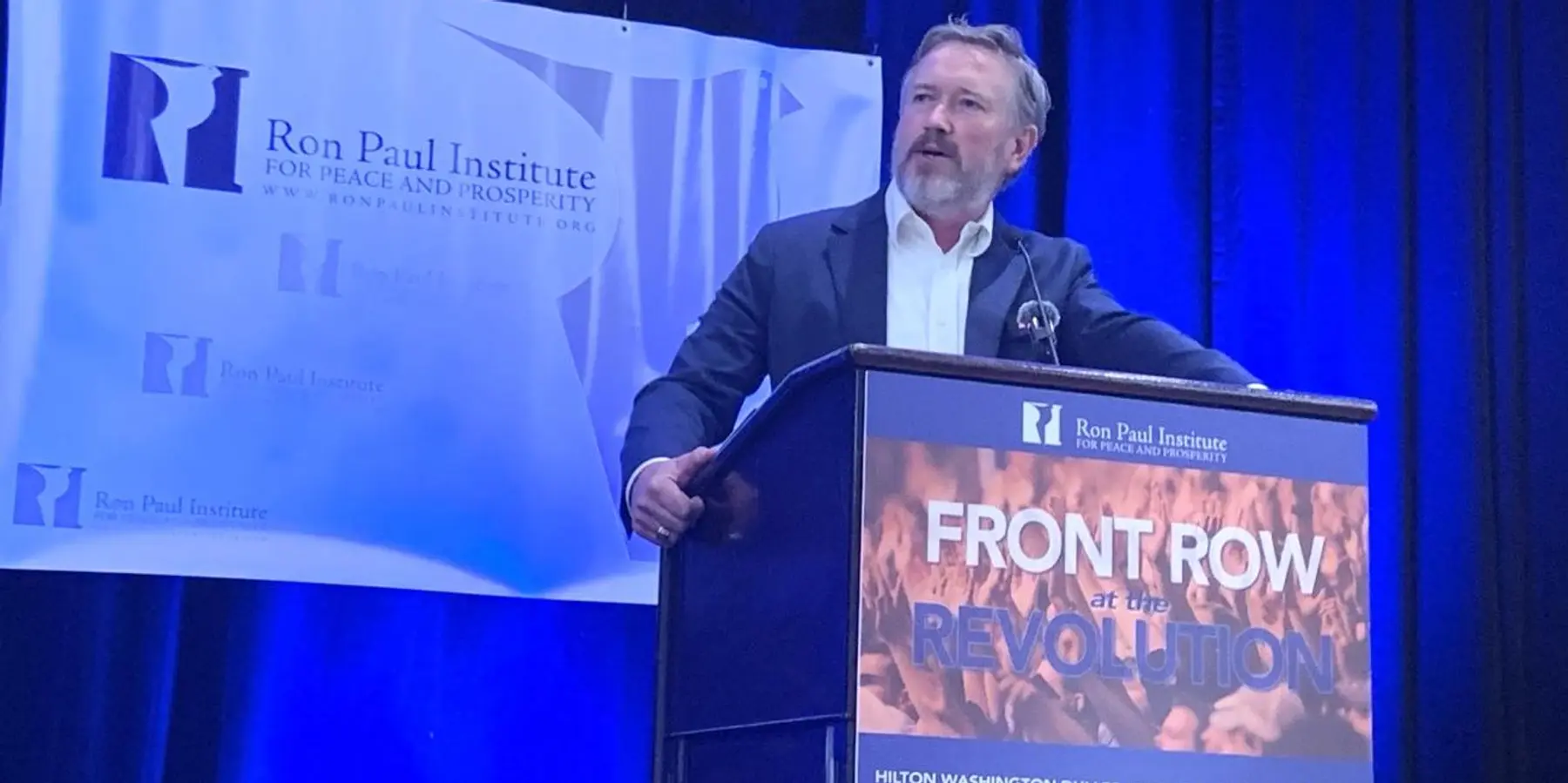
In his first non-Congressional public speech since his Republican primary loss to Ed Gallrhein, Thomas Massie brought some of the loudest energy to the Ron Paul Institute’s Washington conference on Saturday. He was full of jokes and promise for the future.
Massie said he was not interested in mourning the defeat and declared that he was, in a way, happy he had lost. When addressing what he planned to do next, he joked that “you could scan my head” for an answer and still come up empty because he had not yet decided himself. One possibility, however, was firmly off the table: another run for Congress. Massie said he once held out hope that Congress could fix itself. His years inside the institution had convinced him otherwise.
The energy with which he was received was indicative of his standing at the conference and within the broader antiwar movement. His name was invoked repeatedly throughout the day. His May 19 defeat followed more than $32 million in campaign spending, making it the most expensive House primary in American history. Pro-Israel groups spent more than $15 million to oust the representative after years of clashes over his foreign aid and U.S. policy stances on Israel.
Beyond Massie’s dissent in Congress, former National Counterterrorism Center director Joe Kent and former State Department official Josh Paul offered the conference two examples of dissent from inside the Executive Branch.
Paul resigned as director of congressional and public affairs from Biden’s Bureau of Political-Military Affairs in October 2023, saying he could no longer participate in the expedited transfer of American weapons to Israel without consideration of civilian harm. Kent made a similar break with the current admin this March. He resigned as President Trump’s counterterrorism chief, declaring that Iran posed no imminent threat to the United States and accused Israel and its American supporters of pushing Washington into this latest war.
Together, the two offered the conference’s clearest illustration of the remarkable coalition taking shape around opposition to US Middle East policy. One resigned from a Democratic administration over Gaza and the other from a Republican administration over Iran.
Israel, unsurprisingly, was one of the dominant subjects of the day, with speaker after speaker challenging one aspect of Washington’s relationship with the country or another.
Fair use excerpt from Responsible Statecraft. Read the whole article here.
