
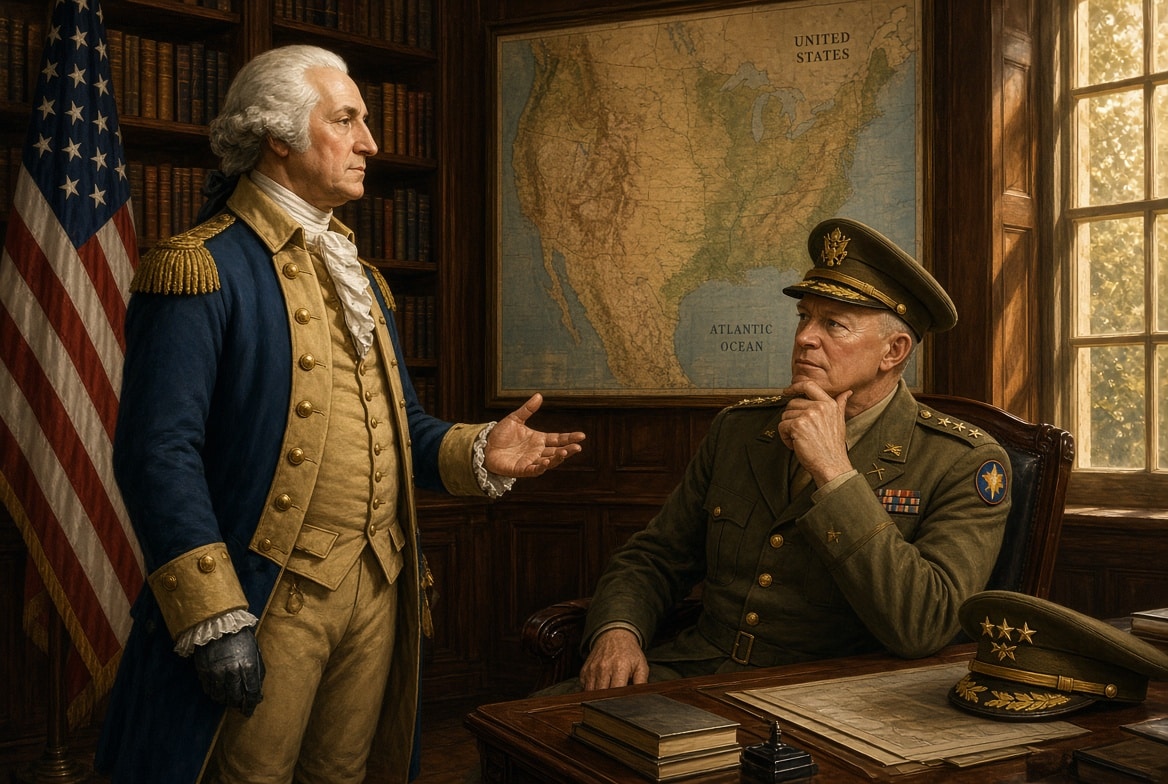
“God help the Nation when it has a President who doesn’t know as much about the military as I do,”
– President Dwight D. Eisenhower speaking to his White House Staff Secretary, Gen. Andrew Goodpaster.
These words are quoted in a book about Eisenhower’s foreign policy called “Ike’s Bluff—President Eisenhower’s Secret Battle To Save The World,” by Evan Thomas.
In the same paragraph as the words above are these: “When Defense Secretary Neil McElroy warned him that further cuts would harm national security, Eisenhower acerbically replied, ‘If you go to any military installation in the world where the American flag is flying and tell the commander that Ike says he will give him an extra star for his shoulder if he cuts his budget, there’ll be such a rush to cut costs that you’ll have to get out of the way.’”
In a speech to the Canadian Club in Ottawa on Jan. 10, 1946, Eisenhower said these words: “I hate war only as a soldier who has lived it can, only as one who has seen its brutality, its futility, its stupidity.”
In a speech broadcast from London in 1959, Eisenhower said: “I think people want peace so much that one of these days, governments had better get out of the way and let them have it.”
Because of these and many other things he said and did, I think a very strong case can be made that Eisenhower was our most antiwar President.
Certainly his most famous remarks were given in his farewell address from the White House on Jan. 17, 1961. He talked of the “grave implications” of “an immense military establishment and a large arms industry.”
Then he added these famous words: “In the councils of government, we must guard against the acquisition of unwarranted influence, whether sought or unsought, by the military-industrial complex. The potential for the disastrous rise of misplaced power exists and will persist.”
I think Eisenhower would be shocked at how far we have gone down the road against which he warned, especially since the Pentagon is now wanting a one-year budget of an incomprehensible of more than one trillion, four hundred billion.
Less famous than his farewell address is his first major speech after his inauguration. It was given on April 16,1953 at a meeting in Washington to the American Society of Newspaper Editors and was probably the most antiwar speech ever given by an American President.
He gave several examples of wonderful things that could be done with war money and then said: “Every gun that is made, every warship launched, every rocket fired signifies, in the final sense, a theft from those who hunger and are not fed, those who are cold and are not clothed.”
He added: “This world in arms is not spending money alone. It is spending the sweat of its laborers, the genius of its scientists, the hopes of its children…This is not a way of life at all…it is humanity hanging from a cross of iron.”
This speech is quoted above Eisenhower’s grave and in a book by Brett Baker entitled “Three Days In January—Dwight Eisenhower’s Final Mission”.
In addition to his inspiring words, Eisenhower ended the Korean War and even went on national television shortly before the 1956 election to refuse Israel’s request (demand) to join a war against Egypt over the Suez Canal.
Mitchell Bard wrote in The Times of Israel in 2014: “Eisenhower went on television to criticize Israel’s failure to withdraw from Egypt and warned he would impose sanctions if it failed to comply. Eisenhower was prepared to cut off all economic aid, to lift the tax-exempt status of the United Jewish Appeal, and to apply sanctions on Israel.”
Israel withdrew, and war was averted .
I think it is very significant that possibly our other most antiwar President was our other most famous General, George Washington. His farewell address has been read in a ceremonial session of the Senate every year since 1862.
In that speech, he warned against “overgrown military establishments which, under any form of government, are inauspicious to liberty, and which are to be regarded as particularly hostile to republican liberty.”
He added these very important words: “A passionate attachment of one nation for another produces a variety of evils. Sympathy for the favorite nation, facilitating the illusion of an imaginary common interest…betrays the former into a participation in the quarrels and wars of the latter without adequate inducement or justification.” (Israel?)
Finally, in Scott Berg’s lengthy biography of Woodrow Wilson is a statement about World War 1 made by Winston Churchill to a New York newspaper editor: “America should have minded her own business and stayed out of the world war.”
Then Churchill added: “If you hadn’t entered the war the allies would have made peace with Germany in the Spring of 1917. Had we made peace then there would have been no collapse in Russia followed by Communism, no break-down in Italy followed by Fascism, and Germany would not have…enthroned Nazism.”(p583)
I wish we could have more political and military leaders who would mind our own business and not be so eager to go to war.
