
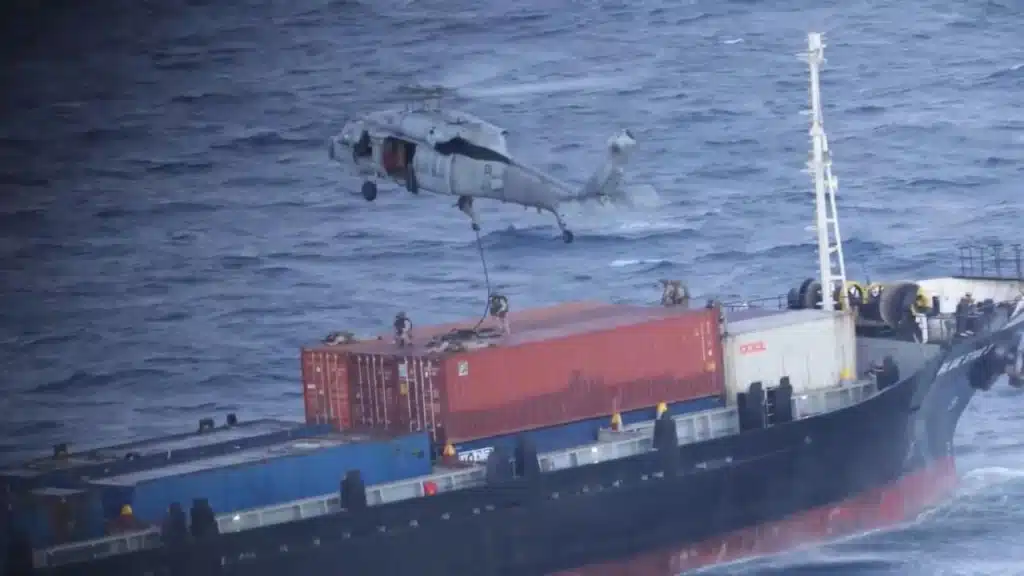
Pete Hegseth is lying about the US blockade of Iranian ports. On April 12, after JD Vance announced that talks with Iran had failed, Trump declared a naval blockade of Iranian ports and coastal areas. CENTCOM clarified that the blockade would be enforced against vessels of all nations entering or departing Iranian ports, but would not impede freedom of navigation for vessels transiting the Strait of Hormuz to and from non-Iranian ports.
Now, after more than two weeks, Pete Hegseth has been saying the US blockade is working and getting stronger, describing it as “ironclad,” “tightening by the hour,” and even “going global.” He said the Navy had turned back 34 ships, that transit through the Strait of Hormuz is now “much more limited,” and that the blockade will last “as long as it takes.”
He also framed the blockade as coercive leverage on Iran, saying it is meant to cut off shipping pressure until Tehran abandons its nuclear ambitions. In the same remarks, he warned the US would “shoot to destroy” any Iranian boats laying mines or otherwise threatening commercial shipping.
Here’s what the available data tells us about Strait of Hormuz transits since April 15:
Daily volumes (around April 15): On April 15 alone, there were 19 transits — 5 inbound and 14 outbound — according to Windward. Around that same period, April 11 saw 17 transits, April 12 saw 21, and April 13 saw 17. United Against Nuclear IranWindward
Overall picture since April 15: A precise cumulative total from April 15 through today (April 30) isn’t publicly available in a single figure, but based on the data points above, daily transits have been running roughly in the range of 6–21 ships per day. Recent data from Windward and AIS trackers confirm persistent low volumes of 6–13 vessels daily.
That would put a rough estimate somewhere in the ballpark of 100–200 total transits over the 15-day stretch since April 15 — though the true number could be higher due to GPS spoofing. I can’t comment on GPS spoofing, but I can say with certainty that Pete Hegseth is spoofing the American public about the effectiveness of the blockade.
In order to understand Hegseth’s perfidy, you need to understand the US Navy doctrine for handling a blockade. The US Navy’s approach to taking control of a ship seized during a blockade centers on Visit, Board, Search, and Seizure (VBSS) operations, governed primarily by the Commander’s Handbook on the Law of Naval Operations (NWP 1-14M/MCTP 11-10B, March 2022) and aligned with the law of armed conflict (LOAC), including customary rules on blockades.
Standard Procedure for Seizure and Control
- Interception and Warnings: US forces (Navy warships, often with Marine or Coast Guard support) issue radio warnings, visual signals, or warning shots to order the vessel to stop. Non-compliance can lead to disabling fire (e.g., targeting engines) to halt the ship without sinking it.
- Boarding (VBSS): A specialized boarding party—typically from the Navy, Marines (e.g., 31st MEU), or Coast Guard—approaches via small boats, helicopters, or fast-roping. The team secures the bridge, engine room, and key areas to establish control. Teams train for both compliant and non-compliant (opposed) boardings, using tactics for close-quarters battle, searches, and restraint of crew.
- Taking Control:
- The boarding party assumes operational command of the vessel.
- In a formal wartime blockade or armed conflict context, a prize crew (detachment of US personnel) may be placed aboard to sail the seized ship to a friendly port for adjudication. The original crew can be detained, removed, or (for neutrals) sometimes allowed limited continued presence under guard.
- The ship and cargo become subject to inspection for contraband, sanctions violations, or blockade breach. Under prize law (revivable in armed conflict), a prize court may condemn the vessel/cargo as lawful prize.
- Post-Seizure: Here is the key point: the vessel is typically escorted to a US or allied port for further inspection, potential forfeiture, or release if the capture is deemed unlawful. Crew handling follows LOAC (e.g., humane treatment; possible internment for belligerents).
Blockades are acts of war requiring effective enforcement (impartial, declared, and maintained by force). Violators (enemy or neutral ships breaching or attempting to breach) are subject to capture
Now that you understand the procedure, let’s look at the US Navy’s constraints. As I discussed in my last article, the US Navy is keeping its ships 200 miles off the coast of Iran. If the venture any closer to shore they are vulnerable to missile and drone attacks. The Iranian ships — when they leave port — normally stay within 50 miles of the Iranian coast, which means they are outside the reach of the US Navy.
Next, let’s look at the current US Navy order of battle (this is based on publicly available information). As of late April 2026, the US Navy has at least 14 actively operating or supporting in the broader region (Gulf of Oman, Arabian Sea, and relevant Indian Ocean areas). This includes three Carrier Strike Groups (CSGs); at least eight multiple guided-missile destroyers; six ships attached to the Amphibious Ready Groups (ARG) for the 31st and 11th MEUs, and two additional escorts (not part of the core ARG but often operate with it): the Cruiser USS Robert Smalls (CG-62) and the destroyer USS Rafael Peralta (DDG-115), forming a broader Expeditionary Strike Group. In other words, the US Navy only as 11 ships that could be used in a VBSS operation.
Do you see the math problem? The current US deployment means that the US Navy could do VBSS operations on 11 vessels… Tops! But that would mean that US destroyers, which have the mission of protecting the US carriers from air attacks, would have to be pulled off of their primary mission leaving the carriers to fend for themselves. If we assume that all 11 US ships carried out successful VBSS operations since 15 April, that means between 89% and 96% of all Iranian ships out of the Strait of Hormuz have evaded the blockade. Hegseth is lying.
Reprinted with permission from Sonar21.
