

I was wrong. I believed that controlling Venezuelan oil was the primary objective behind Donald Trump’s decision to order the kidnapping of Venezuelan President Nicholas Maduro. After reviewing the actual numbers it is clear that the belief that Venezuelan oil would provide a buffer if the Persian Gulf is closed as a consequence of an Israeli/US attack on Iran is sheer nonsense. My apologies for entertaining that hypothesis before looking at the actual numbers.
The following graphic illustrates the reality:

If Iran closes the Strait of Hormuz that would be devastating for the world oil market… 72% of OPEC members production comes from the Persian Gulf. Venezuela, who is an OPEC member, only produces 700,000 barrels of oil per day, which represents only 2% of OPEC’s total production per day.
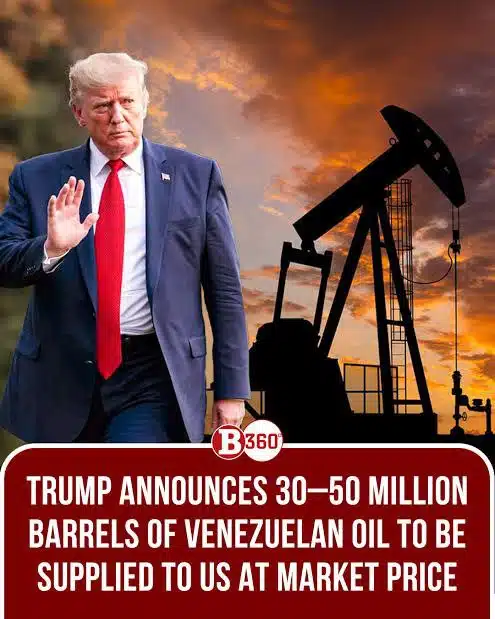
Now let’s examine Trump’s nonsensical claim that the US, by seizing Venezuelan oil, will reap a bonanza and reduce the price of oil. In a Truth Social post (reported January 7, 2026), Trump announced: “Interim Authorities in Venezuela will be turning over between 30 and 50 MILLION Barrels of High Quality, Sanctioned Oil, to the United States of America.” He added that the oil would be sold at market price, with proceeds controlled by him “to ensure it is used to benefit the people of Venezuela and the United States.” During a White House meeting with oil executives on January 9, 2026, Trump reiterated that the U.S. would “immediately begin refining and selling up to 50 million barrels of Venezuelan crude oil, which will continue indefinitely.” He described this as part of a broader plan where U.S. companies would invest at least $100 billion to rebuild Venezuela’s energy infrastructure, potentially boosting long-term production and lowering U.S. energy prices (e.g., aiming for $50 per barrel).
Here are the facts:
At Venezuela’s current production rate of approximately 700,000 to 1 million barrels per day (bpd), delivering 50 million barrels of oil to the U.S. would take 71.4 days if assuming all daily production were dedicated to this delivery.
Now let’s calculate the total production of barrels of oil per day by all of OPEC and non-OPEX countries during that same 71.4 days… the world would produce about 7.17 billion barrels of crude oil, of which Venezuela would contribute roughly 49.7 million barrels, or 0.693% of the global total. Talk about delusional! Does Trump and his advisers really believe that a country that produces a little more that one-half of one percent of global oil production is going to move the price? Ain’t going to happen.
What about Trump’s promise to invest $100 million to rebuild Venezuela’s oil infrastructure. Here’s an analysis of that scenario by the firm, Goehring and Rozencwajg:
When Hugo Chávez came to prominence in the early 2000s, Venezuela moved to nationalize its oil assets, prompting most Western producers to withdraw. The national oil company, PDVSA, then experienced a debilitating strike in 2002–2003, which sharply curtailed production. After the strike ended, output staged a temporary recovery, reaching approximately 3.3 million barrels per day by 2006. That year marked another turning point: contracts were rewritten or voided, capital spending collapsed, and skilled labor began to leave the country. By 2015, production had slipped to 2.8 million barrels per day, before entering a far steeper decline. According to the most recent IEA data, Venezuelan production now stands near 800,000 barrels per day—nearly an eighty percent drop from levels seen in 2000.
In light of recent events, many investors have begun to ask how quickly Venezuelan production might rebound once more. We regard this line of thinking as premature. Much of the infrastructure installed during the late 1990s and early 2000s has since been dismantled or stripped for scrap as the country descended into severe poverty. During the PDVSA strike two decades ago, the disruption was brief and occurred while the broader economic fabric remained somewhat intact. As a result, infrastructure survived largely untouched, allowing production to recover. Today’s circumstances bear little resemblance to that earlier episode.
Restarting Venezuelan heavy-oil production would require capital investment on an extraordinary scale. As one illustrative example, an older industry document indicates that supermajors spent approximately $23 billion in 2010 to bring 600,000 barrels per day of heavy-oil capacity online—roughly $40,000 per flowing barrel. More recent rules of thumb for Canadian heavy oil suggest figures closer to $100,000 per flowing barrel, implying that adding one million barrels per day could require on the order of $100 billion once the cost of an upgrader—an essential component of heavy-oil production—is included.
For a guy who has built his reputation on being a shrewd businessman, Donald Trump is demonstrating he is ignorant when it comes to oil and the oil market.
Reprinted with permission from Sonar21.
