
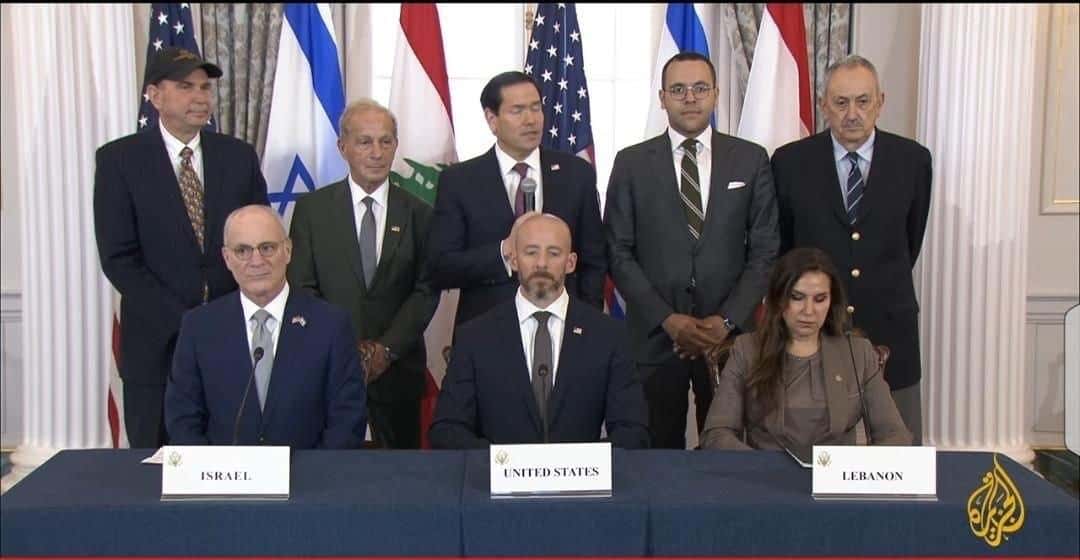
On June 29, General Joseph Aoun, the president of Lebanon, met with Admiral Brad Cooper, Commander of the US Central Command at the Baabda Palace overlooking Beirut. “During the meeting, discussions were held regarding the preparations related to the start of implementation of the framework agreement that was approved as a result of the Lebanese-American-Israeli negotiations in Washington,” the office of the Lebanese Presidency posted to social media.
Lebanon signs 'framework deal' with Israel as Israeli occupation and attacks persist in the south
— The Cradle (@TheCradleMedia) June 26, 2026
Israel and Lebanon have reached and rushed to sign a US-brokered framework agreement following four days of negotiations in Washington, with US Secretary of State Marco Rubio… pic.twitter.com/a0UKTS2Gwn
The Trilateral Framework Between the United States of America, the State of Israel, and the Republic of Lebanon states:
The Government of Lebanon will rebuild the State’s monopoly on the use of force, achieve the complete and verified disarmament of all non-state armed groups [Hezbollah], and ensure that such groups will have no military or security role and no armed capabilities anywhere in Lebanon.
MintPress News posted there is a possibility US ground troops will be sent to Lebanon to tackle the impossible task of eliminating Hezbollah. “Previous reports indicated that US marines would be deployed to Lebanon, in order to train the Lebanese army to confront Hezbollah, while also being on standby in the event of civil war.”
In addition, The Washington Post reported on June 30 the US military has a plan to put “troops on the ground” in Lebanon to assist the Lebanese military and Israel disarm Hezbollah. “The US military will have a direct role in monitoring actions by both the [Lebanese army] and the [Israeli army],” a US official said.
Hezbollah: Hardwired to the Lebanese State
Hezbollah cannot be permanently dismantled without regime change in Iran and dismantling its domestic financial system and political power, notes the Washington Institute for Near East Policy (WINEP), a neocon spin-off from AIPAC to expand the Israel Lobby’s influence over US foreign policy.
In the Lebanese general election of 2022, Hezbollah secured fifteen seats in the Parliament. A significant majority of Shia Muslims backed Hezbollah, with support reaching 93%, whereas the backing among Sunni and Christian communities is notably lower, at 34% and 29% respectively. “Hezbollah is the most prominent of Lebanon’s political movements, and has long been the most powerful in the country,” Al Jazeera reported earlier this month.
Originally an offshoot of the Amal Movement, Hezbollah grew to become the most powerful party—politically and militarily—in Lebanon. It is a religiously conservative Shia Muslim party that, like many parties or political leaders, also provides social services in the absence of the Lebanese state.
On the same day President Aoun held discussions with CENTCOM, Nabih Berri, the Speaker of the Lebanese Parliament and an ally of Hezbollah, stated that the trilateral framework agreement involving Lebanon, Israel, and the United States would not be approved, as it fails to secure Lebanon’s rights, according to Alarabiya. Berri expressed that opposition to the agreement is not limited to Hezbollah but also encompasses Sunni political and religious leaders who are taken aback by the extent of the commitments made during the negotiations.
Speaker Berri replies to a reporter's question about the "Framework Agreement" between Lebanon government and Israeli enemy: You can write it off pic.twitter.com/ySn4T8CUtJ
— Al-Manar English (@manarenglish) July 2, 2026
Naim Qassem, who leads Hezbollah, has rejected the agreement, labeling it a surrender to Israel. As a Shia cleric and the Secretary-General of Hezbollah, Qassem took on this position after the previous leader, Hassan Nasrallah, was assassinated by the Zionist IDF.
Hussain Abdul-Hussain, a research fellow at the neocon think tank the Foundation for Defense of Democracies, writes that “Lebanon can either disarm Hezbollah or lose its depopulated southern border region to Israeli control.” Nevertheless, as Zionist Finance Minister Bezalel Smotrich stated in March, the Israelis are concentrating on their Greater Israel initiative, which aims to annex southern Lebanon up to the Litani River.
“The comments by Finance Minister Bezalel Smotrich were the most explicit yet by a senior Israeli official on seizing Lebanese territory in a fight Israel says targets Iran-backed Hezbollah militants,” Reuters reported.
Furthermore, Israeli National Security Minister Itamar Ben-Gvir admitted the expansionist Zionist state has a “settlement plan for Lebanon.” Ben-Gvir made his remark on the occasion of “Jerusalem Day,” commemorated by Israelis on May 15 after the annexation in 1967 of the eastern part of the holy city, reports L’Orient Today.
Greater Israel and Lebanon
The determination of the Zionist movement to occupy and annex southern Lebanon can be traced back to 1918, when David Ben-Gurion, recognized as the founding father of Israel, penned Gvul artzeinu v’admatah (The Borders of Our Land and Its Territory). In this work, he asserted that the Land of Israel constitutes a natural geographic entity, bordered by the Mediterranean Sea to the west, the Syrian desert to the east, the deserts of Sinai and Arabia to the south, and the mountains of Lebanon and Hermon to the north, The Jerusalem Post summarized. “And, most importantly, he concluded that the natural northern border of the Land of Israel is the Litani River in southern Lebanon.”
Theodor Herzl, the founder of Zionism, wrote in his Complete Diaries (Vol.II, page 711), the area of the Jewish state stretches from “the Brook of Egypt to the Euphrates,” while Rabbi Fischmann, member of the Jewish Agency for Palestine, later declared in his testimony before the UN Special Committee of Enquiry on July 9, 1947, “The Promised Land extends from the River of Egypt to the Euphrates. It includes parts of Syria and Lebanon.”
“Zionist designs upon Lebanon long antedated the formation of the state of Israel. In 1918, Britain was informed of Zionist claims to Lebanon up to and inclusive of the Litani River,” writes Ralph Schoenman (The Hidden History of Zionism). “By 1936, the Zionists had offered to support Maronite hegemony in Lebanon.”
Factions within the Maronite community in Lebanon have in the past embraced fascism, most notably the Phalange/Kataeb Party. The Kataeb was founded in 1936 as a Maronite paramilitary youth movement, and its founder Pierre Gemayel explicitly modeled it on European fascist organizations he observed in the 1930s.
The 1982 Zionist invasion of Lebanon, which prompted the formation of Hezbollah, was launched under the pretext of removing the PLO from Lebanon. The late Robert Fisk, author of Pity the Nation: The Abduction of Lebanon, “understood that the catastrophe [massacres of Palestinians in Beirut’s Sabra neighborhood and the adjacent Shatila refugee camp] conducted by a Maronite militia,
was not merely Israeli aggression—it was the product of a poisonous alliance between Israel and certain Maronite Christian factions who saw the Jewish state as a powerful patron against Palestinian and Muslim Lebanese.
Lebanese President Joseph Aoun, a Maronite Christian, hailed the trilateral framework, despite Israel occupying around 20 percent of Lebanon, and declared it to be “the first step on the path towards Lebanon restoring its sovereignty.” Israel PM Benjamin Netanyahu, however, said Israeli troops will remain in the occupied south until “Hezbollah and other terror groups are disarmed.”
He acknowledges that Israel will be withdrawing from two small areas it currently holds, in a pilot project for disarming Hezbollah and transferring territory to the Lebanese Army. Showing the areas on a map, he says one is completely outside the security zone, and the other is on the edge of the zone in an area the IDF no longer needs to hold.
The Israel Defense Forces and the Lebanese Army lack the capability to disarm Hezbollah. A senior Israeli military official, as reported by The Times of Israel in April, stated the complete disarmament of Hezbollah is an unrealistic expectation. IDF officials told Haaretz the same month that disarming Hezbollah can only be accomplished by the Lebanese military. “Lebanon is caught in a trap not of its own making,” notes Foreign Policy. “The government cannot disarm Hezbollah or defend Lebanon against Israel.”
Hawks in Lebanon and Washington have always been cavalier about pushing the Lebanese government or army to confront Hezbollah, even when the prospects of success were limited. Hezbollah’s Lebanese rivals should beware of a headlong clash that they cannot win.
🎥 NEW: Hezbollah expert Amal Saad on the new “framework” between Israel and Lebanon:
— Drop Site (@DropSiteNews) July 2, 2026
“I think it’s not an exaggeration to say… it transcends even the Abraham Accords… and it resembles much more closely an alliance treaty… not a proper alliance… [but] an alliance that… https://t.co/rRIQQj5foU pic.twitter.com/zfClJtYri8
Hezbollah was not consulted on the framework and rejected it outright. The plan calls for the establishment of “pilot zones” in which the Lebanese Armed Forces (LAF) would deploy in order to dismantle “non-state armed groups,” including the resistance, The Cradle reported. In yet another affront to Lebanese sovereignty, Clause 3 of the framework stipulates the LAF must ask permission from Israel on where to deploy its troops.
The deal would also bar Lebanon from filing legitimate international legal complaints against Israel, which has killed over 4,000 Lebanese and displaced over a million since the start of March this year… Hebrew and Lebanese media reports have discussed the existence of secret clauses which aim to solidify Israeli occupation and grant Tel Aviv the right to “approve” the LAF’s work.
The 1983 Bombing of the Marine Barracks in Beirut
If the Trump administration indeed decides to use military force in Lebanon to disarm Hezbollah, it should take a moment to consider the 1983 barracks bombing at the Beirut International Airport that killed 220 Marines, the deadliest single-day death toll for the United States Armed Forces since the first day of the Tet Offensive in the Vietnam War.
Initially, the Shia militia Islamic Jihad was blamed for the attack, although then United States Secretary of Defense Caspar Weinberger said there was no evidence implicating the group. The month prior to the barracks bombing, President Reagan deployed the USS New Jersey to the waters off Lebanon during the nation’s civil war.
In December, following the bombing, the warship fired its 16-inch guns and secondary 5-inch guns at Druze and Shia targets in the hills overlooking Beirut. The offensive was the heaviest US naval shore bombardment since the Korean War. The inaccuracy of its 16-inch guns resulted in hundreds of civilian deaths, according to former Secretary of State Colin Powell in his memoir (My American Journey, 1995). The shelling and civilian deaths turned Muslims against the US presence in Lebanon.
Similar to Trump’s attack on Iran, Reagan’s effort encountered serious problems, including unclear objectives, escalating violence, congressional opposition, and the collapse of the Lebanese Army in early 1984. In February of 1984, Reagan announced a full withdrawal of forces from Lebanon. In a letter to Congress in March of that year, he admitted the failure of US goals—establishing a sovereign Lebanon, withdrawal of foreign forces, and Israel’s northern border security.
Israel’s invasion of Lebanon in 1982, Operation Peace for Galilee, inflicted heavy damage on Lebanon, including large scale urban destruction and attacks on Palestinian refugee camps (the above mentioned Sabra and Shatila massacre). Thousands of Lebanese, Syrian, and Palestinian civilians and combatants were killed. Israel established the Khiam Detention Camp, named after a nearby village in southern Lebanon. Hundreds of Palestinians, Lebanese, and Syrians, including women, were illegally abducted and held for indefinite periods without any legal proceedings, and often tortured, according to Rosa Luxembourg Stiftung and other human rights groups.
In April 1985, the IDF began withdrawing to its “security zone” in southern Lebanon following a long-term effort by resistance groups, including the newly formed Hezbollah, to expel them. The guerrilla war against the IDF finally forced Israel to completely leave Lebanon in 2000.
Hezbollah possesses greater military capabilities now than it did in the 1980s, largely attributable to its partnership with Iran. Historically, ground invasions have not succeeded in disarming Hezbollah. As previously mentioned, the group is deeply integrated into Lebanon’s political and social fabric. A significant disarmament initiative could provoke a backlash within state institutions and potentially lead to civil war.
Framework “Stillborn”
On June 30, Hezbollah reiterated its opposition to the framework agreement. Senior official Mahmoud Qamati characterized the accord as “stillborn,” cautioning that the resistance movement “will not permit its implementation” and will “oppose it using all available means.” Melhem Mohammed Al-Hujeiri, also a Hezbollah official, slammed the deal as total humiliation.
Hezbollah vows to defeat US-backed framework agreement with Israel
— The Cradle (@TheCradleMedia) June 30, 2026
——
Hezbollah has pledged to block the implementation of a newly signed, US-backed framework agreement between Lebanon and Israel, following a wave of condemnation from a majority of Lebanese political factions.… pic.twitter.com/QUy9zClwz9
Despite a stillborn or deadlocked framework, France and Italy are preparing to deploy an international coalition force to southern Lebanon, supported by the United States. “Coalition Deployment: France and Italy are organizing the multinational force, heavily backed by the U.S., at the request of the Lebanese government,” reported the Puget Point Capital on Thursday, June 2. “U.S. and European Funding: The U.S. and the EU are funneling millions of dollars into the Lebanese military, with the EU recently adopting a EUR 100 million assistance measure to help the state restore its authority.”
Israeli newspaper Israel Hayom reported that France and Italy have reached out to the United States and "Israel" requesting to take part in the implementation of the new framework agreement with Lebanon.
— Al Mayadeen English (@MayadeenEnglish) June 30, 2026
According to Israel Hayom, efforts are underway at the United Nations to… pic.twitter.com/1cxZJ2BzM6
Israel, the United States, France, and Italy will not be able to disarm Hezbollah. Remarkably, the US and Israel are incapable of learning the lessons of guerrilla war. In southern Lebanon, the Shia know all too well from past experience how the Zionists treat Arabs, and they realize surrender is expulsion and not an option.
“For a colonized people the most essential value, because the most concrete, is first and foremost the land: the land which will bring them bread and, above all, dignity,” wrote Frantz Fanon in The Wretched of the Earth. The Shia of Lebanon will continue the struggle for their homes and dignity regardless of how many troops Israel, the US, and the Europeans send against them.
Reprinted with permission from Another Day in the Empire.
