

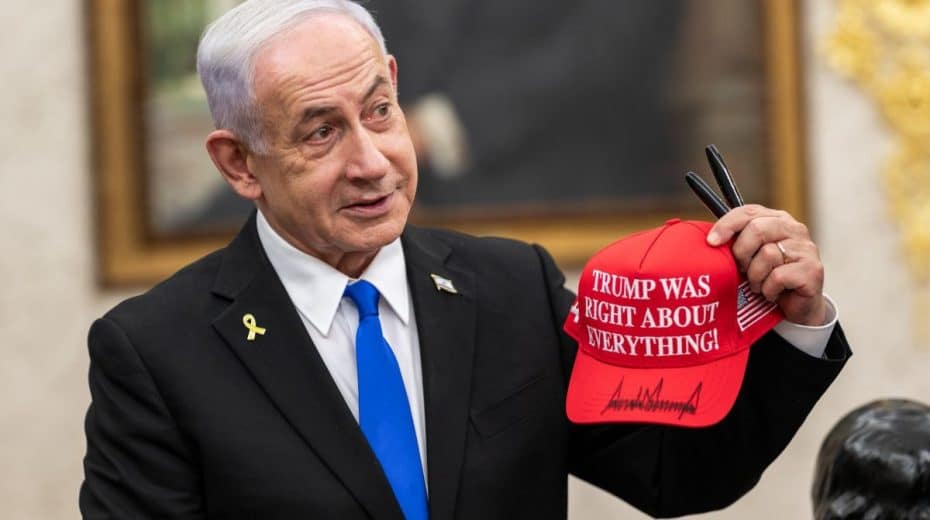
At the 30 December meeting with Netanyahu and his team, President Trump publicly committed to attacking Iran: If they continue with their ballistic missile program, “Yes.” And for their nuclear: “Immediate.” “We’ll knock the hell out of them,” Trump said.
By contrast to this belligerency, the Trump language at the Mar-a-Lago meeting reflected only warmth and fulsome praise for Netanyahu and Israel. Publicly, Netanyahu had received Trump’s public backing on an attack on Iran and for Gaza Phase Two, but behind the scenes many of the specifics remained undefined and disputed.
The escalatory language towards Iran was no surprise to Tehran. It had been expected. All the pointers toward coming hostilities are in plain sight: The escalating narrative – “hundreds of al-Qaida sleeper cells ready to unleash carnage; Al-Qaida found safe harbour in Iran for 25 years … [allowing Iran] to supercharge the spread of Islamic fundamentalism,” an “infiltrator for MI5 and MI6” claims. On cue, the Iranian currency falls precipitously – and Iranians take to the streets.
What lies behind this outbreak of US-Israeli militarism? Trump’s bluster about “the gates of Hell” opening to “whomsoever” is familiar to us all now. Nonetheless the signs are that Trump and Netanyahu are aligned for another round of war.
But why should Netanyahu be opting for kinetic action when Israel was so badly scarred by the incoming sophisticated Iranian missiles during the so-called June 12-day war – and when Israeli air-defences proved deficient? Iran has been re-arming and preparing for a further round ever since.
Some context is required to explain this otherwise seemingly irrational path being pursued by Israel – given the evident dangers attendant on war with Iran.
The first point to note is that Netanyahu is in trouble. His political downfall has been foretold many times before, yet somehow “Houdini” manages to escape the bonds and cuffs of malign Fate. This time it is more serious. The legal consensus is that Netanyahu is likely to be convicted should his corruption cases reach their conclusion.
But that is only one aspect. The tip of the spear, however, are the “Qatargate” allegations – the substance of which is that three members of the PM’s immediate staff have been in the pay of Qatar for the past years, including during the Gaza war (this claim is not disputed). The key issues are: Did Netanyahu know; if not, why not? And what was the benefit being sought by Qatar in exchange for payments? The latter aspect – the return sought by Qatar – is not clear. It is possible that for Qatar it was sufficient to have the PM’s people on the payroll (against a later “rainy day” need).
In Israel, however, the allegations have become explosive. The label “treason” is being bandied about widely, including by former Prime Minister Nafthali Bennett and former Defence Minister Bogie Yalom. Those Israelis of a more cynical bent suggest that the primordial point to the Netanyahu family’s visit to Palm Beach was not so much to discuss Gaza, but rather to progress Trump’s lobbying for a pardon or trial termination – to be urged upon a prevaricating President Hertzog.
In short, Netanyahu is in need of a “balloon” to lift him out of the morass of his legal entanglements and his unfinished wars, and to be wafted aloft through a popular cause by which to win the 2026 general elections. The defeat of Iran, just to be clear, would be applauded – not just by Israelis – but by an enthusiastic US Congress; by donors; and both wings of the Uniparty controlling structures.
For Trump, the calculus would be somewhat different. The principle of avoiding public disputes with Netanyahu was established by former President Biden – not without hiccoughs: “Bibi deliberately sought friction with Biden. With President Trump, he avoids it,” one US official has noted. Trump also is personally loath to alienate some of his most loyal donors, such as Miriam Adelson, and commentators such as Mark Levin.
This Trump trajectory can be understood against the backdrop of the divisions over US support for Israel that has been fracturing his MAGA base (and alienating younger Democrats, too). The images coming out of Gaza of dead women and children galvanised the key constituency, Turning Point USA. A big part of the MAGA win in 2024 was due to this youth movement with thousands of chapters, Christian values and high energy. Turning Point USA potentially offers a formidable “Get Out the Vote” operation.
A small group of top GOP party officials, in combination with powerful established politicians and major donors, seeks to block MAGA extending their reach to take control of the Republican Party – thereby threatening the Party leaders’ primacy. This (now) leaderless, yet organically flourishing “silent majority” is silent no more. The Party Control Officers want it tamed and back under control.
Inserting the wedge issue into MAGA – “if you do not support the policies of Netanyahu, you are an antisemite, a hater of Israel” — was done intentionally, with paid influencers fanning the intra-party fracture, aimed at weakening the Movement. The traditional GOP leaders want to regain full control.
From Trump’s perspective, it is entirely possible to support the State of Israel and still be critical of the politics of the current Netanyahu administration. This represents his hoped for compromise that might keep MAGA whole, going into the mid-term elections. Beneath Trump’s Mar-a-Lago Netanyahu strategy lies intense jockeying to control not just the mid-term outcomes, but the shaping of the 2028 Presidential election.
The pro-Israel donor faction asserts that Trump (and Vance’s) stance of supporting Israel, whilst questioning its policies, is a false dichotomy: To criticise Israel is ipso facto anti-semitic, Netanyahu insists. This effort to split the MAGA base – using Israel — may or may not work. The problem for these high-level party managers is that their playbook of wedge-driving is now too well understood by Gen Z.
So an US-Israeli war on Iran effectively plays out at different levels other than day-day rationality. It is, of course, centred on Iran; but for the Trump circle, it is also a complicated game of chess about who will end in control of MAGA – and by extension the post-Trump era.
And in Israel, the prospect of war becomes too, a board on which to observe the business of which factions (and their donors) will prevail through the cauldron of the coming war to control the system and define what “Israel” will be. Or rather, what remains of it will be.
Against this, the doubts and concerns of the professional military echelon in Israel, or in the US, may be muted out of concern for not being sufficiently “on team” amidst the fervour for war.
Reprinted with permission from Strategic Culture Foundation.
