
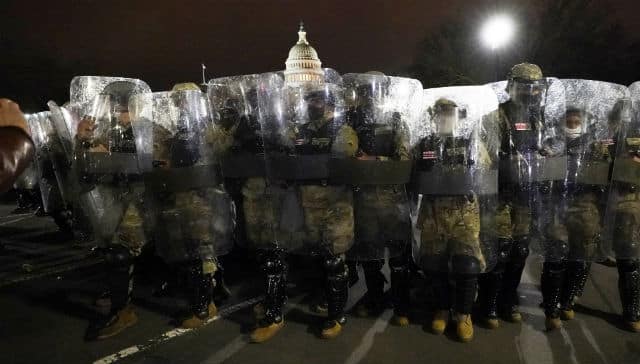
The National Guard was just the beginning.
One year after President Trump deployed military troops to the nation’s capital, we find ourselves navigating a posse comitatus presidency in which the visual trappings of martial law are the norm, not the exception.
When Trump declared a supposed “crime emergency” in Washington, D.C., called in the National Guard, unleashed federal law enforcement throughout the city and temporarily seized control of the Metropolitan Police Department, we warned that the police state had found a new playbook: martial law, one city at a time.
The emergency is long over.
The troops never left.
Now the Pentagon says the National Guard deployment can remain in Washington until January 20, 2029—the final day of Trump’s presidency—unless Trump himself decides to terminate it sooner.
That is not an emergency response.
That is a standing military presence.
The government expects American taxpayers to spend another $1.4 billion maintaining it.
What began in August 2025 as an extraordinary response to a supposedly “extraordinary” crime crisis has become part of the architecture of everyday government.
Thousands of military personnel have remained deployed in the capital. Armed Guard members patrol streets, Metro stations, parks and tourist attractions. They have supported arrest operations. They have responded to medical calls. They have shoveled snow. They have removed trash and weeds and participated in “beautification” projects.
During the nation’s 250th anniversary celebrations, their numbers swelled to roughly 5,000.
Now the Trump administration is making plans to build “apartment-style lodging units” for the troops stationed in DC at a cost of $292 million to the taxpayer.
That is in addition to the $1 billion Trump wants for White House security upgrades, including a new ballroom topped by a proposed “droneport” that he has envisioned as a rooftop staging ground for military trucks, personnel and battlefield weaponry.
The symbolism is hard to miss.
This is how emergency power grabs become entrenched and permanent.
We do not have to speculate about where this leads.
We have already begun to see it.
When Trump federalized California National Guard troops and deployed Marines to Los Angeles during protests against immigration raids in 2025, a federal judge subsequently ruled that the administration had violated the Posse Comitatus Act by using military personnel to carry out civilian law-enforcement functions.
In his ruling, U.S. District Judge Charles Breyer warned that the administration appeared intent on creating something the Constitution was never meant to tolerate: a national police force with the president effectively serving as its chief.
That description increasingly fits the Trump presidency.
Trump is not merely claiming authority as commander-in-chief over America’s military. He is increasingly behaving as though being commander-in-chief makes him commander-in-chief of the American people.
It is a profound, constitutional difference.
A president governs citizens. A commander commands troops. A police chief directs law enforcement. A king commands subjects.
The danger begins when one man starts behaving as though all four offices belong to him.
Trump has increasingly embraced his own digital version of that authoritarian theater.
Just days ago, he circulated an AI-generated image depicting himself in an elaborate military uniform alongside Generals George S. Patton and Douglas MacArthur, laden with decorations and medals he never earned for military service he never performed.
It would be tempting to dismiss such images as narcissistic internet trolling.
That would be a mistake.
This is how Trump sees presidential power: as authoritarian power backed by military force.
The National Guard deployment in Washington is the physical embodiment of that worldview.
Armed soldiers are stationed around the monuments. They guard the perimeter of the Reflecting Pool. They patrol the National Mall. They appear at Metro stations, tourist sites and public parks.
Their presence is no longer presented as extraordinary. That is precisely the problem.
A free people should never become accustomed to soldiers policing their streets. Once that sight becomes ordinary, the constitutional barrier separating military power from civilian government has already begun to collapse.
And Washington is the ideal laboratory as a testing ground.
What can be normalized in the capital today can be demanded elsewhere tomorrow.
Indeed, we have already seen repeated attempts to expand the model beyond Washington: federalized National Guard troops in Los Angeles, attempted Guard deployments elsewhere, federal agents sent into cities, immigration enforcement increasingly carried out with military equipment and rhetoric, and presidential threats to “liberate” jurisdictions whose elected leaders resist federal policy.
Not every deployment has survived judicial scrutiny.
That is encouraging, but the real danger is larger than whether any particular deployment is eventually blocked by a court. The danger is that the country is being conditioned to accept the premise behind all of them: that whenever the president declares a city dangerous, disorderly, disobedient or insufficiently cooperative, military force is an appropriate instrument of domestic government.
That premise should frighten conservatives and liberals alike.
This is not fundamentally a question of whether you trust Donald Trump. It is whether you trust any president with a standing military force at his disposal for domestic political purposes.
The Constitution was not written on the assumption that good people would always hold power. It was written because power attracts abuse.
Every authority surrendered to Trump becomes an authority available to his successors. Every emergency power normalized now becomes part of the presidential toolbox later. Every constitutional boundary ignored because the “right” president is violating it becomes one less boundary available when the “wrong” president takes office.
This is how republics lose their safeguards: One deployment. One emergency. One executive order. One city. One exception at a time.
As we have warned repeatedly in Battlefield America: The War on the American People and its fictional counterpart The Erik Blair Diaries, that is how constitutional lines disappear—not because someone formally erases them, but because enough people stop noticing when they are crossed.
The Founders feared standing armies because they understood that military power and political liberty exist in constant tension.
The Posse Comitatus Act reflects that same hard-earned wisdom.
Soldiers defend the country. Police enforce the law. Presidents execute the laws within constitutional limits.
Citizens are not troops. Cities are not battlefields. Political opponents are not enemy combatants. And the president is not the American people’s commander-in-chief. He is commander-in-chief of the armed forces.
That distinction may be one of the few things standing between a constitutional republic and a police state presidency.
We had better remember it before the exception becomes the rule—and the troops never go home.
Reprinted with permission from the Rutherford Institute.
