

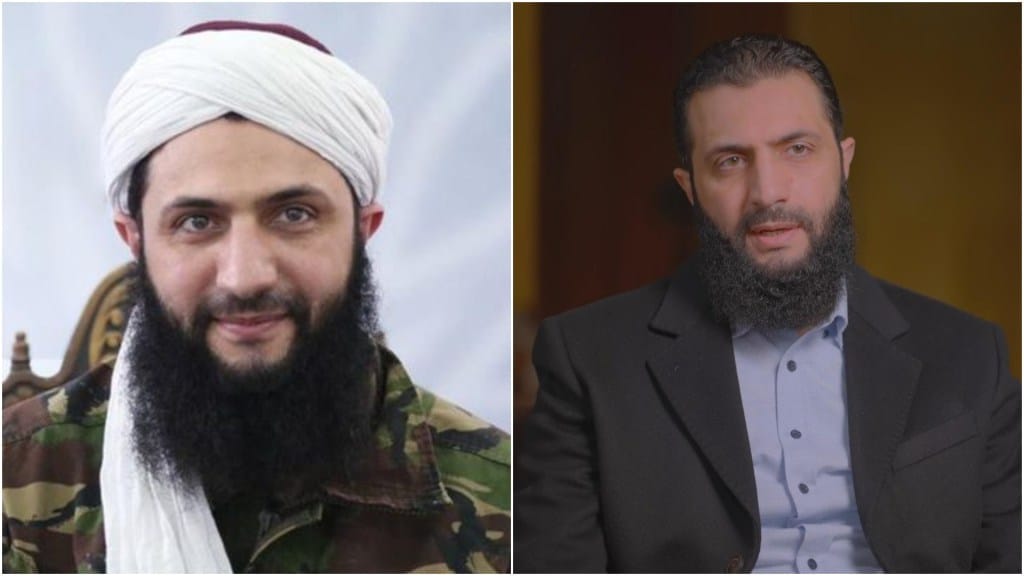
When Judge Andrew Napolitano asked me on his show how Syria ended up with Abu Mohammed al-Jolani as its “president,” I could almost hear the cognitive dissonance on the other side of the screen. How does a man who was once the emir of al-Qaeda in Syria, a co-founder of ISIS by any reasonable historical reading of his trajectory, become Washington’s chosen man in Damascus?
For me, the answer is not a mystery. It is the logical end of a dirty war that began not with Syrian protesters in 2011, but in an American-run prison camp in Iraq years earlier.
And if anyone still suspected this was “just a conspiracy theory,” a former CIA officer – John Kiriakou, who went to prison for exposing CIA torture – has now said publicly what many of us have long argued: Jolani is, in all likelihood, a CIA asset.
Let’s start with the timeline, because the timeline alone already screams “intelligence operation.”
Abu Mohammed al-Jolani was in a CIA-run prison in Iraq – Camp Bucca – alongside another familiar name: Abu Bakr al-Baghdadi. Both men were released in early 2011. “Coincidentally,” that is exactly when the regime-change war in Syria begins. Within weeks, Baghdadi goes on to lead what becomes ISIS, and Jolani crosses into Syria to found Jabhat al-Nusra – officially al-Qaeda’s franchise in my country.
Washington designates Nusra a terrorist organization. The UN follows suit. On paper, Jolani is the enemy. The State Department even slaps a $10 million bounty on his head.
But bounties are cheap. Cruise missiles are expensive. And for over a decade, while the US flattened cities in Iraq and Syria allegedly to fight “terrorism,” it somehow never found the time, or the coordinates, to seriously target Jolani or his core command structure, even though he controlled large swaths of Syrian territory from Aleppo countryside all the way to Idlib.
Why? Because Jolani and his men were fighting the one government Washington had already decided must go: the Syrian state under Bashar al-Assad.
This is where Operation Timber Sycamore comes in: a multi-billion-dollar CIA covert program that funneled weapons, money, and training to so-called “rebels” in Syria. They were sold to Western audiences as “moderate opposition.” On the ground, those moderates were a disappearing species. What existed in reality were hardline Salafi-jihadist factions, with Nusra at the top of the food chain.
The Free Syrian Army (FSA) was the mask, the logo on the paperwork, the brand name you could sell to Congress and CNN. The real muscle on the ground was Jolani’s men and other takfiri groups, who did the actual fighting, took the actual territory, and imposed their version of rule.
Weapons went “to the moderates.” The moderates magically handed them to al-Qaeda. Everyone in Washington pretended to be surprised. No one stopped the pipeline.
Over the years, the mask slipped. US officials themselves began to speak of Jolani as something more than just a former enemy.
James Jeffrey, Washington’s former envoy to Syria, openly called Jolani “an asset” for US strategy – not my word, his. Robert Ford, the former US ambassador to Syria, has publicly admitted that he personally worked with Jolani to “take him out of the world of terrorism” and polish him into a politician.
Think about what that means: the same US that claims to be fighting an endless war against al-Qaeda quietly devotes diplomatic energy to rehabilitating the Syrian branch of al-Qaeda into a partner, a useful strongman, a future head of state.
I said on the show, and I repeat it here: I believe Jolani was recruited in Camp Bucca. The timeline makes no sense otherwise. You don’t walk out of an American-run prison and, weeks later, magically have the networks, the money, the arms, and the logistical capacity to found al-Qaeda in Syria, right at the moment when Washington and its allies need a battering ram against Damascus.
Recently, former CIA director David Petraeus even sat with Jolani and told him, “Your success is our success.” What more do people need? A signed employment contract? But let’s assume, for a moment, that you still think this is a stretch.
Enter John Kiriakou.
Kiriakou is not a YouTuber chasing clicks. He is a former CIA officer who went to prison because he exposed the torture program and named the torturers. His loyalty is clearly not to the Agency’s PR department.
Recently, on Unfettered Speech, he described the Jolani situation bluntly. Here is the essence of what he said, which Judge Napolitano played on air:
-The “new president” of Syria is a former al-Qaeda member and a co-founder of ISIS.
-This same man is welcomed at the White House.
-Senior US officials, including the Assistant Secretary of State for the Near East, travel to meet him.
-President Trump suddenly lifts sanctions on Syria as Jolani consolidates power, prompting Syrians – desperate and exhausted – to dance in the streets.
The only thing that makes sense is that Jolani is a CIA asset, per Kiriakou.
When a former CIA officer who has already sacrificed his career and freedom to tell the truth looks at the pattern and says, “This is our guy,” it is not a conspiracy theory anymore.
Now, you may ask, why would the United States and its allies back such a man? The answer lies in what Syria used to be, and what it has now been turned into.
Before this war, Syria, for all its flaws, was a horizontally integrated state. People identified themselves as Syrian first and then Armenian, Druze, Christian, Alawite, Sunni, Shi’a, Kurdish, and so on. The state’s foreign policy aligned with Iran and Hezbollah, supported Palestinian factions, and kept a real deterrent posture toward Israel.
For Washington and Tel Aviv, this was unacceptable.
The goal was not “democracy”; that word is just wrapping paper. The real objective was to remove a government allied with Iran and replace it with a fragmented landscape: a weak central authority in Damascus, surrounded by sectarian cantons and warlord enclaves, all dependent on foreign patrons.
Jolani is perfect for this role.
For Israel, he brings vertical division. A man with a long al-Qaeda pedigree ruling Syria is a nightmare for minorities: Christians, Druze, Alawites, Shi’a, many Kurds, and other smaller communities. They will not accept al-Qaeda rule. So they retreat into their own militias, their own cantons, their own de facto mini-states, exactly in line with old Israeli strategic doctrines like the Yinon Plan, which openly advocated fragmenting neighboring states along sectarian lines.
On the ground, we already see it:
-Druze militias running their own affairs in the south with quiet Israeli backing.
-Kurdish forces in the northeast under US protection, managing their own autonomous zone.
-Alawites discussing an autonomous coastal enclave.
-Christians living in silence and fear.
You don’t need formal borders on a map to balkanize a country. When I, as a Syrian of Armenian origin, stop thinking of myself as Syrian first and start thinking purely as Armenian, when I instinctively fear my neighbor because he is from another sect, the balkanization has already happened in the mind.
For Washington, Jolani is equally “useful.” He has promised to normalize relations with Israel, to open Syria’s markets to Western capital, and to hand over the country’s resources from the hydrocarbons east of the Euphrates to the gas fields under the Mediterranean to American and allied companies.
A 24-million-person country reduced to a reconstruction market: $300 billion worth of contracts, infrastructure projects, and “investments.” But for investors to feel safe, they need a strongman in Damascus who can project the illusion of stability while remaining utterly dependent on foreign protection.
That strongman, in their design, is Abu Mohammed al-Jolani.
But Jolani is not acting alone. Around him is a constellation of Western intelligence veterans and “conflict resolution” NGOs acting as intermediaries.
British MI6 circles, under figures like Jonathan Powell – former chief of staff to Tony Blair – are central in managing this process. Powell runs an organization called Inter Mediate, which specializes in “talking to armed groups.” Behind the humanitarian language lies political engineering.
One of Inter Mediate’s operatives, a woman named Clare Haigh, is now said to have an office inside the Syrian presidential palace, advising Jolani on how to talk, how to dress, how to handle journalists, how to sell himself as a reformed jihadist turned statesman.
And then there is Qatar. Ahmed Zaidan – once Osama bin Laden’s favorite journalist, photographed sipping tea with him and broadcasting his tapes on Al Jazeera – is now a personal adviser to Jolani.
Make it make sense.
An al-Qaeda emir, handled by US and British intelligence veterans, advised by bin Laden’s favorite media man, massaged by Western PR consultants, welcomed in Washington, and crowned in Damascus as “president.” If you wrote this as fiction, an editor would tell you it’s too on the nose.
Since Jolani took power through an international and regional deal that pushed Assad aside, over 11,000 people have been killed. Many of them are from the very minorities the West loves to mention in speeches but abandons in practice.
Videos circulate of his fighters asking terrified villagers at gunpoint, “Are you Muslim or not?” and executing those who give the “wrong” answer, including Druze and Alawites who are not recognized as “true Muslims” by their extremist ideology.
Christians, who had already suffered massive emigration between 2011 and 2024, are being squeezed further. They have no organized armed force, no foreign sponsor. They are expected either to live under the mercy of an al-Qaeda-bred regime or to leave the land of their ancestors.
This is what Washington’s “asset management” looks like in human terms.
If you are an American reading this, you might be tempted to say: “This cannot be. My government would never knowingly empower al-Qaeda.”
But it already has, repeatedly. From Afghanistan in the 1980s, when US intelligence backed the Mujahideen (and, indirectly, their Arab foreign fighter allies), to Libya and Syria in the last decade, where jihadist factions were instrumentalized against secular or nationalist governments, the pattern is clear.
The names and acronyms change. The logic does not.
The same establishment that lectures the world on “democracy” and “human rights” is perfectly willing to install a man like Jolani as the ruler of one of the oldest civilizations on earth, as long as he delivers strategic gains:
-breaking the Iran–Syria–Hezbollah axis;
-fragmenting Syria into weak, controllable pieces;
-opening its resources and markets to Western and Gulf capital;
-and giving Israel unprecedented strategic depth and security.
Everything else – the massacres, the ethnic cleansing, the collapse of national identity, the destruction of ancient communities – is treated as collateral damage.
I am often asked what Syria will look like in five or ten years. I wish I could answer with optimism. Right now, the forces pushing to turn my country into a permanent vassal state – ruled by a former al-Qaeda emir, policed by foreign intelligence, exploited by foreign capital – are incredibly strong.
But nothing in this region is permanent. People who come to power by cutting off other people’s heads often lose their own. If there are still sane voices left in Western politics – people like Tulsi Gabbard, whom I mentioned on air – they must at least recognize this insanity: backing an al-Qaeda emir as “our man in Damascus” is not just immoral; it is ultimately self-destructive.
Syria does not need Jolani. The West does not need Jolani. There are Syrians who can have friendly relations with the United States without being former al-Qaeda commanders, without murdering their own people, without turning an ancient nation into a laboratory for extremist social engineering.
The question is not whether such alternatives exist. They do.
The question is whether Washington and its allies want a sovereign, stable Syria, or whether they prefer a shattered, cantonized carcass kept alive just enough for the next “asset” to feed on.
A version of this article first appeared on X.
