
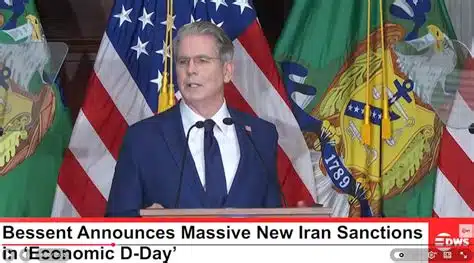
There was one sentence in Scott Bessent’s Monday sanctions announcement that gave the whole game away. Anyone who launders money for the Iranian regime, the Treasury Secretary warned, “will be removed from the US dollar system.” He meant it as a threat of annihilation. It is, instead, a confession of the policy’s central weakness. The entire architecture of what Bessent has branded “Operation Economic Outcast” rests on a single assumption — that Iran and its trading partners need the U.S. dollar. They increasingly do not. And a threat to bar someone from the dollar system means nothing to a trade that has already walked out of it and into the Chinese yuan.
What Bessent actually announced
Strip away the “economic D-Day” theatrics and the substance is a secondary-sanctions framework: the United States threatens to punish any country or entity that refuses to sever economic ties with Iran, expands the categories of activity exposed to those secondary sanctions into five new fields — digital assets, technology, gold, aviation, and shipping — and designates roughly sixty individuals, entities, and vessels tied to nuclear and missile procurement, cyber operations, and oil smuggling. The mechanism of pain, in every case, is the same: exclusion from the dollar-based financial system that Washington polices through its control of dollar clearing, SWIFT messaging, and correspondent banking.
That is a devastating weapon against anyone who lives inside the dollar system. It is close to irrelevant against those who have deliberately built their most important trade outside it. And Iran’s lifeline — the oil trade with China — is now largely outside it.
The trade that runs on yuan
Follow the barrels. China is now the buyer of over 80 percent of Iran’s seaborne crude exports. Iran is shipping somewhere around 1.65 to 1.8 million barrels a day, almost all of it to the independent “teapot” refiners of Shandong, moved by a shadow fleet of more than 350 tankers using ship-to-ship transfers off Malaysia, Singapore, and the Sea of Oman, the cargoes routinely rebranded as Malaysian or Omani. And critically, the money for it increasingly does not move in dollars. Payment flows in yuan, routed through small Chinese banks and Hong Kong trading shells, settled in a growing volume of renminbi that bypasses the dollar clearing system entirely.
The plumbing for this is China’s Cross-Border Interbank Payment System, CIPS — the settlement network the People’s Bank of China launched in 2015 precisely to clear cross-border yuan transactions without touching the Western financial architecture. Its use has surged in lockstep with the war. CIPS processed on the order of $214 billion in March 2026, hit a single-day record of 1.22 trillion yuan — roughly $178 billion — across nearly 42,000 transactions, and saw its average daily value jump about 50 percent from February to March, a spike analysts tied directly to the Iran conflict and rising yuan demand in oil trade. More than five thousand institutions are now connected. These channels allow settlement without any intermediary US bank in the chain — which is the entire point.
Nor is this confined to China. Even Indian refiners buying rare cargoes of Iranian oil have settled the payments in yuan, routed through the Shanghai branch of an Indian bank, because Iran wants a currency that sidesteps the dollar sanctions channel. Iran’s Revolutionary Guard has reportedly begun demanding yuan or cryptocurrency for oil transactions outright. When Bessent adds “digital assets” and “gold” to his sanctions categories, he is chasing evasion routes Iran is already using by design, through a shadow system purpose-built to be untraceable.
You cannot freeze a yuan payment out of a dollar system it never enters. That is not a loophole in Bessent’s plan. It is the plan’s foundation, missing.
The market already delivered its verdict
The most eloquent judgment on these sanctions came not from a pundit but from the oil market itself. If traders believed Bessent’s “economic onslaught” would actually choke off Iranian barrels, crude would have spiked on the announcement. It did the opposite. Brent fell about 2.3 percent on August 24, sliding below $92, as investors concluded the measures were unlikely to remove Iranian oil from the market. A sanctions package advertised as an economic D-Day was met by the market marking the price of oil down. The traders who move real money on real supply read the announcement for exactly what it was: sound and fury aimed at a target the dollar can no longer reach.
The one tooth Bessent won’t bare
There is precisely one measure that could actually bite the yuan trade: sanctioning the major Chinese banks and the CIPS architecture that clear it — cutting large Chinese financial institutions out of the dollar system and forcing Beijing to choose. And that is the step Bessent, once again, announced but did not take. He warned that at least one major financial institution could face sanctions this week, and said China would not be exempt. A threat, not an action — the same threat that has hovered over this campaign for months and never descends, because executing it means a financial rupture with Beijing on the eve of a planned Trump-Xi meeting, and an oil-price shock Washington cannot afford heading into the midterms.
And even if he pulled that trigger, the trade is engineered to survive it. The yuan payments already move through small Chinese banks and Hong Kong front companies precisely so that the large, dollar-exposed institutions stay clean and the flow continues if a big bank is hit. The system was designed by people who assumed Washington would eventually come for it. Bessent is threatening to breach a wall its builders reinforced years ago.
Ten years of sanctions, and a larger economy
Step back from Monday’s announcement and ask the longer question: what has a decade of sanctions actually done to the size of Iran’s economy? Measured properly, it has grown.
The measure matters, because there are two ways to size an economy and here they tell opposite stories. In nominal dollars — the plane on which sanctions operate — Iran looks devastated: its dollar GDP is around $300 billion in 2026, and dollar income per head has been falling fast, because the rial has been pulverized and everything Iranian looks cheap when priced in a currency Iranians increasingly cannot obtain. But nominal-dollar GDP largely measures the exchange rate, not the economy. Measured by purchasing power parity — which values what Iran actually produces at the prices Iranians actually pay, stripping out the collapsed currency — Iran’s GDP has risen from roughly $1.4 trillion in 2015, when the JCPOA-era sanctions architecture was in force, to about $2.18 trillion in 2026, by the IMF’s reckoning the world’s twenty-third-largest economy. That is an expansion of more than fifty percent over the same decade of “maximum pressure” that was supposed to break it.
The caveat belongs in plain sight, not buried: part of that gain is simply more Iranians — the population has grown by roughly a sixth since 2015 — so per-capita output has risen far more modestly, and none of it means Iranian households feel richer, with inflation running near forty percent and the currency in ruins. Growth of the economy is not prosperity for the family. But that is a different claim from the one that matters for sanctions policy. A pressure campaign that can wreck a currency and still not shrink real output is a campaign that produces hardship without submission. Iran has now demonstrated exactly that across two sanctions architectures — the JCPOA snapback and its “maximum pressure” successors — and ten years of data. Bessent is adding a chapter to a book whose ending is already written.
The honest limits
This is a dollar bypass, not the death of the dollar. The greenback still makes up around 57 percent of global foreign-exchange reserves against roughly 2 percent for the yuan, and only a low single-digit share of cross-border trade settles in renminbi; CIPS remains far smaller than the SWIFT-and-CHIPS system it shadows. The claim here is narrow and it is enough: a determined seller like Iran, with a willing Chinese counterparty, can route its oil revenue around the dollar — not that the world has.
Nor are the sanctions literally costless to Tehran. The friction of operating in the shadows is real: Iran sells its crude at discounts of $14 to $17 a barrel below Brent, up from $8 in 2023, precisely because sanctions raise the risk and complexity of buying it; its fiscal break-even sits far above the price it actually realizes, and the rial has lost most of its value. Bessent’s measures will add a little more friction at the margin — another turn of the screw on the discount, another few front companies to replace.
But friction is not a chokehold, and a poorer Iran is not a compliant one. The sanctions make Iran’s oil cheaper and its economy more strained; they do not, and cannot, sever the yuan-denominated artery to China that keeps the oil flowing and the regime funded. That artery is the thing Bessent promised to cut, and it is the one thing his announcement does not touch.
Bessent has threatened to expel Iran and its partners from a financial system Iran has spent years leaving. The dollar guillotine is real, and it still falls with terrible force on anyone standing beneath it — but Iran’s oil trade stepped off the block and into the yuan, and every fresh round of dollar-weaponization only sharpens the incentive for others to follow. The measures announced Monday will generate headlines, a few dozen designations, and a marginal widening of the discount China already enjoys on Iranian crude. What they will not do is the thing they were sold to do: collapse Iran’s options and force it to heel. You cannot sever a lifeline that no longer runs through your hands. Bessent is standing guard at a door Iran walked out of a long time ago, threatening to lock it.
Reprinted with permission from Sonar21.
