

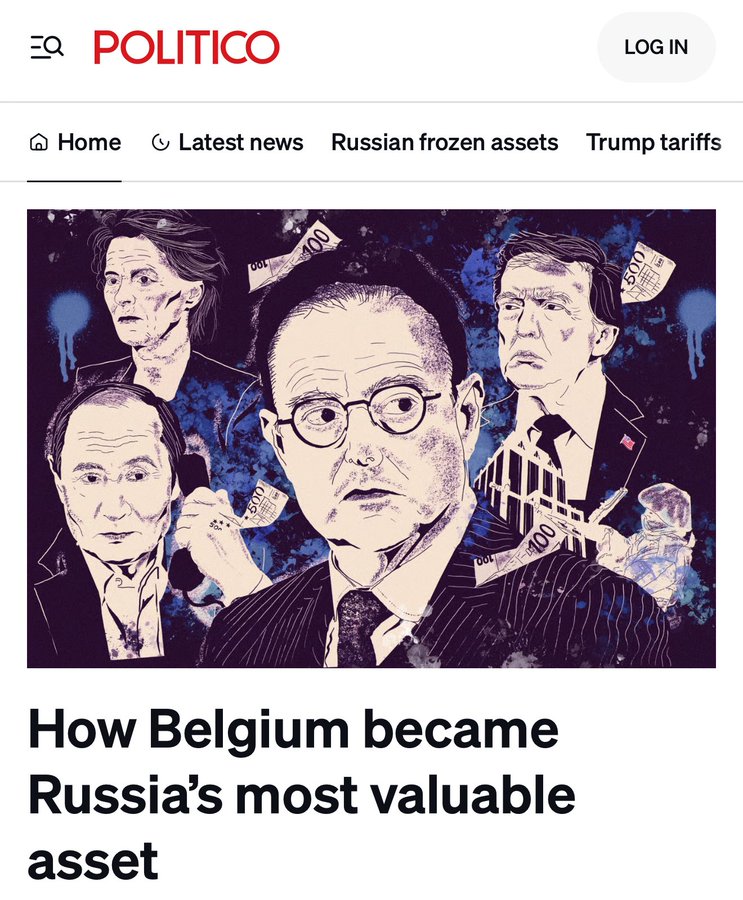
The great farce of late-imperial Europe is that every time Brussels stumbles into another historic blunder of its own making, it immediately searches for a foreign hand to blame. And so the EU’s court chronicler, Politico, delivers its latest fever dream: that Belgium, the most indecisive, over-medicated country in the bloc, has somehow transformed into “Russia’s most valuable asset.” In reality, the only asset Russia needed was the EU’s own arrogance.
Belgium merely did the unthinkable, it told the truth.
What Politico dresses up as geopolitical intrigue is actually a confession of EU derangement. The EU are trying to engineer the largest state-sanctioned theft of sovereign wealth in modern history, a direct raid on the Russian Central Bank’s reserves and expected applause, unity, and moral ecstasy. Instead, Belgium asked the only sane question left in Europe: “Are you all completely out of your minds?” For this, Politico paints De Wever as eccentric, impulsive, unstable, the same labels always deployed when someone refuses to bow to the imperial autopilot. But the deeper scandal is that Brussels expected him to sign off on detonating the post-war financial order for the sake of one more photo-op with Zelensky.
Politico can hide behind metaphors of summit dinners and langoustines, but the legal reality is brutal: raiding another nation’s central bank is not a policy disagreement. It is a declaration of financial war on the entire world. It would obliterate sovereign immunity, destroy the neutrality of reserve holdings, and instantly signal to the global South that their assets in EU banks are hostage to EU’s emotional spasms. One act, one reckless stroke of a pen, and the euro collapses as a safe currency, capital flees to Asia, and the West loses its last functional pillar of power. Belgium saw the cliff’s edge, Brussels mistook it for a (perverse) moral leap of faith.
Politico’s narrative stumbles further when it pretends the only danger lies in Moscow’s retaliation. It does not. Russia’s symmetric countermeasures are well-known, lawful, and devastating: nationalization of Western corporate assets, seizure of industrial infrastructure, liquidation of bond holdings, and the dismantling of Western financial footprints inside Russia. The value of Western assets exposed inside the Russian Federation rivals what sits in Euroclear. Brussels knows this. Euroclear knows this. Investors know this. Only the EU pretends the ledger is irrelevant. But the real threat is not Russia’s response , it is the irreversible collapse of trust in Western custodianship. Once the EU steals central bank reserves, no nation with self-respect will ever again store wealth in Europe. The theft of Russian reserves would be remembered not as an isolated act, but as the day the West proved it cannot be trusted with global money, let alone soverign assets.
This is the part Politico is terrified to articulate. Belgium wasn’t protecting Russia. Belgium is trying to protect the very system the EU purports to defend. Yet instead of portraying De Wever as the only adult in the room, Politico stages a melodrama about a Flemish nationalist gone rogue, supposedly spoiling the EU’s grandiose plan to hurl another €140 billion onto the Ukrainian funeral pyre. The reality is simpler, Belgium refused to mortgage its own future so Europe could continue its cosplay as a geopolitical superpower utterly detached from material reality. The EU elite wanted to play empire with someone else’s risk. Belgium refused to be the guarantor of their delusion.
What makes Politico’s narrative even more absurd is that it accidentally reveals the deeper rot, Europe’s elite caste are incapable of unity, incapable of strategic thought, incapable of honesty. Merz shoots from the hip. Von der Leyen improvises legal fantasies. Orbán holds a veto the size of a continental fault line. Trump instinctively knows he needs an offramp via peace talks and is happy to download project Ukraine’s corpse along with the humiliation onto Western Europe. Zelensky arrives in Brussels begging for cash while European governments fight over whether the money should be spent on their own weapons factories. This is not a union. This is a collective suicide pact.
And through all this chaos, Politico clings to the illusion that Russia must somehow be “laughing.” But Russia isn’t laughing. Russia is watching. Watching as Europe destroys its own energy security, its own industrial base, its own strategic autonomy, its own diplomatic credibility, its own financial reputation, and finally — with this proposed asset raid — the very legal foundations of the Western economic system. If Moscow appears calm, it is because it doesn’t need to act. Europe is demolishing itself at a pace Russia could never have engineered.
Belgium’s “no” was not an act of betrayal. It was the last flicker of European rationality. The EU’s hysteria and psychosis, not Russia, created the crisis. Europe is trying to violate international law, sabotage its own financial institutions, and torch what remains of the bygone postwar order to salvage the illusion of a war it has already lost. Belgium simply refused to join the ritual suicide.
So let us rewrite Politico’s headline as history will record it: “How the EU Became Russia’s Greatest Strategic Gift.” Not because Russia manipulated Europe, but because Europe manipulated itself, into hysteria, into decay, into legal nihilism, into economic ruin. Belgium didn’t hand Russia an asset. It denied the EU the final act of self-destruction… for now.
The tragic irony of the entire Politico piece is that its authors still cling to the fantasy that Europe can recover simply by shaming Belgium into compliance. But history will not be kind to this moment. When future scholars study the collapse of the Western financial empire, this attempted seizure of Russian assets and Belgium’s lonely refusal, will stand as the point where the veil fell, revealing a Europe that could no longer distinguish faux moral posturing from strategic insanity.
Belgium didn’t break with Europe, it broke with Europe’s delusions. The EU convinced itself that tearing down the last pillars of the post-war order was an act of courage. Belgium saw it for what it was, a death rite dressed as morality. And when this era ends, when capitals move eastward, when trust evaporates, when the euro cracks under the weight of its own blind arrogance, historians will look back on this moment. They will not ask why Belgium said no. They will ask why Europe said yes.
Reprinted with permission from X.
