

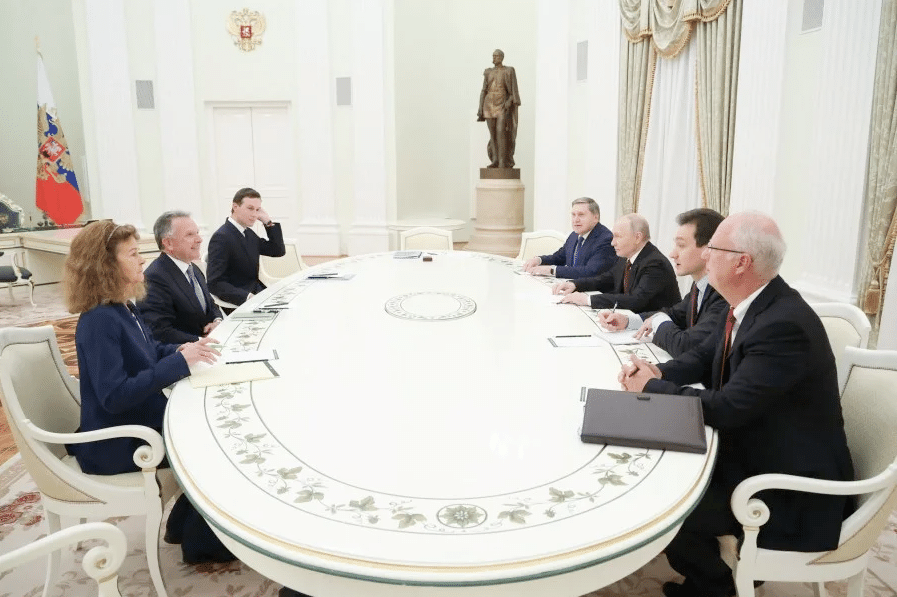
U.S. President Donald Trump’s special envoy, Steve Witkoff and Trump’s son-in-law, Jared Kushner met with Russian President Vladimir Putin at the Kremlin in Moscow. The approximately five-hour session focused on a revised U.S. peace proposal aimed at ending Russia’s nearly four-year war in Ukraine. This marked Witkoff’s sixth meeting with Putin in 2025 and Kushner’s first in-person involvement in these talks. The U.S. delegation arrived directly from recent negotiations with Ukrainian officials in Miami and Paris, where the peace plan was refined from 28 to 19 points.
The media is reporting that the core agenda was the updated U.S. peace framework, which emphasizes:
- A potential ceasefire and de facto border recognition, possibly involving Ukrainian concessions in the Donbas region to meet Russia’s territorial demands.
- Security guarantees for Ukraine, coordinated with European allies like France.
- Broader steps for implementation, including front-line adjustments and restrictions on Ukraine’s military capabilities.
Putin reportedly agreed with some elements of the proposal but reiterated Russia’s non-negotiable positions, including full control over annexed territories and limits on NATO expansion. The U.S. side pushed for Putin to soften these demands in exchange for ending hostilities, but no new wording or provisions were finalized.
Kremlin aide Yuri Ushakov described the talks as “useful” and noted productive exchanges on substantive issues, but emphasized that “no compromise plan has been found yet” and “a lot of work remains.” Russian state media and envoy Dmitriev called the session “productive,” but there were no agreements on specific concessions, a ceasefire timeline, or a follow-up summit between Putin and Trump (potentially slated for April–June 2026).
But what was the real purpose of this meeting? Speaking to reporters in Bishkek, in the Central Asian republic of Kyrgyzstan last Thursday, Putin explained how negotiations would be handled. During that press conference, Putin said that Foreign Minister Sergey Lavrov is responsible for handling contacts and negotiations on possible terms to end the war in Ukraine, and that he relies on Lavrov’s reports from these talks while avoiding public discussion of specific proposals. In his latest comments around US–Russia contacts on Ukraine, Putin indicated that the negotiation process is being conducted through professional channels, explicitly pointing to Lavrov and the Foreign Ministry as those leading the work on possible peace arrangements. He stressed that he is regularly briefed by Lavrov on these discussions, including on US-drafted peace ideas that Moscow says draw heavily on earlier Russian proposals.
While Putin was meeting with Witkoff and Kushner, Sergei Lavrov held warm bilateral talks with China’s Foreign Minister Wang Yi. Lavrov’s absence from the Witkoff/Kushner meeting was a clear signal from Russia that the foundation for actual negotiations was still not in place. Putin’s goal was to explain — politely and firmly — what Russia’s fundamental positions are with respect to settling the war in Ukraine. I am certain that he presented, again, the same points he laid out on June 14, 2024.
The ball is now in Donald Trump’s court. Witkoff and Kushner, after speaking on Wednesday with Zelensky in Ireland, will return to Washington and explain to President Trump Putin’s firm conditions that must be agreed to before the actual negotiations — with Lavrov and Rubio sitting down, accompanied by their respective delegations — can begin.
This meeting is not the beginning of the end… rather, I think it marks the end of the beginning. It is up to President Trump to agree to Russia’s terms and dispatch Secretary of State Marco Rubio to make the deal with Lavrov.
Reprinted with permission from Sonar21.
