
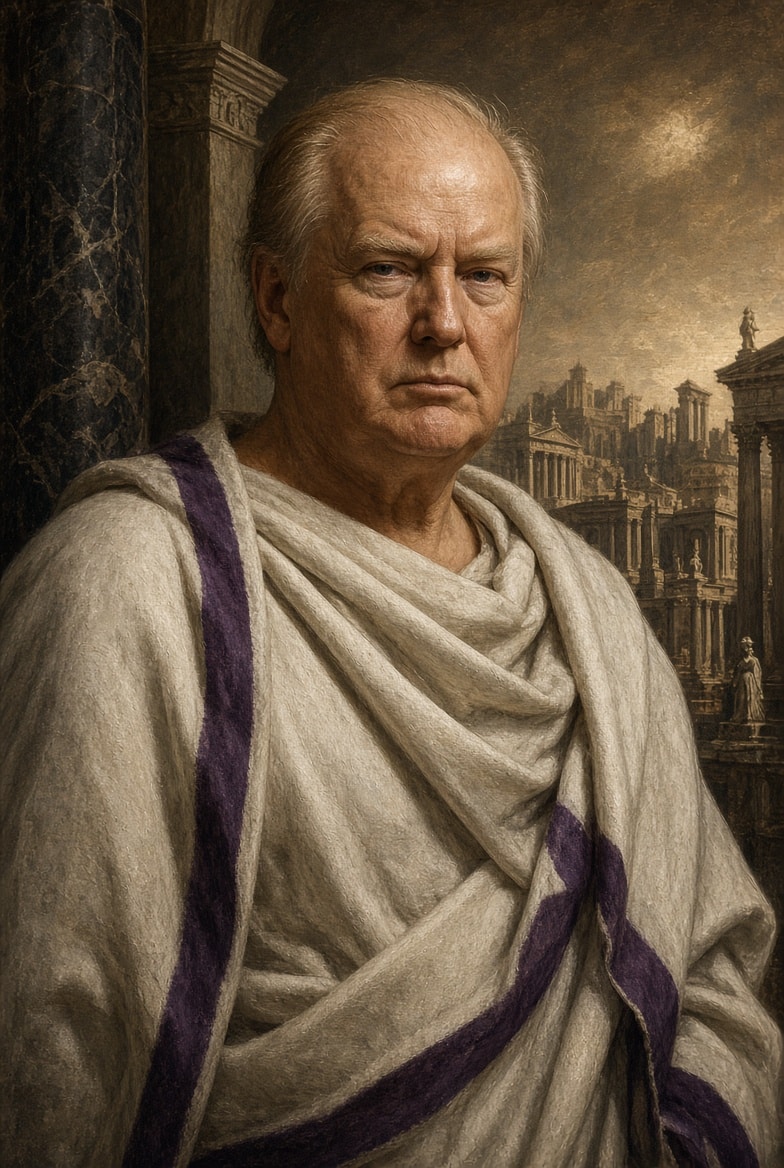
Even the richest man in Rome was relegated to the shadows of his contemporaries. Before allying with Pompey and Caeser to form the First Triumvirate, Marcus Licinius Crassus amassed his wealth through shady real estate deals. Often bargaining for pennies on the dollar (or asses on the sestertius), victims of house fires were presented with the choice to sell quickly or watch their future go up in flames. Before, of course, Crassus sent in his private fire brigade to extinguish the blaze lest it engulf his new assets. Though he owned slaves, artisans, silver mines, and land while sitting comfortably atop his third of the Roman Republic in Syria, Crassus lacked the battle-hardened glory of his cohorts which would secure his place in the annals of history.
The historian Plutarch might as well have been describing Donald Trump when he wrote that the Roman general “was lacking in experience, and his achievements were robbed of their favour by the innate curses of avarice and meanness which beset him.” Like Crassus before him, our unscrupulous real estate mogul has sought distinction while imperiling the coalition that brought him to power. And like Crassus, his legacy of defeat is being administered by the Iranians amid an elective crusade.
The two leaders did not go forth without opposition, however. Crassus ignored the pleas of Ateius, who attempted to prevent his departure from the city on the grounds that the campaign was unjust, for the Parthians had not harmed the Roman state. Upon reaching the country with his seven legions of men, commanding general Cassius advised him in vain to garrison his troops while reconnaissance of the enemy could be effectively performed.
Trump, on the other hand, ignored the information relayed to him by his intelligence agencies which continued to confirm that Iran had not broken from the 2003 fatwa against the pursuit of nuclear weapons levied by Supreme Leader Ayatollah Ali Khamenei. The President also dismissed decades worth of wargames conducted by the Pentagon as well as Iranian live fire drills performed just weeks prior to the start of the bombing campaign which showed the closure of the Strait of Hormuz as a predictable outcome. Trump disregarded Iranian missile, drone, and mining capabilities to the detriment of the global economy and supply of sour crude, just as Crassus endangered the stability of the Roman Republic by scoffing at the warnings of Ateius.
Plutarch’s foreboding insights into the psychology of Crassus, writing that he was “most expert in winning over all men by his flatteries; on the other hand, he himself was an easy prey to flattery from anybody,” shouldn’t seem foreign to analysts of President Trump as he surrounds himself with those who would relish in his demise. The Roman general was flattered by the barbarian, Ariamnes, who convinced him to “hasten on before all the king’s forces are concentrated and he has regained his courage.” Leading Crassus and his army into the open plains, where trees and water were scarce, the barbarian taunted the men, before abandoning them as their Armenian allies had.
Trump’s barbarian arrived in the form of a crooked Israeli Prime Minister who lauded the President’s “perfect operation” to kidnap Venezuelan President Nicolás Maduro. Netanyahu assured him that Iran’s ballistic missile program would prove fruitless within weeks and Kurdish fighters would serve as the ground component to US/Israeli air power, securing the Strait and protecting US bases in the region. But just as the Parthian Archers removed their coverings to reveal armored breastplates as they charged toward the Roman invaders, the Islamic Republic of Iran showed their teeth and punched a hole in the regional US power veneer, critically striking advanced radar systems, satellite communication terminals, fuel storage bunkers, and aircraft.
Crassus and Trump alike had bitten off more than they could chew. The Parthians launched volleys of arrows at the hollow square defense formed by the Romans, piercing their armor, pinning their feet to the ground and their arms to their shields. Crassus’ army suspected they could outlast the onslaught and lure them into hand-to-hand combat, but Parthian general, Surena, was more logistically sophisticated than expected, drawing upon hundreds of camels loaded with spare arrows for replenishment. President Trump fell victim to the same hubristic trap, believing his offensive missile attacks could bring down those of the Iranians, while his Patriot, THAAD, and Aegis defensive systems provided the shield needed to force his will upon the defiant nation. Yet weeks and months later it is the US losing mission readiness and credibility among regional allies, while Iran continues to control Hormuz, retaining 75 percent of their mobile missile launchers and 70 percent of their missile inventory according to a US intelligence assessment taken in May.
Now in August, we are hearing stories of severely collapsing morale among those who chose to serve their nation, as their deployments continue to extend past record breaking consecutive days without shore leave. Plutarch writes of Crassus’ pleas for a battle cry among his men only to be met with despondency; “weak, feeble, and uneven was the shout they made, while that which came from the Barbarians was clear and bold.” With one humiliating defeat after another, and personal despair at the realization of his impotence, Crassus died at the hands of a Parthian in the deserts of Carrhae, his head and hand removed, and molten gold poured into his mouth as a symbol of his greed.
Vainglorious attempts to cast his legacy sealed the fate of Crassus and catalyzed the demise of the Roman Republic. Donald Trump seems dead set on succumbing to a similar fate, but what will become of the US empire after he immortalizes himself in the book of fools?
