

Does anyone know where the love of God goes
When the waves turn the minutes to hours?— Gordon Lightfoot (1938-2023)
“The Wreck of the Edmund Fitzgerald”
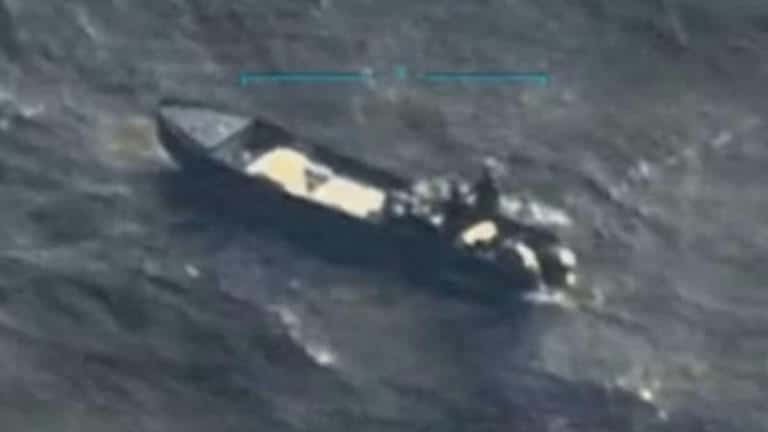
As we learn more about the events on Sept. 2, 2025, in international waters 1,500 miles from the United States, the behavior of the United States military becomes more legally troubling than at first blush. We have learned from members of Congress and others who have seen the videos of the attacks on the speedboat that day that the first strike mainly — but not completely — destroyed the boat and killed 9 of the 11 persons aboard.
The two survivors clung to the wreckage for 45 minutes, during which they frantically waved at what they hoped were American aircraft, expecting to be rescued. This attack was the first of many since ordered by President Donald Trump, and it was done without warning. After the passage of 45 terrifying minutes, three more attacks obliterated the two survivors and their wreckage, for “self-defense,” the White House said.
When two courageous persons privy to all this revealed it two weeks ago to reporters for The Washington Post who corroborated the revelations with five others, the Post published the story. Then, Secretary of Defense Pete Hegseth denied he ordered the survivors killed; it was, he said, “the fog of war.” Then, the White House countermanded that denial. Then, the admiral in charge acknowledged that he ordered the kills pursuant to the secretary’s initial orders.
The military has a duty to rescue the injured and the shipwrecked. And the military has a duty to disregard unlawful orders — a position that Attorney General Pamela Bondi herself argued to the Supreme Court when she was in private practice, and Hegseth himself argued when he was a private citizen.
Not rescuing these survivors was criminal. But the entire killing process is criminal.
Here is the backstory.
The core legal issue here in Hegseth’s fog of fear is whether the president may lawfully order the military to kill noncombatants for law enforcement purposes. The short answer is: NO. The longer answer requires us to delve into the history and nature of the federal government and the purposes of the Constitution.
The federal government is one of limited powers. The powers are delineated in Article I of the Constitution wherein we find 16 grants of power to Congress, plus a catch-all which permits Congress to legislate in areas not specifically found in the 16 but arguably supportive of them.
Nowhere can public safety be found. In fact, the courts have ruled innumerable times that governance over health, safety, welfare and morality — called the “police power” — was and remains reserved to the states. Indeed, the 10th Amendment recites that the powers not granted to the feds are reserved to the people or to the states.
After the Civil War ended and during the period of Reconstruction, federal troops exercised the police power and attempted to govern and even provide safety in the formerly seceding states. Reconstruction ended after 11 years with a number of compromises, one of which is a federal statute that prohibits the use of the military for law enforcement purposes.
This is not a historic anomaly or mere footnote. It is a profound legal commitment to keep troops off American streets and out of the business of domestic law enforcement; and keep the police power local.
When the president takes an oath to uphold the Constitution, he promises to execute his office “faithfully.” James Madison, the scrivener of the Constitution, insisted that the presidential oath be in the Constitution and that the word “faithfully” be in the oath. He knew presidents would be tempted to ignore laws with which they disagreed.
He was right. Such persons are unfit to be president. “Faithfully” in the presidential oath means evenhandedly, irrespective of the president’s personal opinion of the laws. If a president could enforce the laws he liked and disregard those he didn’t like, he’d be violating his oath and veering away from the system of checks and balances Madison so carefully crafted, and toward authoritarianism.
Now back to killing people in speed boats.
Trump claims that the folks in the boats are drug dealers and the drugs are destined for the United States. That is unlikely to be accurate in the case of all the boats destroyed and all the riders killed.
Even if it were true, however, it does not legally justify killing anyone. Neither the military nor domestic law enforcement may lawfully kill nonviolent, noncombatant persons. As horrific as was the experience of those for whom the waves turned the minutes into hours, that is only a small part of the unconstitutional authoritarianism we are witnessing.
The whole program — “kill them all” — is a profound violation of the Fifth Amendment, which the president has sworn to uphold faithfully and which requires a jury trial when the government wants anyone’s life, liberty or property. If the president were really interested in drug interdiction, seizures in US waters and arrests and prosecutions would yield a far better path to the source of the drugs than murdering couriers and destroying any evidence.
The admiral who gave the “kill them all” order was in Florida when he gave the order. The projectiles that struck these boats were dispatched from aircraft that took off from Florida, and the dispatchers — the folks who pulled the triggers (today, pressed the buttons) — were in Florida. No one can seriously argue that they were not subject to the Constitution.
Killing is the most horrific business. It is dangerously becoming normalized due to the demonization of the victims. But killing destroys innocent lives and the values that underlie the Constitution. If the president can demonize those whom he hates and fears, and then kill them in defiance of law and get away with it, of what value are our laws?
To learn more about Judge Andrew Napolitano, visit https://JudgeNap.com.
COPYRIGHT 2025 ANDREW P. NAPOLITANO
DISTRIBUTED BY CREATORS.COM
