

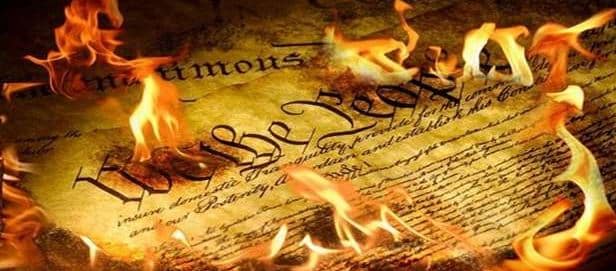
We now live in a nation where constitutional rights exist in theory, not in practice.
Yet what good are rights on paper when every branch of government is allowed to ignore, circumvent, chip away at or hollow them out in practice?
Two hundred and thirty-four years after the ratification of the Bill of Rights on December 15, 1791, the safeguards meant to shield “We the people” from government abuse are barely recognizable.
In ways the Founders could scarcely have imagined—and would never have tolerated—the safeguards meant to restrain government overreach have become little more than empty platitudes.
America’s founders understood that power corrupts and absolute power—especially when it comes to power-hungry governments fixated on amassing institutional power at the expense of individual freedoms—corrupts absolutely. That’s why they insisted on binding down the government “with the chains of the Constitution.”
In 2025, those chains have been cut link by link.
These links were not severed in secret. They snapped under the weight of executive orders issued without congressional authority, judicial doctrines that shield misconduct from accountability, and a Congress that no longer defends its own constitutional prerogatives.
If Americans are finally learning the true significance of constitutional limits, it is because the government keeps violating them—and daring anyone to stop it. Time and again, the message is being drummed into our heads that constitutional limits no longer apply when they inconvenience those in power.
Any government that treats rights as privileges—contingent on economic status, citizenship, race, orientation, religious beliefs, or political alignment—has already abandoned the Bill of Rights.
And a government that does so with the courts’ blessing is not a constitutional republic.
When rights become privileges, what we are left with is a two-tier system of freedom: those afforded the privilege of enjoying their constitutional rights vs. those targeted for exercising those same rights.
The Bill of Rights was intended as a bulwark. Each amendment was drafted as a barrier against a specific form of tyranny.
In 2025, every one of those barriers buckled under the weight of government corruption, political expediency, partisan politics, and institutional neglect.
The following is what it looked like to live without the protections of the Bill of Rights in the American police state.
First Amendment—Speech Without Protection: In 2025, the right to speak freely was not guaranteed—it was conditional.
Second Amendment—The Right to Self-Defense in a Militarized Nation. While the political class fixated on culture-war debates over gun ownership, the government quietly expanded the militarization of policing, federalized National Guard units, and broadened executive authority to deploy armed agents domestically.
Third Amendment—Quartering Without Quarters: The Rise of Domestic Militarization. Although Americans no longer face the literal quartering of soldiers in their homes, the spirit of the Third Amendment—prohibiting the use of the military against the civilian population—has been trampled.
Fourth Amendment—Privacy Without Boundaries. The Framers wrote the Fourth Amendment in response to “general warrants”: broad, suspicionless searches by the British Crown. In 2025, the digital equivalents of general warrants have become routine, executed at the speed of an algorithm and justified by the flimsiest of standards. Americans now live under surveillance so pervasive that privacy survives mostly in legal theory.
Fifth & Sixth Amendments—Due Process Without Process. What we have seen emerge this year is a justice system where the government is accountable only to itself. Due process now bends to government expediency.
Seventh Amendment—Civil Justice Denied by Design. The right to a civil jury trial—already inaccessible for many—continued to erode in 2025, keeping ordinary Americans from ever getting their day in court, while corporations and government agencies enjoy legal shields that no ordinary citizen can penetrate.
Eighth Amendment—Justice Without Humanity. Cruelty, once hidden, has now been codified as policy.
Ninth Amendment—Unenumerated Rights Crushed by Government Power. The Ninth Amendment affirms that the people retain rights beyond those listed in the Constitution. In 2025, those inherent liberties—bodily autonomy, privacy, freedom of movement, freedom from government coercion—were repeatedly undermined.
Tenth Amendment—Powers Reserved to the People Swept Aside. Federal overreach dominated 2025. Executive orders, emergency declarations, and federalized law enforcement displaced state and local authority. The Tenth Amendment’s guarantee that powers not delegated to the federal government are reserved to the states—or to the people—has become meaningless under a system in which the executive branch claims inherent authority to override the rule of law.
Beyond these first ten amendments, the structural safeguards designed to limit government power—the separation of powers, checks and balances, transparency, and federalism—were also weakened dramatically.
Here is what it means to live under the Constitution today.
For generations, Americans were taught that living under the Constitution meant:
- The government cannot enter your home without a warrant.
- The government cannot silence you for criticizing its actions.
- The government cannot surveil you without probable cause.
- The government cannot imprison you without due process.
- The government cannot treat you as guilty until proven innocent.
- The government cannot deploy troops against the public unless the Constitution expressly allows it.
- The government cannot classify you as a threat solely for your beliefs.
Now consider what it means to live under the American Police State of 2025:
- Your digital life is a government search zone.
- Your speech can place you on a watchlist.
- Your movements are tracked without a warrant.
- Your property can be seized without meaningful judicial review.
- Your community can be subjected to predictive policing algorithms with no oversight.
- Your rights depend on which legal category you fall into.
- And the courts increasingly refuse to intervene.
America’s founders assumed the people—not the president, not the politicians, not the courts—would be the ones to keep the government in check.
What the police state wants is for us to meekly accept its constitutional violations as normal, inevitable, or justified. That complacency fuels and sustains tyranny.
We cannot afford to be complacent.
If Americans want a government bound by law, we must insist on it—daily, loudly, relentlessly and without apology or fear.
As I make clear in my book Battlefield America: The War on the American People and in its fictional counterpart The Erik Blair Diaries, the Constitution will not collapse all at once. It will erode one unchallenged abuse at a time—until future generations wonder how the people who inherited a framework for liberty allowed it to slip through their fingers.
If 2025 was the year the Constitution became optional, 2026 will determine whether it becomes obsolete.
Reprinted with permission from Rutherford Institute.
