

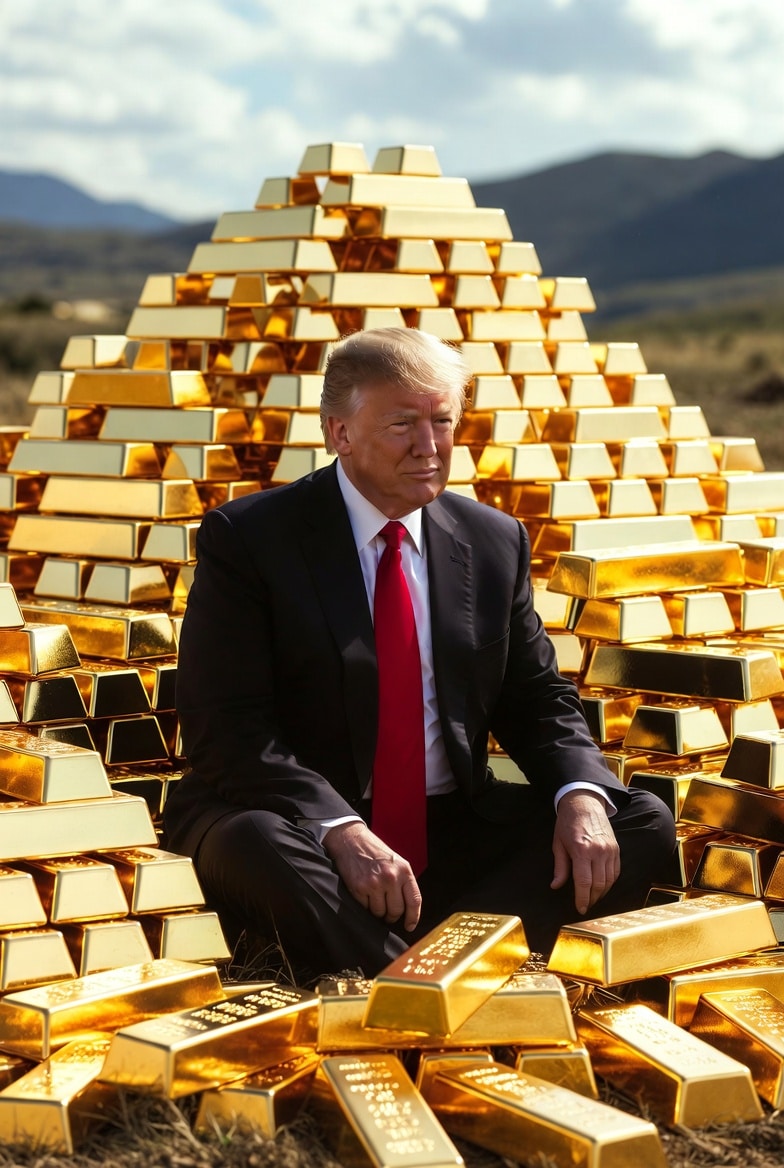
In his State of the Union address, President Trump declared that America is entering a “Golden Age.” Golden for whom?
For a president who lives lavishly in a taxpayer-funded mansion, jets around to weekend golf getaways at taxpayer expense, and dismisses concerns about “affordability” as fake news, life might indeed be gilded.
For the rest of the country, it is fool’s gold.
Nearly six-in-ten Americans say the country is worse off now than it was a year ago. Groceries cost more. Utilities cost more. Housing costs more.
For millions of families, this is not a golden age.
It is a painful lesson in imperial economics: the billionaire class lives large while “we the people” are told to live small.
Trump is not working to make America great again. He is working to expand his wealth, protect his investments, and rule in gilded comfort at taxpayer expense.
As a candidate, Trump promised to “drain the swamp.”
Instead, the swamp has been privatized.
When it comes to the true state of our nation, Americans would do well to examine not just what the Trump administration has accomplished—or failed to accomplish—but who has profited.
The highest public office in the land has become a personal revenue stream for Donald Trump & Co.—a vehicle for private enrichment that monetizes access, influence and public assets while the public pays the tab.
To monetize the presidency is to treat public power as property—something to be leased, leveraged and exploited for private gain.
This is how you bilk a nation.
The man who once lent his name to the ghostwritten The Art of the Deal is now authoring a far more instructive manual: The Art of the Steal—a step-by-step guide to how to convert a constitutional republic into a personal brand.
According to the New York Times Editorial Board, “Trump has used the office of the presidency to make at least $1.4 billion… All told, Mr. Trump has profited from his return to the presidency by an amount of money equal to 16,822 times the median U.S. household income.”
Power attracts conmen and swindlers. It always has. But never has the grift been so openly institutionalized.
Just consider the entries in this administration’s ledger.
Personal indulgence and vanity projects:
$400 million and counting for a White House ballroom underwritten by corporate giants whose regulatory futures sit squarely in presidential hands.
$70 million for a luxury jet with a private bedroom so DHS secretary Kristi Noem can fly around in comfort with her rumored partner.
$28 million for an Amazon documentary on Melania Trump.
Tens of millions for Trump’s weekend golf trips to Mar-a-Lago, including what he charges the American taxpayer for the Secret Service to be housed at the resort.
Policy decisions that generate revenue or leverage:
Billions in stealth taxes disguised as “emergency” tariff revenues paid for by the American people. According to NPR, the federal government is now collecting roughly $30 billion per month in tariff revenue—far more than it collected from import taxes before Trump returned to office—largely paid for by American consumers. So when Trump tries to sell Americans on the idea that tariffs could eventually replace income taxes—a clear bid to overturn the Supreme Court’s ruling against his tariff policy—don’t believe it. That’s just another money grab.
A $10 billion taxpayer buy-in to a privatized Board of Peace created and controlled by Trump in perpetuity with no real oversight or accountability.
$230 million in damages Trump claims he is owed over investigations into his own past misconduct.
Another $10 billion in damages which Trump claims he is owed after an IRS contractor was convicted of leaking his tax information.
Millions in trademark rights and licensing fees tied to Trump’s name on public infrastructure. As trademark attorney Josh Gerben notes, “The move raises unusual questions about the intersection of public infrastructure and private brand ownership. While presidents and public officials have had landmarks named in their honor, a sitting president’s private company has never in the history of the United States sought trademark rights in advance of such naming.”
At least $23 million from licensing Trump’s name overseas since his re-election.
$4 billion flowing into Trump family coffers in the first year of his second term, including $867 million through cryptocurrency ventures.
Public money redirected toward private allies and enforcement expansion:
$128 million for an ICE warehouse purchased three years earlier for $29 million—a $100 million markup benefiting a Russian-backed company.
$15 million earmarked to feed starving children internationally, which was instead impounded for OMB director Russell Vought’s security detail.
$51 billion in taxes not paid by Amazon, Alphabet, Meta, and Tesla in 2025 after receiving a 4.9% tax rate.
A $10 billion government contract between the Army and Palantir, founded by Trump supporter Peter Thiel.
Foreign entanglements and gifts:
A $400 million luxury plane from the Qatari government, which will be retrofitted at taxpayer expense for Trump’s official use as Air Force One and which he plans to take with him when he leaves office.
Hundreds of millions more from foreign government-linked investors gaining access through the purchase of the Trump family’s cryptocurrency ventures.
These are not isolated expenditures. They reveal a pattern.
They speak to the blueprint Trump has used to monetize his stint in the White House.
The Founders anticipated precisely this danger: a president tempted to convert public trust into private profit. The Constitution’s Foreign and Domestic Emoluments Clauses were intended to prevent a president from profiting from office.
With Congress unwilling to enforce the Constitution and the courts slow to intervene, these guardrails have weakened.
As the Brennan Center concludes, “Not even the most notorious public corruption scandals from American history can match the scale of Trump’s profiteering in terms of total dollar amount.”
This is how access to power is sold to the highest bidders.
The American system of government was designed as a constitutional covenant: power delegated, limited, and bound by law.
What we are witnessing is transactional governance: access traded, favors exchanged, loyalty rewarded, and policy negotiated like a business deal.
This pay-to-play culture now permeates the highest levels of power.
The U.S. government is fast becoming a self-serving, money-laundering enterprise masquerading as legitimate authority.
The choice before us is not partisan. It is constitutional.
A republic cannot survive when public office becomes private property.
As I make clear in my book Battlefield America: The War on the American People and in its fictional counterpart The Erik Blair Diaries, this is how republics fall.
It is time to drain the swamp.
Reprinted with permission from the Rutherford Institute.
