

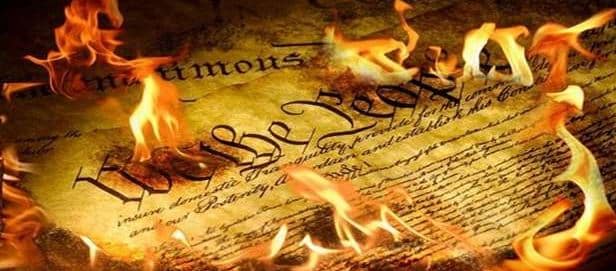
Legal scholars have many lenses through which to examine the Constitution. Lawyers need to master about 150 Supreme Court decisions in order to have a sufficient understanding of the government. But most of what lawyers have studied is theory — how the Constitution is supposed to work, as opposed to how it actually does work. This “supposed to” versus “actually does” conundrum is often called the formal versus the functional.
Formally, the United States still has a Constitution. We still have the three branches of government. Congress still has the House of Representatives and the Senate. The president is still elected by the Electoral College. The courts still function to resolve disputes and to define what the laws mean and what the Constitution means.
Yet, thanks in large measure to the public fear and mania in the war on drugs in the 1980s and 1990s, the war on terror in the 2000s and 2010s, and now the war on immigrants, functionally, Congress found it easy to cut constitutional corners and to look the other way as one crisis after another has led to the expansion of executive powers and the erosion of personal freedoms.
The principal victim in all these wars has been the quintessentially American right to be left alone, which is expressly protected in the Fourth Amendment, which reads: “The right of the people to be secure in their persons, houses, papers, and effects against unreasonable searches and seizures shall not be violated, and no Warrants shall issue, but upon probable cause, supported by Oath or Affirmation, and particularly describing the place to be searched or the persons or things to be seized.”
The courts have held that all searches and seizures, except for a few exigent circumstances, undertaken without warrants are by definition unreasonable, and thus in contravention of the amendment.
In 1947, when overstaying an immigrant’s visa was a civil wrong — like filing your taxes late or failing to shovel the snow from your sidewalk — Congress crafted the concept of administrative warrants in which one federal agent authorized another to look for these civil wrongs. The theory was these were not crimes and no one could go to jail, so a judicial warrant wasn’t needed.
The war on drugs began the slow erosion of the right to privacy by a law enforcement belief that the mere possession of controlled dangerous substances was so harmful to the social order that its eradication was a greater good than preserving constitutional norms. Unfortunately, this attitude permeated into the judiciary, which soon became loath to allow — using Justice Benjamin Cardozo’s phrase — the criminal to go free because the constable has erred.
But, in the war on drugs, just like in the war on terror, the constable did not err, he intentionally violated constitutional norms because of a belief that he could get away with it.
Then in 2001, the Patriot Act permitted one federal agent to authorize another to conduct searches of personal private records in the custody of one’s physician, lawyer, banker, telephone and computer service provider, even the mailman. The theory was that you gave up your privacy when you allowed these custodians to house your records. And, in a strike at the First Amendment, it prohibited the recipient of an agent-written warrant from telling anyone of its receipt.
Then, after the drumbeat of anti-immigrant hysteria and paranoia infected government at nearly all its levels and Congress converted immigration violations from civil wrongs to criminal acts, the feds told their agents to use administrative warrants to arrest people.
This was done in blatant violation of the Fourth Amendment, and is being done somewhere in the United States even as this essay is being read. Administrative warrants are general warrants that authorize the bearer to look where he wishes and seize what he finds. The British use of general warrants was a principal impetus to the American Revolution. The whole purpose of the Fourth Amendment was to eliminate and forbid general warrants.
Today in Minneapolis and elsewhere, searches and seizures of persons, houses, papers and effects are being conducted without judicial warrants. Administrative warrants often don’t even name the person seized. They permit appearance, occupation and location as the descriptive authorization for group stops and arrests. This has resulted in regular, consistent, systematic and massive violations of Fourth Amendment rights of citizens and immigrants.
Throughout this sordid history of government indifference to the Constitution, the attitude of the feds who did the violations, and often the jurists and jurors who validated them, and the legislators who enabled them, has been us versus them. We don’t use drugs, they do. We aren’t terrorists, they are. We were born here, they weren’t.
Until now.
Now, we have seen on the streets and in the homes of the hapless residents of Minneapolis the reason we have a Fourth Amendment. The government cannot be trusted to evaluate or restrain itself when it comes to compliance with the Constitution. Hence the solemn requirement of the interference by the judiciary between the government and its targets. Hence the absolute requirement of probable cause of crime. Hence the mandatory requirement of specificity.
Now, the Trump administration — beating the bushes against all immigrants, even longtime law-abiding residents with American children and grandchildren — has used administrative warrants, which have never been authorized by the Supreme Court, to break down the doors of the homes of immigrants and American citizens and drag them in their underwear in subzero weather to awaiting government vehicles.
Now, the same feds who trample freedoms kill innocent Americans in the streets.
Paraphrasing Justice Louis Brandeis, when the government becomes the lawbreaker, it breeds contempt for the law and due process; it invites anyone to become a law unto himself; it propagates the anarchy it produces.
There have been times when the Constitution protected us. Functionally today, those days are gone.
To learn more about Judge Andrew Napolitano, visit https://JudgeNap.com.
COPYRIGHT 2026 ANDREW P. NAPOLITANO
DISTRIBUTED BY CREATORS.COM
