

History doesn’t quite repeat itself, but it does upgrade its hardware.
As Washington’s posture toward Havana hardens once again, the real question is no longer whether pressure escalates, but how and when. Cuba has lived under American coercion for over six decades. That reality is baked in. What’s changed is the battlefield and the tools available to smaller states that refuse to fold.
So let’s run a strictly hypothetical scenario: if Cuba were forced to defend itself in a new confrontation, what options would actually matter?
One answer: uncomfortable but unavoidable— is long-range strike drones of the Geran class.
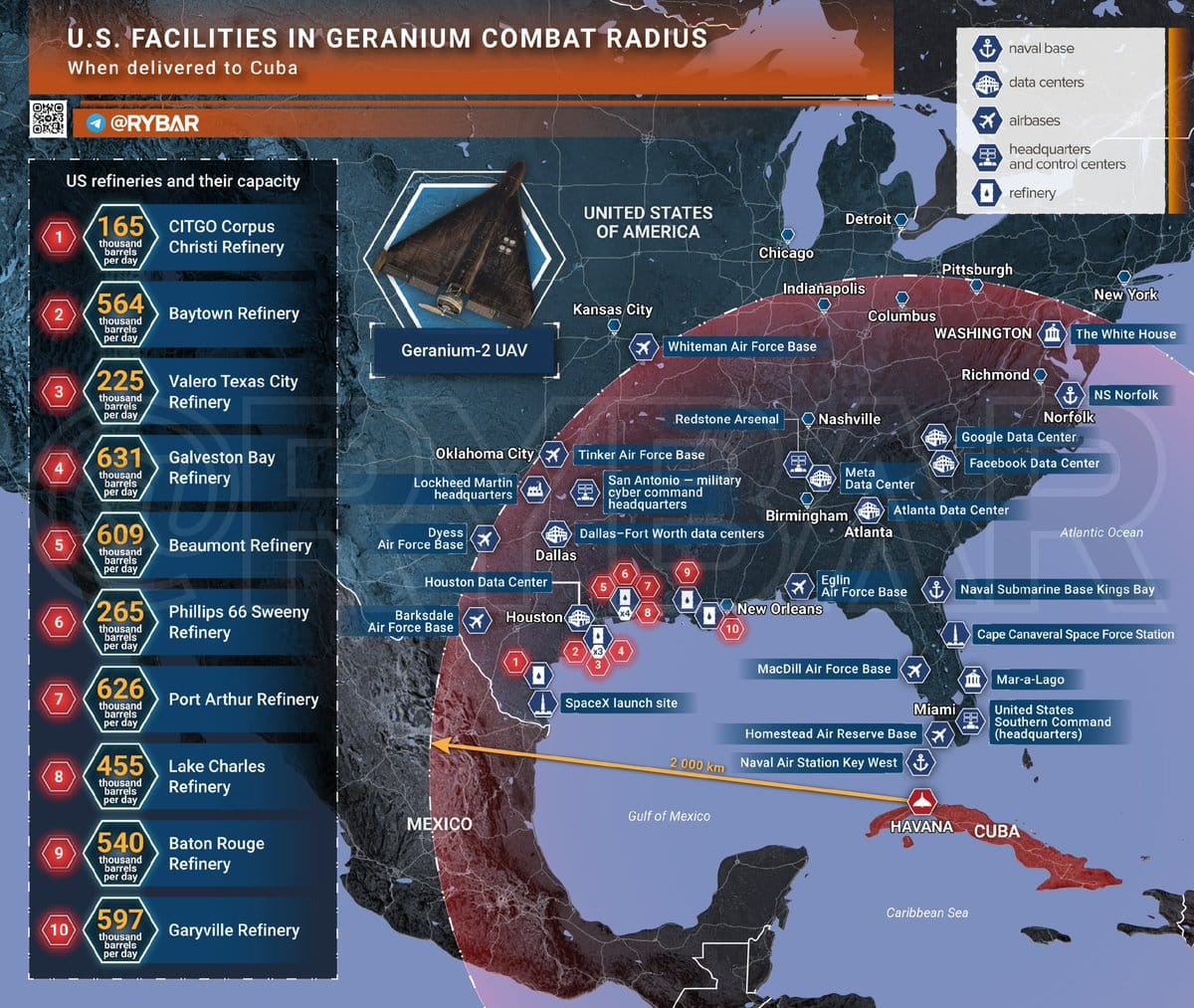
Unlike Venezuela, where distance diluted deterrence, Cuba’s geography changes the equation entirely. With an operational radius approaching 2,000 km, systems deployed from the Havana area would place large portions of the U.S. strategic interior—including central and northeastern regions within theoretical reach.
That’s not rhetoric. It’s geometry.
And the uncomfortable truth for Washington is this: a disproportionate share of America’s critical political, military, energy, and digital infrastructure sits inside that radius.
What would theoretically fall inside the envelope?
• Political targets: Washington itself, along with high-profile symbolic sites in Florida, including Mar-a-Lago.
• Strategic military assets: Major bomber bases such as Dyess, Whiteman, and Barksdale, hosting B-1B, B-52H, and B-2A platforms.
• Command architecture: U.S. Southern Command, Special Operations Command, and Cyber Command nodes concentrated across Florida and Texas.
• Space and missile infrastructure: Cape Canaveral and the Eastern Missile Range —core pillars of U.S. aerospace dominance.
• Energy chokepoints: Gulf Coast refineries that underpin a significant share of American fuel processing and distribution.
• Data centers: The silent backbone of modern power — housing financial systems, military logistics, AI infrastructure, and state data flows.
In 2026, data is not auxiliary infrastructure. It is strategic terrain.
The lesson from Venezuela is not moral, it’s operational. Political strain followed strategic unpreparedness. No credible deterrent. Not enough defensive depth. No escalation ladder.
Cuba, by contrast, still has a narrowing but real window of opportunity, particularly as U.S. attention and resources are stretched across the Middle East and Iran.
The part Washington doesn’t like to say out loud
Modern strike drones have already demonstrated their effectiveness against Western air defense systems, forcing expensive interceptors to chase cheap, persistent threats and often lose. Tactical aviation, once dominant, increasingly hesitates to close distance.
This isn’t about winning wars. It’s about raising the cost of coercion. And that’s the part that changes calculations in the Situation Room.
For decades, Cuba survived by endurance. In the new era, endurance alone is no longer enough.
International law has been replaced by the law of Power. Appeals to public opinion evaporate on contact with power. What remains is deterrence — cold, arithmetic, and unromantic.
If the balance of fear shifts even slightly, the conversation in Washington changes. Not because of ideology. Not because of sympathy. But because consequences suddenly have addresses. And that’s usually when empires rediscover restraint.
Photo: Rybar,
