

For three decades, Washington insisted that internal destabilization was not an act of war when applied abroad. It called it “civil society.” It is now discovering that precedents don’t ask permission to come home — and that shock is already visible on Minnesota’s streets.
This is not about Russia orchestrating unrest in the United States. It isn’t. There’s no evidence for that, and pretending otherwise is a distraction. The uncomfortable truth is simpler: the United States is running into the domestic consequences of doctrines it normalized against others — most notably Russia — over time, at scale, and without an exit clause. This isn’t a partisan failure. It’s a system misreading itself.
In the 1990s, Russia absorbed a shock that few modern societies have walked away from intact. Between 1991 and 1998, Russian GDP contracted by roughly 40–45 percent, industrial output collapsed, and male life expectancy fell from about 64 to under 58 years. Tens of millions were pushed into poverty. Strategic state assets were privatized at fire-sale prices, producing an oligarchic layer that hollowed out sovereignty from the inside. Alongside this economic wreckage came a dense ecosystem of Western-funded NGOs, weaponized media initiatives, legal advocacy groups, “election monitors,” and youth movements — financed openly through structures such as the National Endowment for Democracy and USAID, whose combined “democracy promotion” and civil-society budgets reached into the billions of dollars annually by the late 1990s.
None of this was covert. It was celebrated. Senior Western officials said out loud that these institutions were doing overtly what intelligence services once did quietly. The logic was straightforward: internal pressure was cheaper and cleaner than force. Destabilization was rebranded as reform, and most people in power convinced themselves that was the end of the story.
Russia didn’t respond immediately. It waited. It watched closely. It kept notes.
By the early 2000s — after Serbia (2000), Georgia (2003), Ukraine’s Orange Revolution (2004), and repeated attempts elsewhere — Moscow drew a line. Foreign-funded political NGOs were restricted or expelled. Media space was consolidated. External financing of domestic political activity was treated as a security issue, not a cultural exchange. This was denounced in the West as authoritarian backsliding. What went largely unexamined was that Russia wasn’t reacting to rhetoric. It was reacting to precedent, repeated often enough to stop looking accidental.
That precedent matters now.
What the United States is confronting at home isn’t foreign subversion. It’s doctrinal blowback — the inverse of its own deeply flawed strategic assumptions. The Brzezinski logic assumed internal fracture was something you exported to rivals, namely Russia, to keep them weak. What it never seriously modeled was what happens when a system teaches the world — again and again — that legitimacy is conditional, authority negotiable, and internal pressure a legitimate political tool, then assumes permanent immunity at home. The unspoken assumption was that destabilization could be externalized indefinitely; the error was believing the domestic system would remain immune once those tools were normalized and legitimized.
In real life, systems don’t work that way.
When a Hegemon teaches that legitimacy can be subverted through NGOs, that law-enforcement narratives are suspect by default, that street pressure is an acceptable lever, and that sovereignty bends under moral framing, it shouldn’t be surprised when those same mechanics surface internally. No external hand is required. Just stress, systemic miscalculation, hubris, and time.
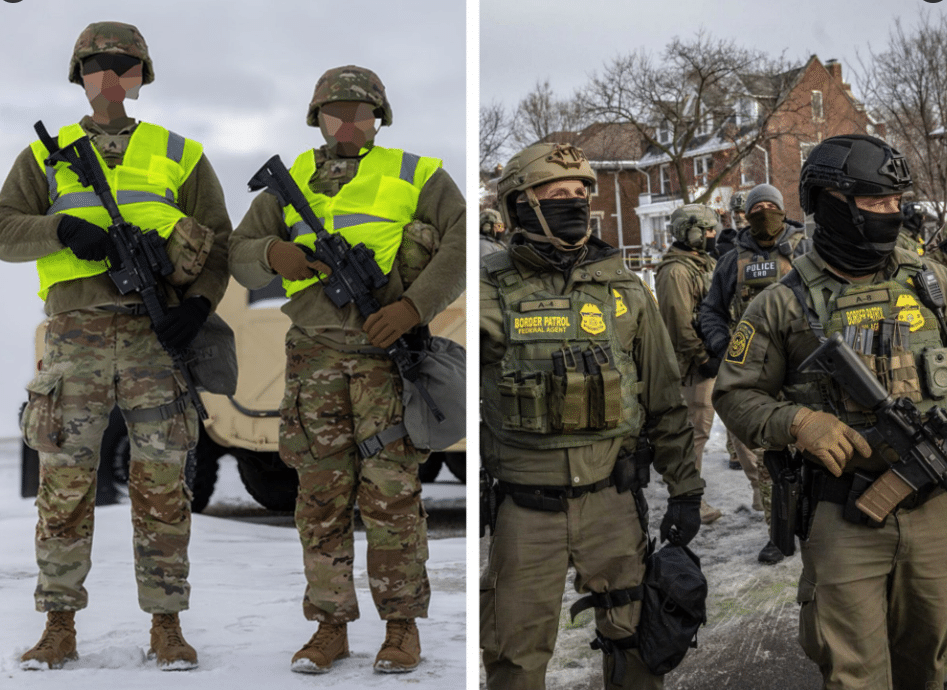
Minnesota is not merely a signal; it is the first instance in which federal force, state authority, and mass street mobilization have collided openly and repeatedly within a single operational theater. Over the past two weeks (January 2026), two U.S. citizens — Renée Good and Alex Pretti — were killed in Minneapolis in separate incidents involving federal immigration enforcement. The details are still disputed and will be argued over for years. What isn’t disputed is what followed and what will follow: sustained unrest, open confrontation between federal authority and local leadership, and the activation of the Minnesota National Guard by Governor Tim Walz during a federal operation he publicly opposed. Once governors are deploying state forces in the shadow of federal enforcement actions, the argument is no longer about immigration policy. It’s about who actually holds authority over force.
The real danger isn’t some cinematic showdown between uniforms, though with this calibre of brain trust all bets are off. The real danger is quieter and worse, that of parallel chains of legitimacy forming in real time. State investigations contest federal narratives. Courts lag events on the ground. Media ecosystems fracture instead of arbitrating. Ordinary people feel it instinctively — that simmering unease when order technically exists, but coherence doesn’t.
This isn’t a color revolution at home, but a system failure under precedential load.
Russia’s experience matters here not because it explains American unrest, but because it shows how states respond once internal political ecosystems turn into contested terrain. Moscow concluded that sovereignty had to be enforced pre-emptively. Washington assumed legitimacy would always self-correct, even as it treated legitimacy abroad as something to be pressured. Those assumptions can’t both survive contact with reality.
What this does is expose the irony at the center of the story, that Washington insisted Russia absorb internal destabilization as the price of modernity, then acted stunned when similar dynamics appeared under its own roof.
This is not collapse as it is usually imagined, but it is the phase that historically precedes it. It’s miscalculation stacked on miscalculation — each one survivable on its own, corrosive in sum. And it goes well beyond parties, elections, or personalities. Systems don’t fail because one faction wins. They fail because the rules governing authority erode faster than anyone can patch them.
If this trajectory holds, the next phase will not announce itself as a crisis — it will arrive already in motion. Federal–state standoffs are no longer theoretical but are unfolding in real time. Guard deployments in political disputes are no longer exceptional, they are operational facts. Since 2020, National Guard deployments for domestic unrest have occurred in over two dozen states, a frequency unprecedented in the post–Cold War period. Public trust in federal institutions now polls below 30 percent across multiple surveys, with confidence in Congress, the courts, and federal law enforcement all near historic lows. Street protests have crossed into sustained clashes, and force is now present on all sides while legitimacy is contested by all sides.
Investigations overlap without resolution. Courts trail events they no longer discipline. Competing narratives harden into parallel claims of lawful authority, enforced selectively by jurisdiction, affiliation, and moment. This is no longer normalization — it is fragmentation under pressure. History shows that once a system reaches this stage, restoration does not proceed incrementally. It comes only after rupture, and at far higher cost than prevention ever required.
Empires rarely fall because someone outmaneuvers them. They unravel when the tools they normalized abroad from legal pressure, to narrative warfare, and legitimacy erosion, come home stripped of moral insulation, operating at scale, and no longer answerable to a single authority.
Russia didn’t orchestrate this moment.The United States didn’t intend it. But intent has never been what decides outcomes.
Beware the precedents you set. Because systems remember what they were taught to tolerate, and they eventually apply it at home.
