
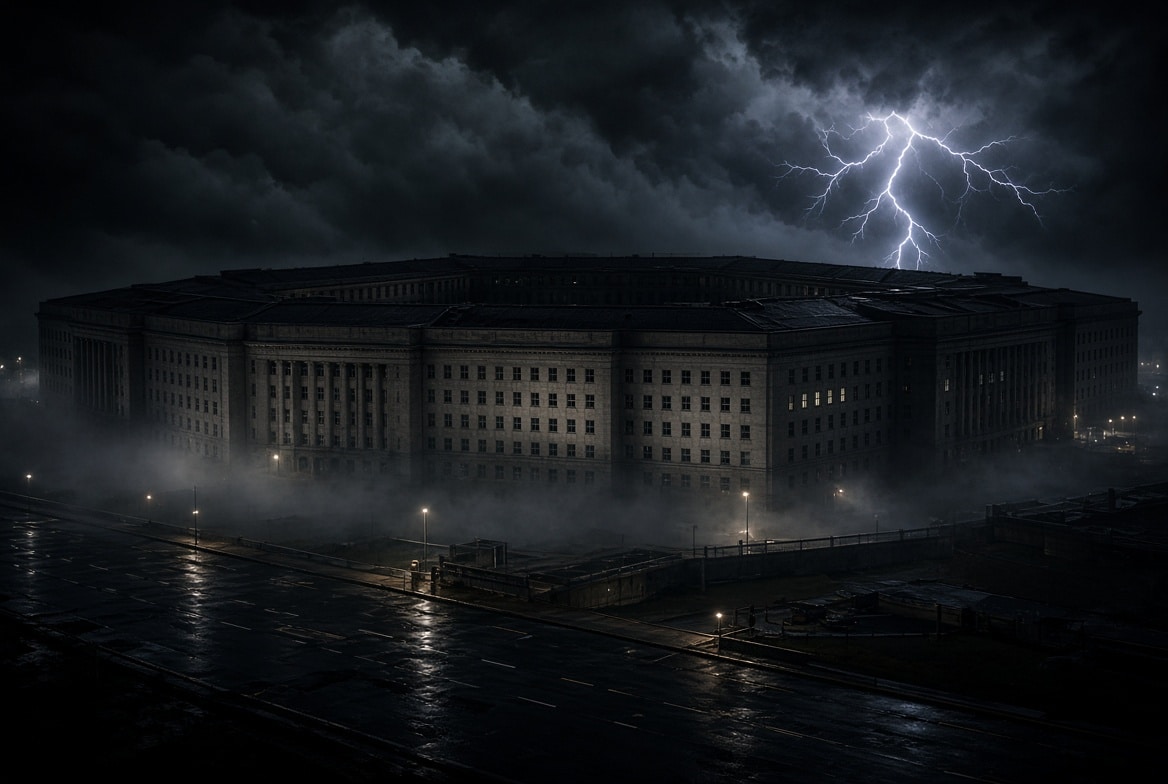
This time of year, there is no shortage of monsters to frighten us.
Hollywood has given us vampires, zombies, mad scientists, masked killers and creatures that emerge from the darkness to prey upon the unsuspecting.
But perhaps the most frightening monster of all is the government that has become so accustomed to wielding extraordinary power that it cannot imagine a future in which that power is diminished.
Enter the Doomsday Plan.
In what sounds like a plot lifted straight out of Stanley Kubrick’s Dr. Strangelove, the Pentagon has unveiled an initiative designed to keep the war machine running even if a catastrophic war devastates the country’s civilian infrastructure.
Under an initiative called FORTRESS, the military is preparing major installations across the United States to operate independently for at least 90 days in the event of a catastrophic disruption. The plan includes portable nuclear reactors, independent power grids, stockpiles of fuel and ammunition, backup communications systems and arrangements for civilian factories to switch over to wartime production.
The Pentagon calls this preparedness.
The rest of us might reasonably wonder: what good is a government that can survive the end of the world if the people it was created to serve cannot?
Of course, governments have a responsibility to prepare for emergencies. But there is a world of difference between preparing to protect the nation and preparing to preserve the power of those who govern it.
That distinction matters, especially when the same government that prepares for catastrophic war also helps create the conditions in which such wars become not only likely but imminent.
The Pentagon has been anticipating a future in which the military can continue fighting, even when the civilian infrastructure that sustains ordinary Americans may no longer function.
Consider the Pentagon’s chilling training video, Megacities: Urban Future, the Emerging Complexity, made public in 2016.
The video envisions a world of sprawling urban centers overwhelmed by poverty, disease, unemployment, overcrowding, failing infrastructure, environmental disasters and civil unrest.
It is a bleak portrait of the world as military planners fear it might look by 2030. In this vision of the future, cities become battlegrounds and the citizenry are viewed as the enemy.
As the video warns, there will be a need to “drain the swamps.” Only in this dystopian future, “we the people” risk becoming inhabitants of the swamp that military forces are preparing to clear out.
That is a dangerous way for any government to view the people it is supposed to protect.
It is particularly dangerous for a nation whose founders explicitly rejected martial law and enacted constitutional bulwarks to guard against the rise of a police state.
Yet this is where the country has been heading for years.
We’ve witnessed the steady militarization of domestic law enforcement, the expansion of surveillance networks, the deployment of military equipment into American communities, and repeated efforts to blur the line between policing and warfare.
Under the Trump administration, those boundaries have been tested even further through domestic military deployments, aggressive immigration enforcement and expansive claims of executive authority in the name of national security.
The message is increasingly unmistakable: the military is increasingly being presented as the solution to every domestic crisis.
Yet this is also why the Pentagon’s latest Doomsday preparations cannot be considered in isolation from the government’s longstanding continuity-of-government plans.
For decades, federal officials have maintained arrangements intended to preserve essential government operations during a catastrophic emergency, including secure facilities, alternate command centers, succession procedures and protected communications systems.
These preparations are hardly limited to military installations.
Even Trump’s controversial White House ballroom project includes plans for fortified underground facilities, bomb shelters, secure communications and medical facilities, ostensibly to ensure that the presidency can continue functioning during a national emergency.
The government is making elaborate preparations to preserve its leadership and military capabilities in the event of catastrophe.
Some of these measures are practical: a functioning government is essential to coordinating rescue operations, maintaining order and rebuilding after disaster. But continuity-of-government planning also raises a constitutional question that is too often overlooked: what exactly is being preserved?
The Constitution establishes a government of limited, divided powers, accountable to the people and constrained by law.
Preserving that government means more than ensuring that the president can issue orders, military commanders can communicate and federal agencies can continue operating. It means preserving the checks and balances that prevent power from becoming absolute. It means preserving Congress, the courts, due process, freedom of speech, freedom of the press and the right of the people to challenge government abuses.
It means ensuring that an emergency does not become an excuse to dispense with the very constitutional restraints that distinguish a republic from a dictatorship.
Otherwise, continuity of government becomes little more than continuity of power.
That is what makes the Pentagon’s doomsday planning so unsettling.
The problem is not that the military wants to keep the lights on during a national catastrophe.
The problem is what happens when keeping the machinery of war functioning becomes the overriding measure of national survival.
So where does that leave us?
President Trump and his self-serving administration of war hawks have squandered so much of our resources, our goodwill on the world stage, and our role as a champion for liberty and justice. Now having pushed us to the apocalyptic brink of devastation, they’re building bunkers to save their own necks while the rest of us are left to fend for ourselves.
Enough is enough.
“We the people” should be demanding a government that works to prevent catastrophe, protects civilian life, respects constitutional limits and remembers that its continued existence is not an end in itself. And if they won’t march in lockstep with our expectations, throw the whole lot of them out.
Because as I make clear in my book Battlefield America: The War on the American People and in its fictional counterpart The Erik Blair Diaries, the danger comes when the government forgets that it exists to serve the people, not the other way around.
A government that survives by abandoning the people and the Constitution has not saved the country.
It has merely saved itself.
The Constitution was not written to ensure that the government would survive at any cost.
It was written to ensure that freedom would survive a tyrannical government.
Reprinted with permission from the Rutherford Institute.
