
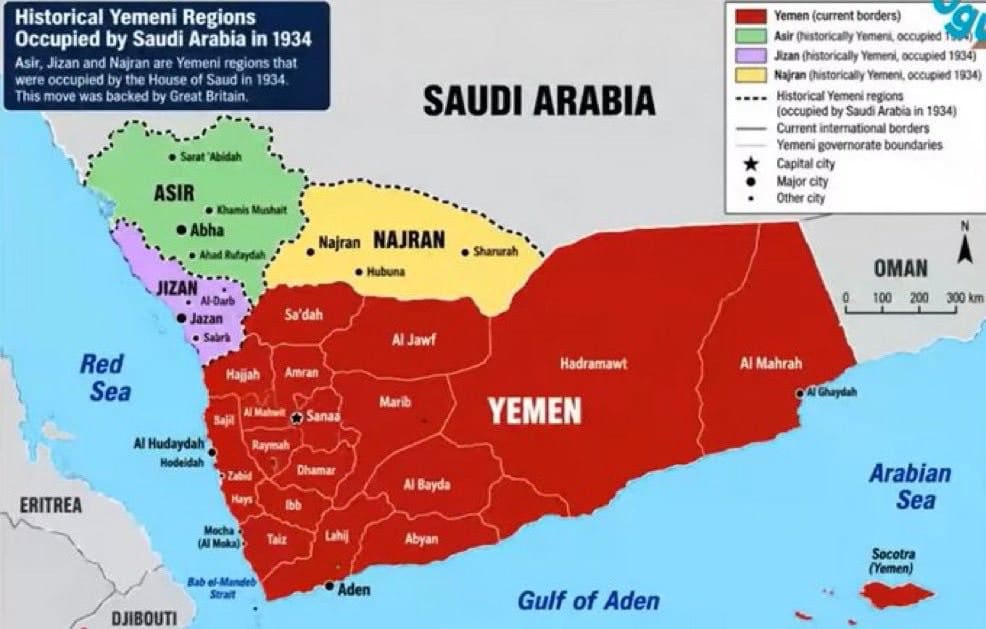
In the 1930s, during the formation of Saudi Arabia, three provinces were taken from Yemen. The Yemeni have always wanted them back. They are now in a position where they may eventually achieve that aim.
The western parts of Yemen are unlike the deserts of Saudi Arabia. The area is mountainous and gets a decent amount of precipitation. Some 80 percent of the 33 million Yemeni live in there. Agricultural production in the mountains is however difficult and Yemen has long been dependent on trade to acquire enough food to keep its people alive.
In recent decades the Saudis had sent Wahhabi preachers into Yemen. This led to conflicts with the Zaidi Shia natives and in 2014 resulted in a revolution against the government of Ali Abdullah Saleh which had allowed the Saudis to gain an ideological foothold. The Houthi, a family clan or tribe of Zaidi Shia with a long tradition, allied with other clans and managed to overthrow the government in Sanaa.
Prince Mohammed bin Salman, the then 29 year old Minister Defense of Saudi Arabia, started a war against the Houthi and their allies to restore the Yemeni government. The Saudis, with US help, launched an intensive bombing campaign which killed many Yemeni people. They enforced a blockade of the country. Several hundred thousand people died due to the lack of food. The Saudis hired foreign mercenaries, Jihadis and tribal forces in southern Yemen to fight the ruling forces in Sanaa. Enforcing an air blockade they bombed the airport of Sanaa more than 200 times.
It was all to no avail. In 2022 a ceasefire was established along the conflict lines. Under the name Ansar Allah (Ansarullah) the Houthis and their local allies established themselves as the government over some 70 percent of the Yemeni population. But they knew that the conflict was far from over. With the help of Iran they managed to build and store thousands of drones and missiles.
In October 2023, in support of the Palestinians fighting in Gaza, the Houthi began to target Israeli and US shipping in the Red Sea. In March 2025 the Trump administration, with support from Great Britain, launched air and naval strikes against Ansar Allah targets in Yemen. The campaign went no where. After two months the US declared victory and retreated.
On July 14 2026 the Saudis broke the ceasefire with Yemen by again bombing the airport in Sanaa:
The purpose of the strikes on the Sanaa airport was to prevent the landing of a plane from Iran carrying a Yemeni delegation that attended the funeral of Iranian Supreme Leader Ayatollah Ali Khamenei. Despite the strikes, the plane was rerouted and landed at the airport in the Yemeni Red Sea port city of Hodeidah.
The strikes came after the Saudi-led coalition threatened to take action in response to an Iranian flight that landed in Sanaa on July 3. At the time, Ansar Allah said that its forces “repelled” Saudi warplanes attempting to interfere with the flight, and two days later, Houthi fighters launched an offensive against Saudi-backed forces, the heaviest fighting between the two sides in years.
While the two sides agreed to a ceasefire in 2022, a long-standing blockade on Yemen that included restrictions on Sanaa airport was only partially lifted, and in recent months, calls have been growing in Yemen for a complete end to the siege.
The Saudi attack, which led to the renewal of the war, was a huge mistake. Saudi Arabia is a glass house. Crown Prince Muhammad bin Salman, who is now its sole ruler, only manages to keep his position by force. He is buying off some of the tribal Arab leaders and population. His rule is only legit as long as he can guarantee security and prosperity.
In contrast to Saudi Arabia the Yemeni are poor. They have nothing to lose, but have a strong ideology. They are experienced warriors. They responded to the Saudi attacks with long range drones and missiles.
Saudi export pipelines and oil installations were hit by missile strikes. The Saudi air defenses, exhausted after spending their munitions against Iranian missiles targeting Israel, are in disarray. The Yemeni have learned to launch mixed attacks of drones and missile, confusing air defenses, which allow them to hit targets within Saudi Arabia at will.
They have announced an air blockade over Saudi Arabia to mirror the one enforced against them. Over the last week the managed to hit passenger terminals at the international airport in Riyadh. Major airlines have stopped their flights to Saudi Arabia endangering Muhammad bin Salman’s plans to remake the country into a center of international business:
In recent days, the Houthi military spokesman, Yahya Saree, has issued repeated warnings to airlines and travelers against using Saudi airports, declaring them a ‘theater of operations for our forces.’
The attacks on the airport came ahead of several large political and business events in Saudi Arabia, including Prince Mohammed’s flagship annual investment summit, during which world leaders, billionaires, and executives typically descend upon Riyadh. It is unclear whether high-profile guests will feel safe enough to attend now.
‘The problem for the Saudis is that they experience more damage from Houthi strikes on their infrastructure than the other way around,’ Mr. Gause said. ‘A strike on Riyadh Airport could lead someone thinking about investing in the country to reconsider.’
In contrast, much of Sanaa, the Yemeni capital, which the Houthis control, has already been destroyed.
There is no one who expects the Saudis to win in this conflict. Saudi allies are reluctant to join the conflict. Turkey and Pakistan, which have signed defense agreements with bin Salman, are unwilling to fight in Yemen. The US is delivering intelligence reports but is too short of ammunition to join the war. Local Saudi mercenaries in Yemen are in disarray and unwilling to fight the superior forces of Ansar Allah.
Unless Mohammad bin Salman is willing to file for peace with Yemen the war will escalate into a larger and longer conflict. Yemeni ground forces are likely to soon enter the former Yemeni provinces in southern Saudi Arabia. Further strikes of Saudi airports will diminish its international reputation. More attacks on its oil installation will lower its income.
Bin Salman’s role is not as secured as it seems to be. After he had gained the crown prince position he had imprisoned tribal leaders and competing family members. He has liberalized the country against the will of its deeply conservative establishment. His many failed vanity projects have cost a lots of money with little to show for it.
Iran has offered to mediate a peace agreement between Saudi Arabia and Yemen.
It is unlikely that Mohammad bin Salman is willing to engage in it even though it is probably the best and only way for him to stay in his position.
Reprinted with permission from Moon of Alabama.
