
“This Is the midnight – let no star
“Delude us – dawn is very far.
“This is the tempest long foretold
“Slow to make head but sure to hold.”
Rudyard Kipling, England’s greatest poet of Empire, who then became the unwilling prophet and witness of that empire’s catastrophe and coming dissolution, published that frightening warning in 1932, the year after Japan seized Manchuria when the mighty British Empire that had dominated Asia for a century could not raise a fingernail to stop it.
Kipling published that poem only a year before Adolf Hitler became Chancellor of Germany, with all that meant for England and the world. Today, his poems offer a prophetic warning yet again as the United States, Saudi Arabia, and the entire industrialized world reel from the latest Iranian strategic masterstroke: shutting down Saudi Arabia and the Gulf states’ ability to export oil to the outside world in any significant quantities at all.
The United States and its ridiculous European Lilliputian military allies in Europe – by which I mean, of course, Britain, France, Germany, and Poland – have huffed and puffed endlessly about how they have strategically isolated Russia over the past four and a half years since Moscow launched its Special Military Operation into Ukraine. With China and India – and now Iran as well – as its solid, loyal trade and strategic partners, Russia, of course, has not been isolated at all. And it is NOT reeling economically after four and a half years of the most determined US, British and NATO efforts to collapse it, despite all the Wall Street and City of London fantasies to the contrary.
But now the boot is on the other foot.
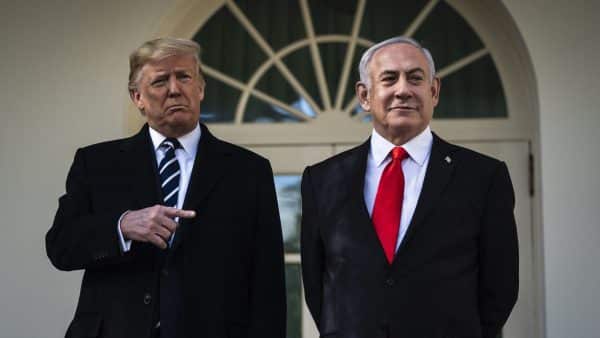
The United States, headed by the strategically witless Trump administration, is now being dealt the ruinous fate that President Joe Biden and his Gadarene Swine tried with total ineptness and failure to apply against Russia and that his successor, President Donald Trump, fatefully followed the urging of and siren calls of his so-beloved hero, Prime Minister Benjamin Netanyahu of Israel, to inflict upon Iran.
For it was Trump who unleashed his aerial armadas against Iran along with Israel to kill the Supreme Guide of Iran, Ayatollah Ali Khamenei on February 28.
Four days of shock, awe and terror were all it would take, Netanyahu assured the President of the United States to his face in front of multiple witnesses, to dissolve the entire Islamic Republic of Iran.
Well, it didn’t.
Instead, Trump was left with a full-scale war on his hands that he and his master strategist, that modern Napoleon, Secretary of Defense Pete Hegseth do not have a prayer of winning.
On September 17, retired US Marine Colonel Andy Milburn, significantly a superhawk on confronting Russia through Ukraine over the years but in the Middle East, an honest and clear-eyed man ready to acknowledge reality when it bites him – and the world – on the butt – spelled out the latest developments and their consequences in a single, stunning map.
“On September 16, Houthi forces took Mocha and Perim Island days later, giving them the eastern shore of Bab al-Mandab. On the 11th, drones from Iraq shut down the East-West pipeline, the last bypass around Hormuz,” he wrote.
This means, as Milburn made stunningly clear, that since March, Iran has successfully shut down all oil exports through the Straits of Hormuz – the gateway of the Persian, or Arabian Gulf to the Indian Ocean and the wider world.
Now, in the space of a few days in September, Milburn continued, Houthi missile attacks and threats have shut down the oil traffic moving through the Bab al-Mandab, the strategic gateway or choke point at the southern end of the Red Sea, from its normal 4 million bpd to a derisory 200,000 bpd – a reduction in the global oil traffic flow of oil in the world’s economy.
Also, Milburn helpfully pointed out, the drone attacks from Iraq’s Maysan province close to the Iran border shut down Saudi Arabia’s great East-West pipeline, thereby shutting down the previous supply of 7 million barrels of oil per day (bpd) to the Red Sea and the West.
That’s the Grand Slam.
And it means US domestic gas prices are going to go through the roof well before the November midterm congressional elections.
That means, sure as day, a sweeping victory giving certainly the House of Representatives and probably the Senate too to a new generation of young, angry, energized anti-war Democrats. With the 80-year-old President Trump reduced to legislative impotence and open to ever more virulent criticism as he tries to rule by decree.
Nor will the Make America Great Again (MGA) legions rally to the President’s defense. They have been abandoning him in droves ever since he believed Netanyahu’s ludicrous lies and charged into his fateful war against Iran. In the baseball parlance the president has always loved, that is an unforced error. One of the biggest of all time.
Another honored retired U.S. Marine officer and first-class strategic mind, my old friend Major Donald Vandergriff, spelled out the strategic significance of this in an assessment published on his Substack on September 17.
The “Houthi seizure of Perim Island and the approaches to Mokha is a textbook case of operational art executed by a hybrid actor. It is neither an isolated raid nor a simple territorial grab,” Vandergriff explained. “It is a deliberate, months-in-preparation maneuver that exploited enemy disunity, information dominance, and tempo to seize a critical vulnerability, the Bab al-Mandab chokepoint, while the United States and its partners were focused on the larger contest with Iran.”
How did this happen? “The Houthis did not invent new technology. They applied old principles with discipline,” Vandergriff explained. “They massed forces and weapons near Mokha in mid-August.”
What can and will the Saudis and the Trump administration do next? As Vandergriff pointed out, the old ways of reliance on cheap and fast pinpoint air attacks have already failed. Indeed, they were always a fantasy. Those infantile dreams of America’s Bomber Barons cost over 30,000 US airmen their lives over the skies of Europe alone in World War II. That was a higher death toll than the entire US Marine Corps death toll in all the battles of the Pacific War.
Saudi Arabia “already fought a costly air campaign that failed to dislodge the Houthis and invited retaliatory strikes on its own energy infrastructure,” Vandergriff confirmed.
Sending massive US forces in to try and succeed where US air power and the Saudis have already failed is the next obvious line of attack open to Trump and Hegseth and the pundits who guide them on Fox News every night. And because it is so simplistic and obvious, it is virtually a guaranteed certainty that they will indeed take it. But it will still fail, all the same.
Vandergriff again makes the point clear: “Opening a third front while Iran remains the main effort is a classic way to lose focus. The anti-Houthi side’s fragmentation of southern separatists, Muslim Brotherhood-aligned groups, and remnants of the former government is a cohesion problem that no amount of U.S. airpower can paper over.”
The Houthis in their latest operations have shown a tactical flexibility and ingenuity that has run rings around the slow and ponderous Observe-Orient-Decide-Act or OODA loop cycles that the elephantine US military leadership remains trapped in.
Once more, Vandergriff makes the necessary point: The Houthis, he observes, have “threatened opponent supply lines, and used control of Yemeni telecommunications to intercept communications, sow confusion, and intimidate rivals into collapse. They waited for the Saudi-UAE rupture that fractured the anti-Houthi coalition into multiple armies with competing commands. … They are adaptive and unafraid of the United States. That combination of 3GW (Third Generation Warfare) operational technique married to 4GW (Fourth Generation Warfare) strategic resilience is what makes them dangerous.”
We have seen this pattern of apparently tiny, inconsequential regional actors defeating the mighty American World Goliath all too often before. It was the pattern of the Taliban waiting out US forces for two decades in Afghanistan. And long, long before that, it was the pattern of General Vo Nguyen Giap with his Viet Cong forces in the 1960s Vietnam War.
Giap made his mistakes, as everyone does. He never repeated them.
He retreated, bided his time, learned his lessons, drew the appropriate conclusions.
Then he trained in new tactics for the next time.
And inevitably, in the end, he won.
Now President Trump must learn not to any longer emulate the ghastly, rightly despised examples of his predecessors, Democratic President Lyndon Johnson in Vietnam and Republican President George W. Bush in Iraq and Afghanistan.
First, Trump needs to Chill out. Cool down.
Second, he needs to practice restraint.
Third, he needs to settle his war with Iran if he can on Tehran’s terms. And if they won’t accept that, he needs to show restraint and patience – two very un-Trumpian, indeed entirely un-American, virtues to try and contain them. He needs to learn from that most unfashionable and crucial of Roman heroes, Fabius the Delayer, who won the long war with the invincible Hannibal of Carthage by refusing to fight him in full pitched battle – face to face.
Fourth, Trump must banish the endless screeching from Netanyahu, the neocons, the neolibs and all the rest of the effeminate, hysterical, morally outraged armchair warrior Moltkes and Napoleons in their imagination and refuse to open up a third New Front in Yemen against the Houthis at all.
None of this will magically fill the hole that Trump, Hegseth and their cheerleaders have already dug the United States deep into.
But at least it will begin to address the first law of survival and recovery for everyone who has dug themselves already into a deep hole.
Stop digging.
Facile optimism and denial of the hard realities will only make things infinitely worse.
The prophetic English poet Kipling understood this 94 years ago when he wrote “The Storm Cone.”
“Stand by! The lull twixt blast and blast
“Signals the storm is near, not past;
“And worse than present jeopardy
“May our forlorn to-morrow be.”
Reprinted with permission from the Realist Review.
