
After the 9/11 attacks, US officials used the “emergency” to wield and exercise extraordinary totalitarian-like powers. This was reflected by such totalitarian-like measures as the USA PATRIOT Act, warrantless telecommunications surveillance, torture, indefinite detention, assassination, the TSA takeover of the airports, and the undeclared wars of aggression against Afghanistan and Iraq.
Of course, that isn’t the only time US officials have used an “emergency” to justify the use of extraordinary totalitarian-like powers. We saw this phenomenon during the Covid “emergency,” when both federal and state officials were imposing mandatory lockdowns, mandates, and vaccination requirements on businesses and people.
Consider President Trump’s unilateral imposition of tariffs under the International Emergency Economic Powers Act. He justified those tariffs by declaring an economic “emergency” relating to the trade deficit. In February 2026, however, the Supreme Court held that IEEPA did not authorize the president to impose tariffs. In other words, the declaration of an “emergency” did not itself confer the power to tax imports.
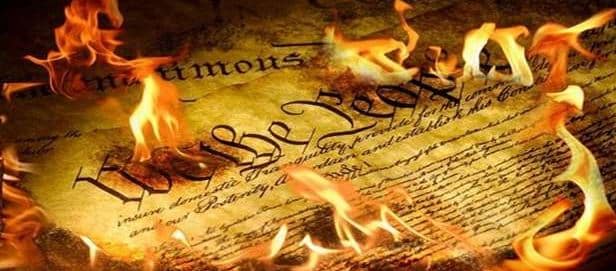
There is one great big problem, however, with using “emergencies” to justify the use of extraordinary totalitarian-like powers: This justification is not authorized by the Constitution.
In other words, there is no general emergency exception in the Constitution that empowers federal officials to exercise otherwise unconstitutional powers. Indeed, when the Framers wished to recognize extraordinary authority in extraordinary circumstances, they did so expressly, as with the Constitution’s narrowly drawn provision permitting suspension of habeas corpus in cases of rebellion or invasion when public safety requires it.
The Constitution called into existence a federal government whose powers were limited to those few powers that are enumerated in the Constitution itself (as well as the powers incidental to carrying its enumerated powers into execution). If a power is not enumerated, it cannot legally be exercised by the president, the Congress, the judiciary, or the national-security establishment.
Notice something important: There is no constitutional provision that states “In an emergency, US officials shall be vested with whatever powers they deem necessary to address the emergency.”
There is a good reason why the Framers failed to include that provision. They knew that “emergencies” were the time-honored way by which government officials have taken away the rights and freedoms of the citizenry. They also knew that it was during “emergencies” that many citizens, besieged by fear and anxiety, would be eager to surrender their rights and liberties to their own government in the hope of being kept “safe.” They also knew that once such a surrender took place, the chance that people would later regain the freedoms that they had traded away to their own government would be slim.
Notice something else about the Constitution: There is no emergency exception in the Bill of Rights. That’s because our American ancestors did not want an emergency exception to the express restrictions on power that the Bill of Rights imposed on federal officials. Their reasoning was the same as outlined above. Our ancestors knew that throughout history, people had lost their liberties at the hands of their own government because officials would use “emergencies” to take permanent control over the citizenry.
Adolf Hitler perfectly understood this phenomenon. The Nazis used the Reichstag Fire “emergency” to suspend fundamental civil liberties and then secure passage of the Enabling Act, which effectively destroyed the constitutional restraints on Hitler’s government. Needless to say, such “emergency” powers were never rescinded.
It’s important to recognize that the “emergency” can come in various forms. Recall the economic “emergency” of the Great Depression. President Roosevelt used that “emergency” to nationalize gold, impose a paper-money system on the American people, convert America’s economic system to a welfare state, and establish a government-managed, government-controlled, and government-regulated economic system. All of this was done without even the semblance of a constitutional amendment.
There was the post-World War II “emergency” of the supposed threat by the Reds to take over America. That “emergency” was used to convert the federal government to a national-security state, one that was no longer restricted by the Constitution and the Bill of Rights. That’s when the totalitarian powers of assassination, torture, and indefinite detention of both citizens and foreigners became an institutional part of America’s governmental system, again without even the semblance of a constitutional amendment.
There was the post-9/11 terrorism “emergency” and the Islamic caliphate “emergency,” which have given us the perpetual “war on terrorism.” There is now the ever-present danger of a new health-care “emergency,” which would mean that the “emergency” swords of mandates and lockdowns could easily be unsheathed and used again.
There is also the decades-old, ongoing, never-ending drug-war and illegal-immigration “emergencies,” both of which have given us a permanent harsh and brutal nationwide drug-war police state and immigration police state, including the power to assassinate drug-war suspects based on secret evidence supposedly acquired by government officials.
The Framers and our American ancestors were right not to include an emergency exception in the Constitution and the Bill of Rights. Too bad modern-day Americans have permitted their federal officials to get away with using “emergencies” to wield and exercise unconstitutional powers. It’s one of the principal ways the American people have lost their liberty at the hands of their own government.
Reprinted with permission from Future of Freedom Foundation.
