
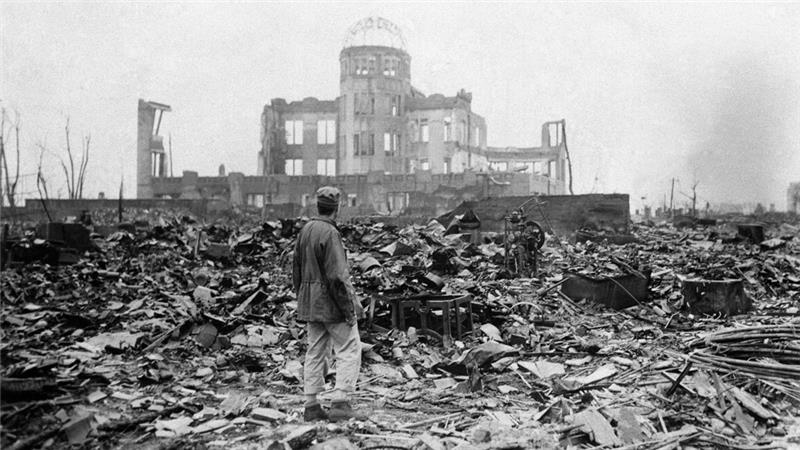
In a recent televised rant on the Fox News Channel, the neoconservative publicist Mark Levin made the eye-opening claim that the current US-Israeli War on Iran is “every bit as important as World War Two.” Still more, according to Levin, the specter of an Iranian nuclear weapon (for which there is approximately zero evidence), requires us, as good citizens to rally around the President and the military. Not surprisingly, Levin also noted that President’s Truman decision to use atomic weapons against Japan saved “a million men” by forestalling a US invasion of the Japanese Home Islands (the inference being: Trump should do likewise). Truman’s decision to incinerate Hiroshima and Nagasaki with atomic bombs remains a topic (among a number of others) with which we Americans largely deal in the counterfeit currency of myths.
Despite the conclusions of the US Bombing Survey, that “certainly prior to December 1, 1945, and in all probability prior to November 1, Japan would have surrendered even if the atomic bombs had not been dropped, even if Russia had not entered the war, and even if no invasion had been planned or contemplated,” few myths are as entrenched in the psyche of America’a media and political elites as the claim that Truman’s decision (invariably valorized as “brave”) to incinerate a quarter of a million civilians—mainly women, children, and elderly—in Hiroshima and Nagasaki won the war in the Pacific.
The claim that Truman’s decision saved countless American lives has grown to proportions that would have surprised, if not shocked, Truman’s own military high command. President George H.W. Bush, himself a veteran of the Pacific campaign, claimed that the atomic bombs saved the lives of half-a-million US servicemen.
The record, however, rebuts the myth.
Truman’s military advisers disagreed with Truman. Five-star Navy Admiral William Leahy, who served as Roosevelt and Truman’s chief of staff, felt that the bombs were “of no material assistance in our war against Japan.” The Japanese, said Leahy, “were already defeated and ready to surrender.” Leahy believed Truman’s decision to use nuclear weapons had “adopted an ethical standard common to the barbarians of the Dark Ages.” Likewise, Admiral William F. Halesy, Commander of the Pacific Fleet, noted that, “the Japs had put out a lot of peace feelers throughout Russia long before” Truman decided to drop the bombs. Two weeks after the nuclear attacks, General Curtis LeMay publicly criticized the decision, saying, “The war would have been over in two weeks. . . . The atomic bomb had nothing to do with the end of the war at all.”
The myth that the bombs “saved” a million US servicemen who would have otherwise perished in the invasion of the Home Islands came from the pen and imagination of the man who would become among the most infamous strategists and apologists for the War in Vietnam, McGeorge Bundy.
Born in 1919 to an upper-class family from Boston, Bundy was a graduate of Yale who served as an Army intelligence officer during the war. His father, Harvey Hollister Bundy, was a close associate of FDR’s Secretary of War, Henry Stimson. After the war, McGeorge was hired to ghostwrite Stimson’s memoirs. It was just around that time that journalists and a number of former high-ranking military officials began asking uncomfortable questions about whether it was necessary to use the atomic bomb against the Japanese.
Stimson and Harvey Bundy viewed the growing criticism with alarm, and so, McGeorge was given a second assignment, which was to help Stimson write defense of Truman. That spirited and wholly dishonest apologia appeared on the February 1947 cover of Harper’s magazine. The article, which heavily relied on material provided by Harvey Bundy, said that the atomic bombs were “our least abhorrent choice,” despite the fact that the Japanese had been actively suing for peace. The Harper’s article also included the entirely made up claim that an invasion of the Japanese Home Islands would have come at the cost of a million US casualties.
As Robert Oppenheimer’s biographer, Kai Bird, later noted, Bundy’s essay, “Would stand for at least two decades as the definitive explanation of the decision to use the atomic bomb. Even today, it remains the orthodox view.” Six years after assuming the role of national security adviser, Bundy would depart the White House in disgrace, reviled for his role in perpetuating and defending the war in Vietnam. There is a certain symmetry to his public career, which began as it ended: In the retailing of lies.
Alarmingly, those very lies are now being repurposed by fools like Mark Levin and the his Israel First supporters within the Trump administration to justify a nuclear attack on Iran.
Reprinted with permission from the Realist Review.
Subscribe and support here.
