
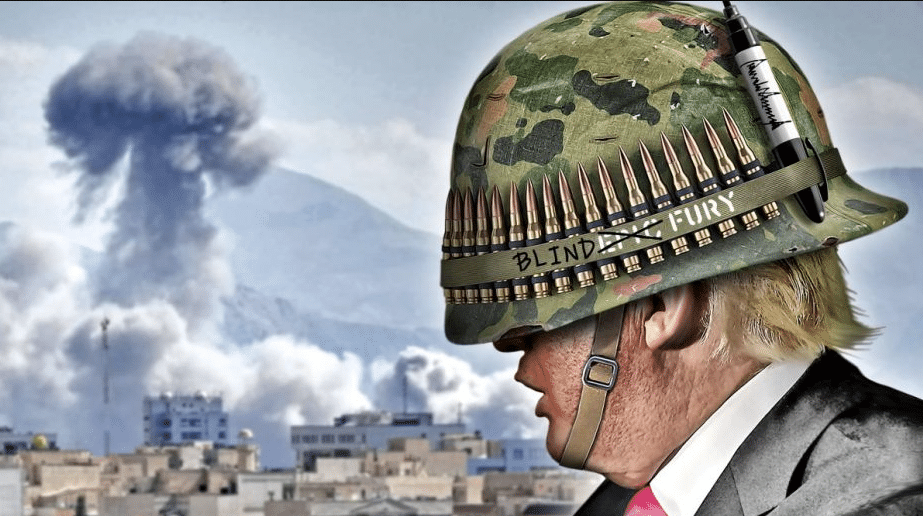
Western propaganda machinery – the West’s most powerful strategic weapon – has repeatedly asserted that US forces have been winning a swift and sweeping victory over Iran. In tandem, Israeli intelligence officials are briefing western media saying they see increasing signs of disarray and “chaos” within the regime in Tehran, adding that the Iranian chain-of-command has become marred by serious breakdowns.
And why not make such claims of sweeping victory? Trump presumably went into the war sublimely confident in America’s military prowess to obliterate the Iranian state structure, its command network, and its military capacity. His generals seemingly endorsed the general proposition of destructive potential – adding however, several “buts” that likely did not penetrate the Trumpian mental workings.
And that’s what Trump duly did – sweeping “obliteration;” continuous waves of stand-off bombing. To doubters of his success in collapsing Iran’s state structure, he retorts simply that we’ll obliterate all the more. “We’ll kill more of their leaders.”
Western (including Israeli) media, in wake of the 28 February strikes, in companion reports hailed too the devastating nature of the blow struck against Iran’s political and military leadership.
No attempt was made to critically think through the effect on a State that had been preparing an asymmetric response to this coming war for 20-40 years. No effort was made to think through the real impact of bombing a State that has taken all its military infrastructure (including its “air force”) off its land-surface, only to bury it in deep underground “cities.”
No effort was made to judge the impact of assassinations of Iran’s political and military leaders on the public mood. No understanding was made of how the Iranian de-centralised leadership “mosaic” might provide a fast-reaction, pre-planned response to leadership decapitation. Nor was it considered that such a diffused leadership structure would allow Iran to pursue a long war of attrition against the US and Israel – in contrast to the US-Israeli insistence on short wars that do not strain popular resilience.
All mainstream reporting, by contrast, was focused on the scale of damage inflicted on Tehran and its people – carrying the implicit presumption that the civic demolition and high civilian deaths would, in itself, create the opposition that would “rise up” and “seize” the reins of national leadership.
That so little of this conflict was properly considered reflects the fact that the US increasingly has modelled its war-fighting way-of-thinking on those long employed by Israel – with far-reaching consequences for the West’s future, perhaps.
Of course, there are professional US military officers who repeatedly have warned of the short-comings of mass bombardment as a stand-alone strategic tool, arguing that it has never brought the expected results; but their cautionary messages have had little impact against the prevailing “obliteration” zeitgeist.
The very language used by Trump and his team to describe Iranians as “evil” and “murderous baby-killing” sub-humans plainly is designed to polarise the clash to the point of excluding military strategies other than yet further “obliteration.”
Trump told New York Times journalists “that he did not feel constrained by any international laws, norms, checks or balances,” and the “only limits on his ability to use American military might” were “my [his] own morality. My own mind. It’s the only thing that can stop me.”
He reportedly expressed surprise that America’s sneak attack on the Iranian leadership had produced an immediate riposte of counter-strikes on American bases in the Gulf: “We hadn’t expected that,” Trump said; nor did he anticipate the subsequent selective closure of the Strait of Hormuz, although the Iranians explicitly warned that they would do exactly that. He knew the risk, yet still went ahead, saying he “did not think” that the Iranians would assume control over the Hormuz choke point.
SOURCE: lloydslist.com
The terms by which the world trades in oil and gas
The consequence of Iranian control of the approximate 20% of global oil and a similar volume of gas that transits Hormuz gives Iran unique leverage over the whole dollar-based economic sphere. Yet it poses a special threat to Gulf States – for Hormuz also serves as the corridor for fertiliser, food supplies and much else too.
Hormuz’s selective closure therefore carries second and third-order global economic consequences for the world. As Lloyd’s Intelligence noted yesterday:
“Several governments — including India, Pakistan, Iraq, Malaysia and China — are in direct talks with Tehran, coordinating vessel transits via an emerging IRGC-run registration and vetting system … Lloyds … understands [that] the IRGC is expected to establish a more formalised vessel approval process in the coming days.”
So, why did Israel escalate so strategically in attacking Iran’s terminals receiving gas from the South Pars gas field that it shares with Qatar? Israel insists that Trump gave them a green light for the attack. Trump replied that “Israel attacked Iran’s South Pars gas field earlier today without informing the United States or Qatar.”
The attack on Iran’s energy infrastructure predictably enough triggered a reciprocal escalation with Iranian missile strikes on Gulf energy infrastructure – thus elevating the conflict to that of serious economic war.
Essentially what now is at issue are the terms on which the world will be able to buy oil and gas. Will purchasers be able to buy energy purchased in currencies other than the dollar? It seems so – Pakistan has been able to negotiate the passage of its cargo through Hormuz in just such a fashion – by proving that the cargo was purchased in Yuan.
At issue therefore is not just the US military presence in the region – which Iran insists must be expelled – but rather, Iranian calls for the ending altogether of the Region’s dollar trading.
This – if Iran gets its way – could comprise the awkward gateway to continued economic survival for Gulf States.
Gulf States may soon have to decide where they stand on this war. On the one hand, they have embedded themselves wholeheartedly in the American mercantilist way of life. But Iran threatens to overturn that paradigm. On the other hand, future Gulf prospects – which they will need to ponder – may hang on Iranian acquiescence to allow them to traverse Hormuz.
If Iran’s “foot on the throat” of the global economic system is pursued selectively – according to their specific criteria — it is possible that other states (including the Europeans) may be forced to the “negotiating table” with Tehran to ensure their future economic well-being.
The US’ unseen power structures
It is not however just the Gulf that will need to consider where they – the Gulf monarchs – stand in the wake of this ill-considered and potentially very damaging economic war. There are those in the US insisting that Americans too need to discuss where they should stand as well.
US commentator Bret Weinstein recently struck a chord with many Americans who, like him, had actively supported Trump, but were now confused and unsettled by Trump’s espousal of a war on Iran – especially as his Presidency hangs in the balance in consequence:
“Why would a man, [like] Trump, who understands politics make such an obvious mistake?”
In discussion with Tucker Carlson, Weinstein suggested that one answer is that Trump is not in fact in control:
“We Americans need to have a conversation with ourselves – not only about how broken the system is and what it results in us doing, but how does it actually work. [Who] is it that is driving us to do what we do.”
The question is deeper than the issue of Trump breaking his campaign promises of “no new foreign wars.” (Reuters today reports that “the Trump administration is considering deploying thousands of additional US troops to the Middle East – as Trump weighs next steps regarding Iran which could include an attempt to secure the Strait”).
Weinstein pointed out in his conversation with Tucker Carlson that for some time (since 1961 or 1963), the US system has seemed to be badly broken: It no longer had American interests at heart. In fact, American governance, he argued, visibly had become antithetical to Americans’ real interests – across many spheres, from finance to health. And the state had transformed into an “anti-Constitutional” structure since the events of November 1963 – the exact opposite to what the US was intended to be.
Weinstein attributed this situation to “a something” that is undeclared; something that cannot visibly be observed. It suggested a “hidden power structure” whose control and interests are opaque: “What drives it? Who exactly holds the power in this system. We do not know,” he argued. What were the unseen interests that drove the US to this succession of foreign wars in the Middle East?
This was why the Epstein episode was so crucial, Weinstein emphasised: The few details published have painted a power-structure involving intelligence services, money and corruption that spoke to an unspoken Constitutional and acute Security crisis within the US
Americans urgently needed to be informed what this power structure is – and what its interests are. And to then discuss where Americans stand, and how to recover the elements that could lead to a recovery of a state governed by Americans’ own interests.
Reprinted with permission from Strategic Culture Foundation.
