
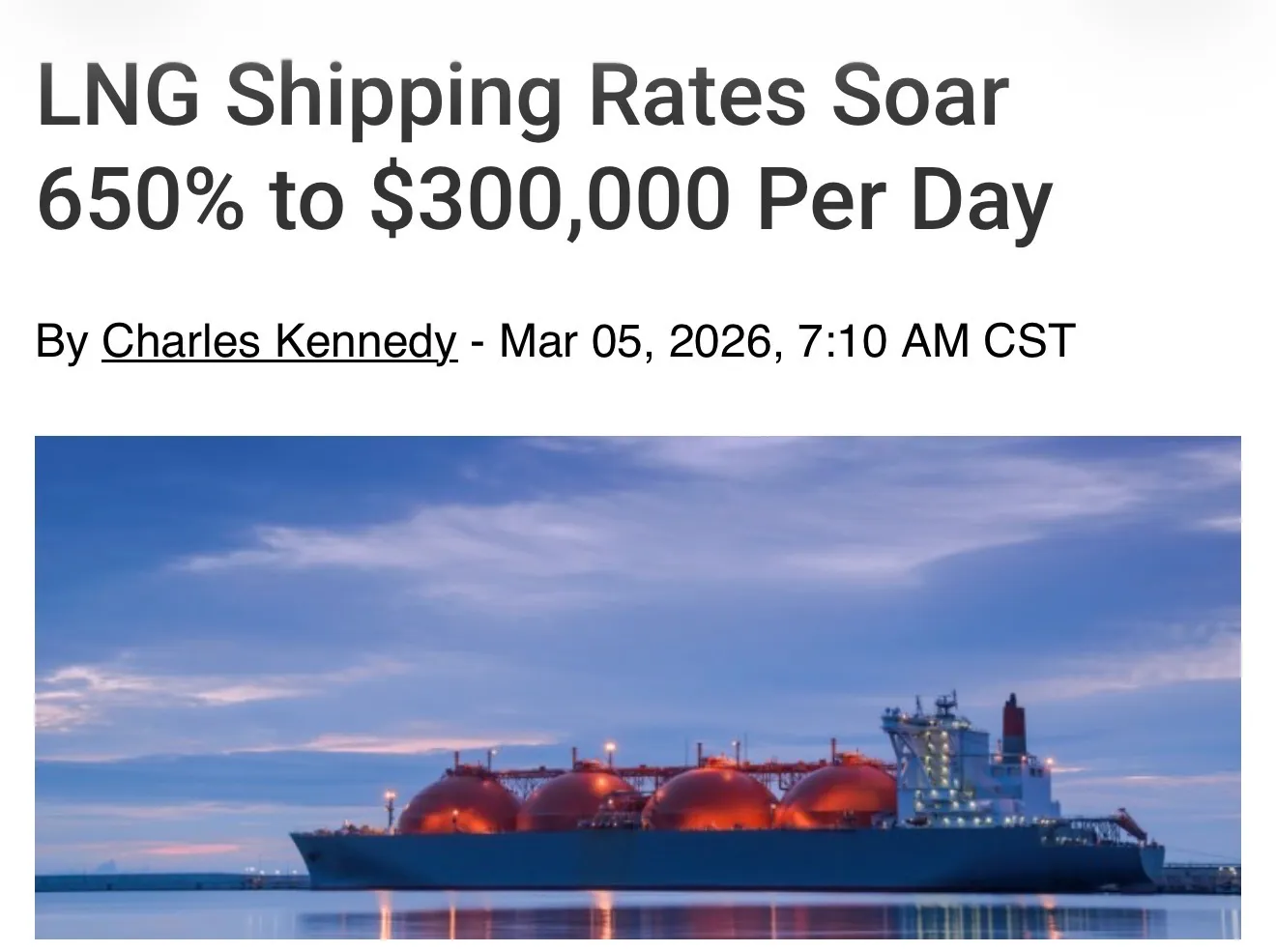
LNG shipping rates have gone from $40,000 to $300,000 per day — a 650% vertical climb in less than a week — and the men who ordered the strikes that caused this are still strutting around the Oval Office talking about “strength.” That is not strength. That is the economics of catastrophe unfolding in real time, and it will reach every kitchen table from Tokyo to Turin before anyone in the beltway finishes reading the intelligence brief they probably won’t bother to read anyway.
The Strait of Hormuz — through which roughly 20 million barrels of oil per day transit, representing north of 20% of global seaborne oil trade — has effectively ceased to function as a commercial corridor, and what’s doing the closing is less about Iranian missiles, and more the insurance market, the invisible hand of capital that everyone in Washington claims to worship suddenly delivering its honest verdict on Operation Epstein Epic Fury. Major commercial operators, oil companies and insurers have effectively withdrawn from the corridor, creating a de facto closure comparable in character to the Red Sea disruption — but with far larger volumes at stake. The market has spoken. The war lobby apparently has not listened.
Qatar declared force majeure on gas exports, and sources say it may take at least a month to return to normal production volumes — meaning global gas markets will experience shortages for weeks even in the unlikely scenario the conflict ends today. Read that sentence again slowly. Even if it stopped right now. Even if every bomb stopped falling this afternoon and every missile went cold, the damage is already baked in, the supply chain already severed, the cryogenic infrastructure already in shutdown sequence — because the cryogenic nature of LNG requires specialised storage maintaining temperatures of approximately -160°C, making it impossible to simply store excess production in temporary facilities, and once disruptions occur, restarting operations requires weeks of careful, sequential rehabilitation to avoid thermal shock to the entire system.
Qatar supplies 20 percent of the world’s LNG — and if that’s off the table, countries must scramble for what remains. Japan scrambles. South Korea scrambles. Taiwan scrambles. India, which sources nearly half of its LNG intake from Qatari supply under long-term contracts , scrambles. These are not abstract geopolitical actors — these are the factories that make your semiconductors, the power grids that keep hospitals running, the fertiliser supply chains that feed a billion people, and every one of them is now competing in a spot market that has been stripped of a fifth of its supply overnight. This is what cascading systemic failure looks like before it hits the news cycle.
Dutch TTF futures, Europe’s benchmark gas contract — rose 35% on Tuesday alone, with prices on the week running roughly 76% higher, while the Japan-Korea Marker benchmark reached a one-year high. Europe, still carrying the scar tissue of 2022 when Russia’s war on Ukraine sent the continent into an energy convulsion it spent hundreds of billions surviving, is now staring down a second shock — this one detonated by an ally that drew the target circles, pulled the trigger, and handed Europe the wreckage as a fait accompli — no consultation, no warning, no framework for what follows, just the bill. The shutdown also affects downstream products including urea, polymers, methanol and aluminium , meaning the price destruction moves through industrial supply chains like a slow haemorrhage through every sector that uses energy as an input — which is every sector.
Maersk, Hapag-Lloyd and CMA CGM have all suspended operations through the Strait of Hormuz, rerouting vessels around the southern tip of Africa — adding weeks to transit times and driving costs across the entire container shipping ecosystem. The global just-in-time economy was already running thin margins after Covid, and now it absorbs voyages six weeks longer with insurance premiums at the ceiling and no clear date when any of it normalises. Every delay is a price. The Bangladeshi textile worker whose factory loses power this month didn’t vote for this war. The Filipino seafarer rerouted around the Cape of Good Hope for the third time this year didn’t either. The cost transfers downward with perfect precision — away from the people who made the decision, toward everyone who had no part in it and no protection from it.
Because what is happening is not a regional energy disruption — it is the deliberate removal of approximately one quarter of the world’s seaborne energy supply from the global market, not by accident, not by miscalculation in the margins, but as the direct and foreseeable consequence of a war of choice waged on behalf of a government in Tel Aviv that has now pulled Washington into a confrontation with consequences that will metastasise across every economy on the planet that cannot print its own reserve currency. Countries heavily reliant on imported energy with limited fiscal space — Japan, India, South Africa, Turkey, Hungary, Malaysia — are the most exposed to the shock, while the architects of this disaster enjoy the insulation of domestic shale production and the privilege of pricing oil in their own currency. The Global South will pay the highest price for a war it never voted for, never wanted, and was never once consulted about.
The Covid pandemic cost the world approximately $13 trillion and this will be orders of magnitude worse to a level of economic suicide that would make Darwin roll in his grave. There is no exit ramp here, only the compounding arithmetic of a war of choice whose costs will be distributed with ruthless precision to everyone who had no say in the choosing. It will arrive not as a headline but as a bill — a gas bill in Rotterdam, a power cut in Karachi, a factory closure in Busan, that no emergency fund will fully reach in time. Billions of people across Asia, Africa, and the Global South are now the unconsulted collateral of a war fought for reasons they were never given a vote on and objectives they were never shown. They will survive it, most of them. They will rebuild, and they will remember — with a clarity that no Pentagon briefing, no State Department white paper, and no carefully worded presidential statement will ever extinguish — exactly who decided, and exactly who paid. But the invoice for betrayal will come due and that will dwarf the economic one.
Reprinted with permission from The Islander.
