
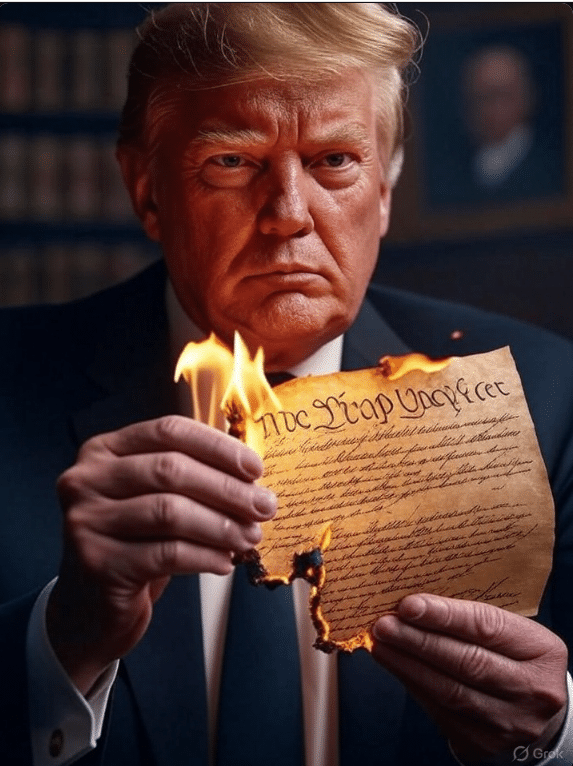
We are living through a period of open lawlessness at the highest levels of government.
Executive orders are issued to sidestep Congress. Federal law enforcement is deployed as a tool of retaliation. Protest is criminalized. Surveillance expands. Due process becomes optional. Courts are packed, ignored, or bypassed. Entire communities are terrorized under the guise of “law and order.”
None of this is accidental. And none of it is temporary.
At a time when executive orders are used to punish dissent, federal agencies are weaponized against political opponents, protesters are met with militarized force, immigration enforcement is used as terror theater, and constitutional limits are treated as inconveniences rather than restraints, one fact has become impossible to ignore: politics won’t fix a system that is broken beyond repair.
Elections have failed to check the police state.
Courts increasingly defer to it.
And a year into Trump’s second term, what began as campaign rhetoric has hardened into administrative policy; what was once framed as a national emergency has become routine authoritarianism.
Executive power has expanded, accountability has contracted, and constitutional limits have been tested—and ignored—by the Trump administration with increasing confidence.
This is no longer a warning about what might happen. It is a record of what has already occurred.
This same authoritarian mindset has not remained confined to domestic policy. It has predictably expanded outward, revealing itself just as clearly in foreign affairs.
Trump’s renewed saber-rattling over Greenland—treating another nation’s territory as if it were a corporate asset to be acquired or controlled—reveals how deeply this distortion of power has taken hold.
It is the language of ownership, not governance; of command, not consent.
A president is not a monarch, a CEO, or a landlord over the republic. He is an employee—hired by “we the people,” bound by a written contract called the Constitution, and subject to limits he did not write and cannot rewrite.
When that employee ignores his limits, only one check remains: the people themselves.
John Lennon’s reminder that “the people have the power” has never been more relevant—or more dangerous to those in power.
That power has a name: nullification.
It is the authority of ordinary citizens and local communities to refuse cooperation with unjust laws, illegitimate prosecutions, and unconstitutional government action.
In an era of open executive defiance and punitive governance, nullification is no longer optional—it is a civic necessity.
Nullification works.
Just as a President may veto an act of Congress, the American juror possesses the “People’s Veto”—the power to refuse enforcement of a law or prosecution that offends the conscience of the Constitution.
When a former Department of Justice employee threw a sandwich at an ICE agent, the Trump administration sent 20 officers in riot gear to his home to arrest him, then attempted to have a grand jury send him to jail for eight years on charges of a felony assault on a federal agent. The grand jury refused.
That refusal was not lawlessness. It was conscience.
As law professor Ilya Somin explains, jury nullification is the practice by which a jury refuses to convict someone accused of a crime if they believe the “law in question is unjust or the punishment is excessive.” According to former federal prosecutor Paul Butler, the doctrine of jury nullification is “premised on the idea that ordinary citizens, not government officials, should have the final say as to whether a person should be punished.”
In a world of “rampant overcriminalization,” where the average American unknowingly breaks multiple laws every day, jury nullification serves as “a check on runaway authoritarian criminalization and the increasing network of confusing laws that are passed with neither the approval nor oftentimes even the knowledge of the citizenry.”
In other words, it is “we the people”—not politicians, not prosecutors, not judges, not corporate interests—who can and should be determining what laws are just, what activities are criminal and who can be jailed for what crimes.
This is why nullification matters now more than ever—not just because injustice is being imposed from below, but because accountability is being erased from above.
The question is no longer whether the police state can be reasoned with, voted out, or restrained from within.
The question is how ordinary people reclaim power in a system designed to deny it.
You change the rules.
You engage in disciplined, nonviolent resistance that disrupts unjust systems without surrendering moral authority. You practice civil disobedience and militant nonviolence, as Martin Luther King Jr. did through sit-ins, boycotts, and mass protest. You build grassroots power locally—thinking nationally, but acting locally.
And above all, you refuse to comply with laws, prosecutions, and policies that are illegitimate, egregious, or unconstitutional.
Nullify injustice.
Nullify unjust court cases. Nullify unjust laws. Nullify executive overreach.
Justice in America is too often reserved for those who can afford to buy it. For everyone else, the system is riddled with failures: police misconduct, prosecutorial abuse, judicial bias, inadequate defense, and a legal code so vast and convoluted that innocence becomes almost irrelevant.
In a courtroom, the conscience of a jury manifesting as nullification may be the one advantage left to us in the face of government corruption.
Nullification is not lawlessness. It is lawful resistance and it may be our last remaining safeguard against tyranny.
It is ordinary people refusing to rubber-stamp injustice. It is the citizenry exercising the authority the Constitution entrusts to them when every other safeguard has failed.
What nullification represents is the power of the people to reject potentates and tyrants.
It is a reminder that no president owns this country—just as no president gets to purchase, annex, or command the world as if it were his personal domain.
For too long, we have been conditioned to believe that power flows downward—from politicians, courts, and enforcers to the people. The truth is the opposite. Power flows upward, but only when citizens are willing to claim it.
As I make clear in Battlefield America: The War on the American People and in its fictional counterpart The Erik Blair Diaries, “We the people” are the government.
And if those in power don’t like being reminded of that fact, they’re free to get another job.
Reprinted with permission from the Rutherford Institute.
