
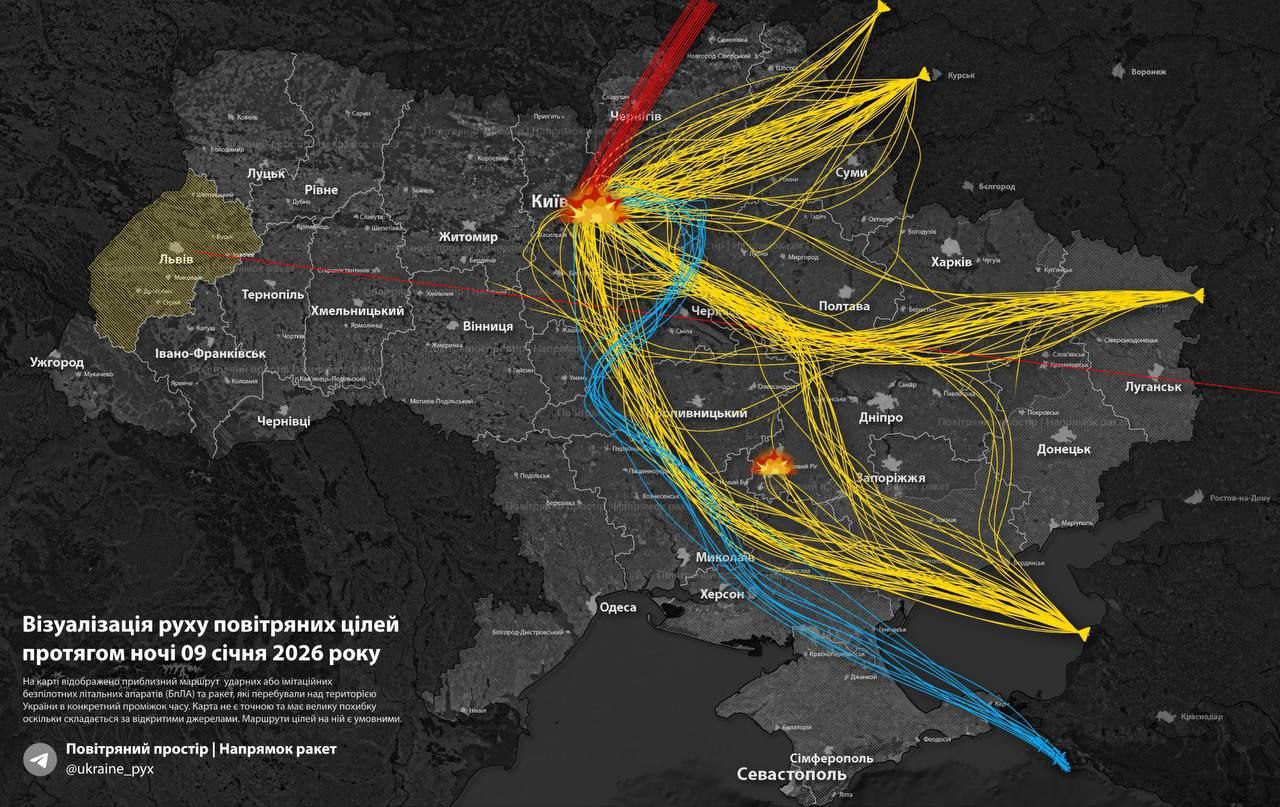
The electricity and heat supply in Ukraine has stopped in large parts of the country. Kiev had already been on scheduled blackouts where groups of consumers received for example four hours of electricity to then be cutoff for eight hours. That scheduling has ended. The blackout has become permanent.
Over several weeks Russian attacks had isolated the electricity supply in Kiev from other parts of the country. It then attacked generating stations within the city. There is now less than 10% of electricity supply available than the city would normally use. Public lighting has been shut down as much as possible. Factories have closed down. Schools and Universities are on prolonged holidays. Many shops have closed as running their private generators is costing more money than they can make while open.
The electricity generation stations were also supplying hot water for long-distance heating. Several hundred of Soviet era high-rises in Kiev, each of them with hundreds of apartments, have neither heat nor power. The temperature in Ukraine has been below zero degree C for several days. Many of the buildings had not drained their water systems. The radiators and water supply lines have frozen and burst open. Those high rises are now uninhabitable. Experts estimate that up to nine month repair time, and a lot of money, will be needed to fix each of them. There are about 150,000 people affected by this.
Kiev is not the only city in trouble. Odessa is likewise shut down. People are protesting in the streets. Dnipro has similar problems. Today an attack hit Kharkiv and disable one of the last combined heat and electricity station within the city. Sumy and Zaparochia also reported blackouts.
Currently a wave of arctic air is flowing into Ukraine with night temperatures expected to go down to minus 30° centigrade.
The government of Ukraine says that it is expecting a new Russian wave of attacks. This, it says, will likely take out transformer station that make up Ukraine’s long distance 750 kilovolt electricity network which is fed by nuclear power stations. The stations are not endangered but they would have to lower their output or shut down as there will be no-one connected to them to receive the electricity they generate.
Large electric energy systems are very complex. To restart a system once it broke down requires a lot of coordination and planning. Any mistake will immediately lead to new breakdowns and damaged equipment. The systems in Kiev are now in a state where it could take weeks without new Russian attacks to get the it up and running again.
Ukraine had been warned that any attack on Russian infrastructure would be responded to in kind. But it continued to attack Russian cities which led to deaths and serious problems in Belgograd and elsewhere.
For three years Russia had mostly refrained from attacking Ukrainian infrastructure. Electricity and heat supply operated at peace time levels. Only during the last year did attacks increase. In March 2025 President Trump announced a 30 day infrastructure ceasefire. Russia committed to it. Ukraine didn’t.
In November 2015 Ukraine blew up transmission pylons that supplied Crimea. 75% of its populations were left without electricity. A brewery in Lviv celebrated that by creating a dark beer named ‘Crimea by night’.
In 1999 NATO bombed Serbia to further split up Yugoslavia. NATO bombing started on March 23 1999. It took out some 80% of Serbia’s electricity and water supply. During a press conference on May 25 1999 NATO spokesman Jamie Shea justified the attacks as follows:
Question: Yesterday, several television reports showed Yugoslav doctors and … facing difficult standards related to their generators in their hospitals and who ultimately accuse the Alliance of taking the civilian population hostage, and therefore taking innocent people hostage by bombing power stations, transformers, and drinking water pipes.
Jamie Shea: Pierre, excuse me if I reply to this in English but this is an important point and therefore I would like to get my message across universally here to everybody in this room.
Let us not lose sight of proportions in this debate. President Milosevic has got plenty of back-up generators. His armed forces have hundreds of them. He can either use these back-up generators to supply his hospitals, his schools, or he can use them to supply his military. His choice. If he has a big headache over this, then that is exactly what we want him to have and I am not going to make any apology for that.
[…]Question (Norwegian News Agency): I am sorry Jamie but if you say that the Army has a lot of back-up generators, why are you depriving 70% of the country of not only electricity, but also water supply, if he has so much back-up electricity that he can use because you say you are only targeting military targets?
Jamie Shea: Yes, I’m afraid electricity also drives command and control systems. If President Milosevic really wants all of his population to have water and electricity all he has to do is accept NATO’s five conditions and we will stop this campaign. But as long as he doesn’t do so we will continue to attack those targets which provide the electricity for his armed forces. If that has civilian consequences, it’s for him to deal with but that water, that electricity is turned back on for the people of Serbia.
It seems that NATO doctrine says that the side of a war that has sever trouble with its infrastructure has choices to make to better its circumstances. It is time for someone to teach that to Kiev.
Reprinted with permission from Moon of Alabama.
