
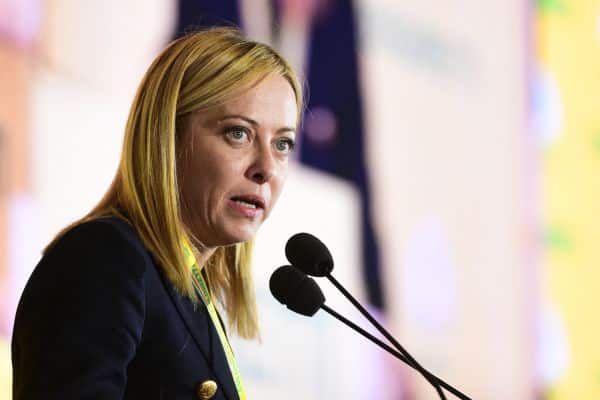
When a prime minister tells her own staff to rest because next year will be much worse, it is not gallows humor. It is not exhaustion speaking. It is a slip of the mask, the kind of remark leaders make only when the internal forecasts no longer align with the public script.
Giorgia Meloni was not addressing voters. She was addressing the state itself — the bureaucratic core tasked with executing decisions whose consequences can no longer be disguised. Her words were not about a mundane increased workload. They were about constraint. About limits. About a Europe that has crossed from crisis management into managed decline, and knows that 2026 is when the accumulated costs finally collide.
What Meloni let slip is what Europe’s elites already understand: the Western project in Ukraine has run head-first into material reality. Not Russian propaganda. Not disinformation. Not populism. Steel, munitions, energy, labor, and time. And once material reality asserts itself, legitimacy begins to drain.
The War Europe Cannot Supply
Europe can posture for war. It cannot produce for war.
Four years into a high-intensity war of attrition, the United States and Europe are confronting a truth they spent decades unlearning: you do not sustain this kind of conflict with theatrical speeches, sanctions, or abandoning diplomacy. You sustain it with shells, missiles, trained crews, repair cycles, and production rates that exceed losses — month after month, without interruption.
By 2025, the gap is no longer theoretical.
Russia is now producing artillery ammunition at a scale that Western officials themselves concede outpaces the combined output of NATO. Russian industry has shifted to continuous near-wartime production (without even being fully mobilized), with centralized procurement, simplified supply chains, and state-directed throughput. Estimates place annual Russian artillery production at several million rounds — production already flowing, not promised.
Europe, by contrast, has spent 2025 celebrating targets it cannot ever materially meet. The European Union’s flagship pledge remains two million shells per year — a goal dependent on new facilities, new contracts, and new labor that will not fully materialize within the decisive window of the war, if ever. Even the dreamed target if reached, would not put it at parity with Russian output. The United States, after emergency expansion, is projecting roughly one million shells annually once and a big if, full ramp-up is achieved. Even combined on paper, Western production struggles to match Russian output already delivered. Talk about paper tiger.
This is not a gap. It is a major tempo mismatch. Russia is producing at scale now. Europe is dreaming of rebuilding the ability to produce at scale later.
And time is the one variable that cannot be sanctioned.
Nor can the United States simply compensate for Europe’s hollowed-out capacity. Washington faces its own industrial choke points. Production of Patriot air-defense interceptors runs in the low hundreds per year while demand now spans Ukraine, Israel, Taiwan, and US stockpile replenishment simultaneously — a mismatch senior Pentagon officials have acknowledged cannot be resolved quickly, if ever. US naval shipbuilding tells the same story: submarine and surface-combatant programs are years behind schedule, constrained by labor shortages, aging yards, and cost overruns that push meaningful expansion into the 2030s. The assumption that America can industrially backstop Europe no longer matches reality. This is not a European problem alone; it is a Western one.
War Footing Without Factories
European leaders speak of “war footing” as if it were a political posture. In reality, it is an industrial condition and Europe does not meet it.
New artillery production lines require years to reach stable throughput. Air-defense interceptor manufacturing runs in long cycles measured in batches, not surges. Even basic inputs such as explosives remain bottlenecks, with facilities shuttered decades ago only now being reopened, some not expected to reach capacity until the late 2020s.
That date alone is an admission.
Russia, meanwhile, is already operating inside wartime tempo. Its defense sector has delivered thousands of armored vehicles, hundreds of aircraft and helicopters, and vast quantities of drones annually.
Europe’s problem is not conceptual; it is institutional. Germany’s much-vaunted Zeitenwende exposed this brutally. Tens of billions were authorized, but procurement bottlenecks, fragmented contracting, and an atrophied supplier base meant delivery lagged years behind rhetoric. France, often cited as Europe’s most capable arms producer, can manufacture more sophisticated systems — but only in boutique quantities, measured in dozens where attritional war demands thousands. Even the EU’s own ammunition acceleration initiatives expanded capacity on paper while the front consumed shells in weeks. These are not ideological failures. They are administrative and industrial ones and they compound under pressure.
The difference is structural. Western industry was optimized for shareholder efficiency and peacetime margins. Russia’s has been reorganized for endurance under pressure. NATO announces packages. Russia counts deliveries.
The €210 Billion Fantasy
This industrial reality explains why the frozen-assets saga mattered so much, and why it failed.
Europe’s leadership did not pursue the seizure of Russian sovereign assets out of legal creativity or moral clarity. It pursued it because it needed time. Time to avoid admitting that the war could not be sustained on Western industrial terms. Time to substitute finance for production.
When the attempt to seize roughly €210 billion in Russian assets collapsed on December 20th, blocked by legal risk, market consequences, and resistance led by Belgium, with Italy, Malta, Slovakia and Hungary, aligned against outright confiscation, Europe settled for a degraded substitute: a €90 billion loan to Ukraine for 2026–27, serviced by 3B in annual interest, further mortgaging Europe’s future. This was not strategy. It was triage, and further divided, an already weakened Union.
Outright confiscation would have detonated Europe’s credibility as a financial custodian. Permanent immobilization avoids the blast — but creates a slow bleed. The assets remain frozen indefinitely, a standing act of economic warfare that signals to the world that reserves held in Europe are conditional and not worth the risk. Europe chose reputational erosion over legal rupture. That choice reveals fear, not strength.
Ukraine as a Balance-Sheet War
The deeper truth is that Ukraine is no longer primarily a battlefield problem. It is a solvency problem. Washington understands this. The United States can absorb embarrassment. It cannot absorb open-ended liabilities indefinitely. An offramp is being sought — quietly, unevenly, and with rhetorical cover.
Europe cannot admit it needs one. Europe framed the war as existential, civilizational, moral. It declared compromise appeasement and negotiation surrender. In doing so, it erased its own exit ramps.
Now the costs land where no narrative can deflect them: on European budgets, European energy bills, European industry, and European political cohesion. The €90 billion loan is not solidarity. It is securitization of decline — rolling obligations forward while the productive base required to justify them continues to erode.
Meloni knows this. That is why her tone was not defiant, but weary.
Censorship as Panic Management
As material limits harden, narrative control tightens. The aggressive enforcement of the EU’s Digital Services Act is not about safety. It is about containment, in its most Orwellian form — constructing an information perimeter around an elite consensus that can no longer withstand open accounting. When citizens begin asking calmly, and then not calmly, relentlessly, what was this for?, the illusion of legitimacy collapses quickly.
This is why regulatory pressure now reaches beyond Europe’s borders, provoking transatlantic friction over jurisdiction and speech. Confident systems do not fear conversation. Fragile ones do.Censorship here is not ideology. It is insurance.
Deindustrialization: The Unspoken Betrayal
Europe did not merely sanction Russia. It sanctioned its own industrial model.
By 2025, European industry continues to pay energy costs far above those of competitors in the United States or Russia. Germany. the engine, has seen sustained contraction in energy-intensive manufacturing. Chemical, steel, fertilizer, and glass production have either shut down or relocated. Small and medium enterprises across Italy and Central Europe are failing quietly, without headlines.
This is why Europe cannot scale ammunition the way it needs to. This is why rearmament remains a promise rather than a condition. Cheap energy was not a luxury. It was the foundation. Remove it via self-sabotage (Nordstream et. al), and the structure hollows out.
China, watching all of this, holds the other half of Europe’s nightmare. It commands the deepest manufacturing base on earth without having entered wartime footing. Russia does not need China’s breadth, only its strategic depth behind it in reserve. Europe has neither.
What Meloni Actually Fears
Not hard work. Not busy schedules. She fears a 2026 in which Europe’s elites lose control of three things at once.
Money — as Ukraine’s funding becomes an EU balance-sheet problem, replacing the fantasy that “Russia will pay.”
Narrative — as censorship tightens and still fails to suppress the question echoing across the continent: what was this all for?
Alliance discipline — as Washington maneuvers for exit while Europe absorbs the cost, the risk, and the humiliation.
That is the panic. Not losing the war overnight, but losing legitimacy slowly, as reality leaks out through energy bills, shuttered factories, empty arsenals, and mortgaged futures.
Humanity at the Abyss
This is not just Europe’s crisis. It is civilizational. A system that cannot produce, cannot replenish, cannot tell the truth, and cannot retreat without collapsing credibility has reached its limits. When leaders begin preparing their own institutions for worse years ahead, they are not forecasting inconvenience. They are conceding structure.
Meloni’s remark mattered because it pierced the performance. Empires announce triumph loudly. Systems in decline lower expectations quietly, or loudly in Meloni’s case.
Europe’s leadership is lowering expectations now because it knows what the warehouses contain, what the factories cannot yet deliver, what the debt curves look like — and what the public has already begun to understand.
For most Europeans, this reckoning will not arrive as an abstract debate about strategy or supply chains. It will arrive as a far simpler realization: this was never a war they consented to. It was not fought to defend their homes, their prosperity, or their future. It was fought for greed for Empire, and paid for with their living standards, their industry, and their children’s future.
They were told it was existential. They were told there was no alternative. They were told sacrifice was virtue.
Yet what Europeans want is not endless mobilization or permanent austerity. They want peace. They want stability. They want the quiet dignity of prosperity — affordable energy, functioning industry, and a future that is not mortgaged to conflicts they did not consent to.
And when that truth settles, when the fear recedes and the spell breaks, the question Europeans will ask will not be technical, ideological, or rhetorical.
It will be human. Why were we forced to sacrifice everything for a war we never agreed to and told there was no peace worth pursuing? And this is what keeps Meloni up at night.
