
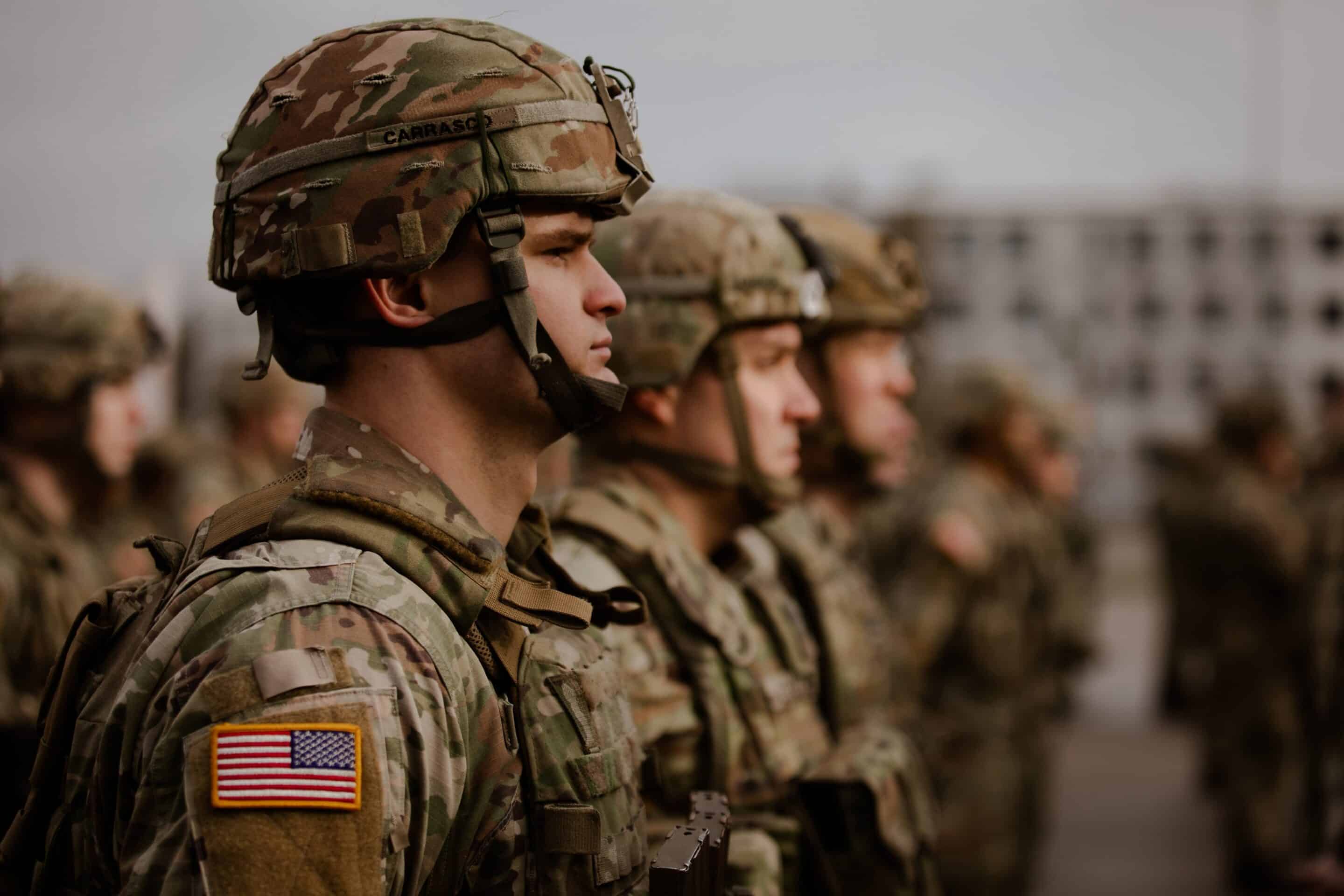
Every military servicemember’s oath is a pledge to defend the Constitution against all enemies, foreign and domestic.
It is not an oath to a politician. It is not an oath to a party. And it is not an oath to the police state.
Yet what happens when those same men and women are being told—by their own government—that obedience to power and loyalty to a political leader come before allegiance to the Constitution they swore to uphold?
That question isn’t hypothetical.
It is the moral line now being tested in real time, and it goes to the heart of what kind of country we are: do we live in a constitutional republic governed by the rule of law, or in a militarized police state where “legality” is whatever the person with the most power and the biggest army say it is?
The answer becomes painfully clear when you look at what our troops are being ordered to do—and what “we the people” are tacitly allowing them to be ordered to do—in the so-called name of national security.
It’s legally dubious enough that the military is being used to enforce immigration crackdowns and police protests in American cities. But now they’re being tasked with killing civilians far from any declared battlefield in the absence of an imminent threat—all while being told that questioning the legality of those missions is itself a form of disloyalty.
So, which is it: obedience to the Constitution or the Commander-in-Chief?
At the center of this latest maelstrom is a report that Defense Secretary Pete Hegseth issued a verbal order to “kill everybody” on a maritime vessel in the Caribbean that was suspected of transporting drugs.
According to multiple accounts, after an initial “lethal, kinetic” strike disabled the vessel and killed nine men on board, a second strike was carried out to kill two survivors clinging to the wreckage—an alleged “double tap strike” that legal experts warn could constitute murder or a war crime if the survivors no longer posed a threat.
Intentionally killing survivors clinging to the remains of a boat in the middle of the ocean, in the absence of an imminent threat, whether or not the U.S. is engaged in “armed conflict” with drug cartels, is unlawful.
Not surprisingly, the Trump administration has done an about-face.
Suddenly, the White House—which had been gleefully chest-thumping over its power to kill extrajudicially—is signaling its willingness to scapegoat subordinates in the chain of command.
Here’s the problem, though. While the media fixates on who will bear the blame for ordering the double-tap strike, the government war machine is moving forward, full steam ahead.
The Sept. 2 boat strike was part of a broader Trump administration campaign of maritime attacks that has already killed at least 80 people at sea, all without a formal declaration of war or due process—evidence of who they were or what they had done—to warrant an extrajudicial execution.
This is yet another of Trump’s everywhere, endless wars—this time at sea—sold as toughness on “narco-terrorists” at a moment when his poll numbers are slipping, economic promises have failed to manifest, and new Epstein-related revelations continue to surface.
When presidents manufacture new fronts in a forever war whenever they need a distraction, we should all beware.
The Trump administration has tried to frame this preemptive maritime war on suspected “narco-terrorists” as a “non-international armed conflict” with designated terrorist organizations.
Yet what it amounts to is an undeclared war, launched in international waters, without just cause and without congressional authorization.
The legal landscape is not murky—it is clear.
Three bodies of law converge here: the Constitution’s allocation of war powers, the international law of armed conflict, and the Uniform Code of Military Justice.
First, there has been no declaration of war by Congress. Under the Constitution, only Congress can declare war. The president cannot start wars based solely on his own authority.
Second, the law of armed conflict and the law of the sea forbid killing shipwrecked survivors who pose no immediate threat.
Third, the Uniform Code of Military Justice requires every servicemember to refuse manifestly unlawful orders.
A command to “kill everybody” is precisely the kind of order these guardrails were written to forbid.
Every military recruit is supposed to learn in basic training that there is a duty to obey lawful orders, and an equal duty to disobey manifestly unlawful orders.
No president—Republican or Democrat—can override that principle.
The Commander-in-Chief may issue orders, but he does not get to erase the Constitution or rewrite the laws of war by fiat.
The White House rationale—that a preemptive “kill everybody” attack “was conducted in self-defense to protect U.S. interests”—should terrify every American.
If the government can redefine “self-defense” to justify killing incapacitated survivors on a sinking boat, then it can justify killing anyone—at home or abroad, in uniform or out of it.
The danger becomes even clearer when you examine the rhetoric now shaping national policy.
Now Trump wants to launch land attacks on Venezuela, a country that is conveniently richer in oil reserves than Iraq—all in the so-called name of fighting the war on drugs.
Meanwhile, Trump just issued a presidential pardon to Juan Orlando Hernández, the former president of Honduras, who had been sentenced to 45 years in prison for conspiring with drug traffickers to move cocaine into the U.S.
So the president is blowing up boats in the Caribbean he claims—without proof—are ferrying drugs all the while pardoning someone who was convicted of conspiring to transport hundreds of tons of cocaine into the U.S.
This corrupt double standard has become business as usual for the Trump administration.
Yet conscripting the military to do the dirty work of the police state—and then throwing them under the bus for doing so—takes us into even darker territory.
The U.S. government’s weaponization of the armed forces for political power is a betrayal of the Constitution, but it is also a betrayal of the very men and women who swore to give their lives for it.
This has never been about public safety.
As I make clear in my book Battlefield America: The War on the American People and in its fictional counterpart The Erik Blair Diaries, this has always been about power—who wields it, who is protected by it, and who is crushed under it.
This betrayal of those who swore an oath to the Constitution is not an accident—it is a warning.
Be warned.
Reprinted with permission from the Rutherford Institute.
